Why Chinese Property Buyers Are Quietly Leaving Thailand in 2026
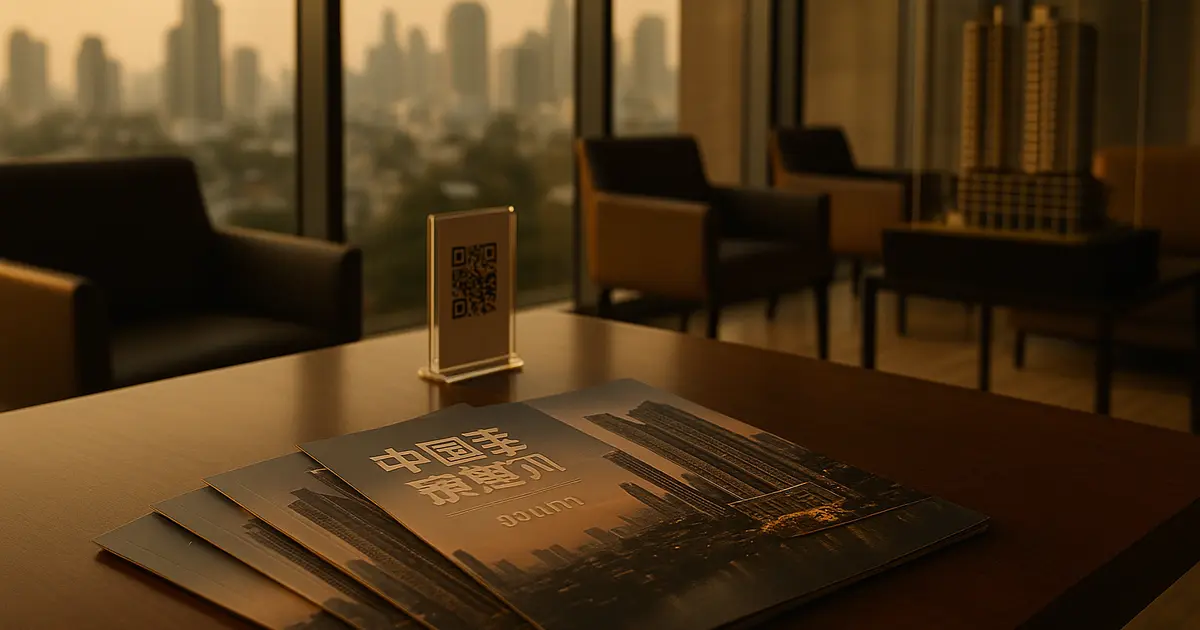
Walk into a Bangkok sales gallery in 2026 and you'll still see the same brochures aimed at mainland Chinese buyers: bilingual signage, WeChat QR codes, Mandarin-speaking sales staff, and "China Lucky Number" pricing on unit 8B-08. The brochures are still printed. The buyers are increasingly absent.
Thai developers have been quiet about it, agents quieter still, and the local English-language press tends to bury the data points in market reports nobody reads past page two. But the official numbers from the Real Estate Information Center (REIC) tell a clear story: Chinese demand for Thai condominiums is shrinking fast, and the trend looks structural rather than cyclical.
This is the part of the 2026 market that doesn't get said out loud. We'll say it here.
Why this matters for foreign buyers
If you're a non-Chinese foreign buyer looking at Thailand right now, the receding Chinese tide affects pricing, foreign-ownership quota availability, and developer behavior. Most of the changes work in your favor. But not all of them. The piece below is the unvarnished read.
The Numbers Nobody Wants to Print
The first thing to anchor is how much room Chinese buyers used to occupy in Thai condominium demand. Before COVID, China was not just one nationality among many. It was the structural top-of-table.
- Bangkok condos, 2018-2019: Chinese buyers represented roughly 25-30% of all foreign condo purchases, with some new launches in Sukhumvit and Rama 9 selling 60%+ to Chinese off-plan buyers in single weekends.
- Phuket off-plan, pre-2020: An estimated 60-70% of off-plan inventory in Bang Tao, Laguna, and Surin was being absorbed by mainland Chinese investors looking for both lifestyle and rental yield.
- 2020-2024 reset: CBRE Thailand estimates a 40% drop in foreign property transactions over that window, driven by capital controls in China, tightened Thai visa and work-permit rules, and post-COVID demand reshuffling.
By 2026, the picture has settled into something noticeably different. REIC data for January-September 2025 shows:
| Metric | 2024 (full year) | Jan-Sep 2025 | Change |
|---|---|---|---|
| Total foreign condo transfers (THB) | Higher base | ฿44.1 billion | −14.2% |
| Chinese share of foreign transfer value | 39% | 30.5% | −8.5pp |
| Chinese transfer value (THB) | Higher base | Down ~30% YoY | −30% |
| Chinese unit count | Higher base | Down ~13% YoY | −12.9% |
| Foreign share of total transfers (Q3 2025) | — | 14.3% units / 24.8% value | Structurally lower |
The headline is that China is still the largest single source of foreign buyers. The story is that the gap between China and the second-tier nationalities is collapsing. Russian, Burmese, Taiwanese, Indian, and Gulf buyers are filling part of that gap in headline numbers. They are not filling it in ticket size or volume.
Phuket tells the same story from a different angle. Pre-2020 the Phuket off-plan market was 60-70% Chinese. By 2024 the mix had reshuffled almost entirely: roughly 25-30% Russian and CIS buyers, 25% European, 20% Southeast Asian and domestic Thai, and 10% Middle Eastern. Chinese demand didn't disappear, but it stopped being the structural floor that developers had built their business plans on.
A note on what "still 30.5%" means
Chinese buyers are not gone. They are down by a third in value over twelve months and the trajectory has been consistent for five years. A 30.5% market share with that velocity is structural retreat, not a temporary dip — and the drivers below explain why a sharp rebound is unlikely.
Driver 1 — Beijing Locked the Door on 1 January 2026
The single most overlooked development for Thai property in 2026 is not on a Thai government website. It's on the website of China's State Administration of Foreign Exchange (SAFE).
On 31 October 2025, the People's Bank of China together with the Banking and Securities Regulatory Commissions announced tighter cross-border capital flow rules taking effect 1 January 2026. The headline changes:
- Bank record retention doubled — transaction records on outbound foreign-currency transfers must now be kept for 10 years instead of 5. Translation: every USD wire is now searchable, traceable, and auditable for a decade.
- Identity verification thresholds slashed — banks must verify the identity of any individual sending more than RMB 5,000 or USD 1,000 abroad. The previous practical threshold was substantially higher.
- USD 50,000 annual ceiling enforced harder — the long-standing per-person ceiling on foreign exchange purchases remains, but the new rules close many of the workarounds (multiple-family-member pooling, structured transfers via small business channels, gift-flow routing).
For a Thai condo costing THB 8-15 million (roughly USD 230,000-430,000), the math used to be: pool the limit across three or four immediate family members, route via Hong Kong, transfer in three or four tranches across a calendar year. That playbook is now under hard supervision. The friction isn't a complete block — moving the money is still possible — but the cost, time, and personal exposure have all increased.
This matters more than the headline rule changes suggest, because Thai property is competing with Chinese asset classes that don't require the same outbound friction (domestic Tier-1 cities at distressed prices, Hong Kong-listed property funds, dollar-denominated bonds bought via local QDII channels). The relative cost of buying a Bangkok condo just went up — not in baht, but in regulatory exposure to Chinese authorities.
Driver 2 — The Phuket 23-Defendant Verdict
The second driver is squarely a Thai development, and it sent a louder signal than its English-language press coverage suggests.
On 11 September 2024, the Criminal Court of Thailand delivered judgment in Case No. A.2812/2567 — the most consequential nominee-shareholder ruling in modern Thai property history. The defendants: a Phuket-based law and accounting firm that had orchestrated nominee Thai shareholders for approximately 60 companies tied to a Chinese-led real estate network. The asset base: roughly THB 1 billion across restaurants, an international school, hotels, car rental businesses, condominiums, and luxury villa developments.
| Element | The Court's Decision |
|---|---|
| Defendants | 23 individuals (Thai nominee shareholders + Chinese principals + Thai facilitators) |
| Initial sentence | 10 years imprisonment each |
| Reduced sentence (confessions + clean records) | 5 years each, suspended 2 years, 1-year probation, THB 200,000 fine each |
| Asset consequences | All 60 companies ordered to dissolve immediately; THB 10,000/day fine for non-compliance |
| Cash seized in raids | THB 4.1 million |
| Nominee compensation discovered | THB 30,000-50,000 per company paid to each Thai nominee |
The five-year suspended sentence is the kind of outcome that gets glossed as "lenient" by foreign-press readers used to harsher punitive frameworks. That reading misses the chilling effect on the actual workflow. Suspended sentences mean criminal records. THB 200,000 fines for nominee shareholders earning THB 30,000-50,000 per company is a net loss. Mandatory company dissolution wipes out the asset structure. For the Chinese principal who paid THB 30,000-50,000 to get a Thai face on a villa, the entire scheme — the entry vehicle into Thai real estate ownership of land and houses (not just condos) — is now a path to convictable conduct.
The broader number, less reported: between September 2024 and May 2025, Thai enforcement agencies handled 861 nominee business cases with combined economic damages estimated at THB 15.3 billion. Hua Hin, Koh Samui, Pattaya, Chiang Mai — the enforcement footprint is national, not just Phuket.
Warning: Why this hits Chinese buyers harder than other nationalities
European and Gulf buyers tend to use condominiums (which are legal to own freehold under the foreign-ownership quota — see our foreign ownership guide) or long-leasehold structures. Chinese buyers, particularly in Phuket, disproportionately used the company-with-Thai-shareholders structure to acquire land + house — exactly the vehicle the 11 September 2024 ruling criminalized. The crackdown is statistically neutral by nationality, but the exposure is not.
Driver 3 — When Home Equity in China Evaporates
Even if Beijing hadn't tightened capital controls and even if Phuket hadn't sent 23 nominees through court, there's a third force that would have pulled Chinese buyers out of Thai property anyway: the home market they're funding the offshore purchase from has been falling for four years and hasn't found a floor.
- Real estate investment in China declined 14.7% in January-October 2025, on top of multi-year declines in 2022, 2023, and 2024.
- New home sales are projected to fall 8% in full-year 2025 — the fifth consecutive year of negative growth.
- Evergrande, once China's largest developer, was delisted from the Hong Kong Stock Exchange in August 2025 with a residual market value of just over USD 275 million. At its peak it had over USD 300 billion in liabilities. Hundreds of unfinished projects sit incomplete across the country.
- Vanke, a state-backed developer often treated as the "safe" benchmark, requested bond repayment extensions in late 2025 — the first major state-linked developer to signal restructuring needs.
The mechanism for Thai property is not direct. It's the wealth effect.
For middle-class Chinese families, the apartment in Shanghai, Chengdu, or Hangzhou wasn't just a home. It was the asset that backed the dream of buying a second home overseas — for retirement, for kids' international schooling, for "Plan B." When that apartment has fallen 15-30% in market value (and 40%+ in some Tier-2 cities), the second-home math no longer works. The buyer doesn't lose appetite in a literal sense — they lose the collateral that made the offshore purchase rational.
Chinese household savings rates have actually risen through this period, which sounds good but is a textbook recessionary signal: when consumers expect future weakness, they save more and spend less, including on discretionary international assets. Thai condos are exactly the kind of discretionary purchase that gets postponed.
Where the Chinese Money Is Going Instead
It's incomplete to say Chinese buyers are leaving Thai property without noting where the residual offshore appetite is going. The honest answer is: not very far.
Malaysia's revamped Malaysia My Second Home (MM2H) program has been the biggest beneficiary. Since the 2024 program reset:
- 14,535 applications lodged through early 2026, with mainland Chinese accounting for 7,600 of those (52%).
- Of property purchases linked to MM2H, Chinese nationals accounted for 304 — about 41% of all transactions. Taiwanese (91) and Singaporean (63) buyers fill out the next tiers.
- The program has nearly hit USD 1 billion in property inflows, with Chinese demand the single largest driver.
Why Malaysia and not Thailand? The MM2H package addresses two pain points that Thai equivalents don't:
| Feature | Malaysia MM2H (2024 reset) | Thailand LTR Visa |
|---|---|---|
| Dependents covered | Spouse, parents, children — generous family inclusion | Spouse and children up to age 20, 4-dependent cap |
| Property ownership for land + house | Allowed (subject to state minimum values) | Not directly — condo freehold only; land via leasehold or company structure |
| Investment threshold structure | Tiered: Silver / Gold / Platinum | Flat criteria by category (Wealthy Global Citizen / Pensioner / Work-from-Thailand / etc.) |
| Nominee structure risk | Largely irrelevant — direct foreign land ownership permitted | High — see Driver 2 above |
For a Chinese family that wants the house, the garden, the international school, and the legal certainty in one package, MM2H solves the problem that Thai property doesn't. Japan (yen weakness, transparent freehold) and Portugal (despite Golden Visa changes, still EU-residency-bearing) are absorbing the higher-end and HNWI segments respectively. Thailand keeps the condo-only urban buyer and the lifestyle retiree who is content with condo freehold.
Counter-Evidence — Who's Still Buying
Honest analysis includes the data that pushes back on the headline thesis. Here's what's still working in favor of Chinese demand for Thai property:
- 30.5% is still the largest share. No other nationality matches it. Russian buyers (concentrated in Phuket and Pattaya), Burmese buyers (capital flight from Yangon), and Indian buyers (rising HNWI segment) are growing, but none individually approaches Chinese share.
- Ultra-high-net-worth Chinese are not subject to the same friction. Family offices with offshore vehicles already in place continue to buy Bangkok luxury and Phuket beachfront. The volume is low but ticket sizes are very high (THB 50M+).
- Chinese tourist recovery in 2026 may bring lifestyle/retirement buyer interest back, particularly for Chiang Mai (international schools, dry season, lower entry prices). Tourism arrivals don't translate 1:1 to property purchases, but the funnel matters.
- Tier-2 Chinese cities — buyers from places like Kunming and Nanning, which have stronger geographic and cultural ties to Thailand than Tier-1 cities — show less of the wealth-effect retreat. Their domestic property may have held up better, and the language/cultural friction with Thailand is lower.
The right way to read this: the structural top-of-table position Chinese buyers held in 2018-2019 is gone. The segment hasn't vanished — it has reshaped from a broad middle-class wave into a narrower HNWI core. Developers who built their pipeline assuming the broad wave will keep selling are the ones exposed.
What This Means If You're Not Chinese
If you're a European, Gulf, American, or Asian non-Chinese buyer looking at Thailand in 2026, the receding Chinese tide has four practical effects:
1. Foreign-ownership quota is more available
Thai condominium law caps foreign ownership at 49% of total saleable area per building. Chinese demand had been the primary driver of quota exhaustion in popular Bangkok and Phuket developments — meaning latecomers (often European or Gulf buyers) had to wait for Thai owners to sell back into the foreign quota. With Chinese demand softer, quota is more available on launch day in 2026 than it has been in five years. Check live foreign quota availability before committing.
2. Developer incentives are sharper
Developers who designed Chinese-targeted units (compact 1-bedrooms in 30-35 sqm range, optimized for rental yield rather than lifestyle) are stuck with inventory. Expect "second-buyer" promotions, free furniture packages, locked maintenance fees, and rental guarantees. These are real value when used correctly. They are also markers that you're buying in a soft market — negotiate the headline price too, not just the perks.
3. Resale liquidity in Chinese-targeted developments is the new risk
If you buy a unit in a building that was 60%+ sold to Chinese off-plan in 2018-2019, your future exit liquidity depends on Chinese buyers returning. They might. They might not. Diversifying away from those buildings — toward developments with broader nationality mixes (European, Gulf, domestic Thai) — protects exit optionality. Our Bangkok neighbourhood ranking shows which submarkets have the most diversified foreign-buyer profile.
4. Compliance scrutiny is higher across the board
The September 2024 nominee ruling didn't just deter Chinese buyers — it raised the bar for all foreigners using corporate or hybrid structures. If you're considering company ownership of land + house in Phuket, Hua Hin, Koh Samui, or Chiang Mai, the legal risk profile is materially different in 2026 than it was in 2022. Leasehold and freehold land options are the lower-risk paths now.
What to Do With This Information
If you're actively shopping for property in Thailand in 2026, three concrete adjustments based on the above:
Practical adjustments
- Ask the developer for the nationality split on existing sold units before signing. Buildings with 50%+ Chinese ownership concentration have higher resale risk in current market.
- Use the foreign-ownership quota availability as a negotiation lever. If quota is wide open on a building you like, that's a buyer's market signal — push on price 8-12%, not just on perks.
- Avoid nominee or company structures for land + house in 2026. Either buy condo freehold (legally clean under the foreign-ownership quota), or use a properly-structured 30-year leasehold with renewals. Browse current condo listings in nationality-diversified buildings.
The Thai property market in 2026 is not in crisis. It's in a structural reshuffle — Chinese demand stepping back, other nationalities filling the gap unevenly, developers adjusting their pipelines slowly. For a careful non-Chinese buyer, this is actually one of the better moments in the past decade to enter the market. The trick is recognizing where the soft spots are and where they're not.
The brochures will continue to be in Mandarin. The QR codes will still go to WeChat. The data tells a different story than the marketing does. That's usually how it works.
Sources & References
- CBRE Thailand — Thailand Real Estate Market Outlook 2025 — foreign transaction trends, Chinese share data
- CBRE — 2025 Asia Pacific Real Estate Market Outlook Mid-Year Review — regional context for Thai market position
- Knight Frank Thailand — 2025 Real Estate Trends — condominium oversupply analysis
- Cushman & Wakefield — Thailand Real Estate Market Outlook 2025-2026 — trend analysis and developer strategies
- Nation Thailand — Foreign condo transfers slump to THB 44 billion as India surges — REIC Q3 2025 data
- Nation Thailand — Thai Property Market Faces Worst Slowdown in Nearly 30 Years — macro context
- Bangkok Post — Condo Sales Likely to Remain Flat on Muted Purchasing Power — purchasing power and demand analysis
- Bangkok Post — Year to End With Dip in Transfers and Transfer Value — REIC data context
- Marketing China — Navigating 2026 SAFE Regulations — China capital control framework changes effective 1 January 2026
- Bloomberg — China Economists Urge Looser Capital Controls — policy debate context
- Formichella & Sritawat — Thailand's Unprecedented Crackdown on Illegal Nominee Structures — Case A.2812/2567 detailed legal analysis
- ThaiLawOnline — Recent Crackdowns on Nominees in Thailand — court decisions and statute summary
- Compliancia — Thailand's Nominee Crackdown — investor compliance breakdown
- Thai Examiner — Koh Samui Nominee Crackdown — geographic spread of enforcement
- Hua Hin Today — Foreign Property Owners Face Scrutiny — Hua Hin enforcement reach
- CNBC — Why China's Real Estate Market Is Still Searching for a Bottom — Dec 2025 update on Chinese property crisis
- Bloomberg — China Property Crisis Mess and Stimulus Plans — government response framework
- CNBC — Evergrande's $50 Billion Rise and Fall — Evergrande delisting and legacy
- South China Morning Post — Chinese Buyers Top Malaysia's MM2H List — Chinese MM2H application data
- CEOWORLD — Malaysia's Revamped MM2H Nears USD 1 Billion Inflows — MM2H property investment scale
- The Star Malaysia — China, Taiwan and Singapore Top MM2H Property Buyers — MM2H buyer nationality breakdown
- Wikipedia — Chinese Property Sector Crisis 2020-Present — comprehensive crisis timeline
This article was researched using parallel web searches across 22 verified sources (CBRE, Knight Frank, Cushman & Wakefield, REIC via Nation Thailand and Bangkok Post, Formichella & Sritawat, ThaiLawOnline, Compliancia, Thai Examiner, Hua Hin Today, CNBC, Bloomberg, South China Morning Post, CEOWORLD, The Star Malaysia, Marketing China) and written with AI assistance. Last updated: 18 May 2026.