Leasehold vs Freehold Land in Thailand: Which Actually Protects You? (2026)
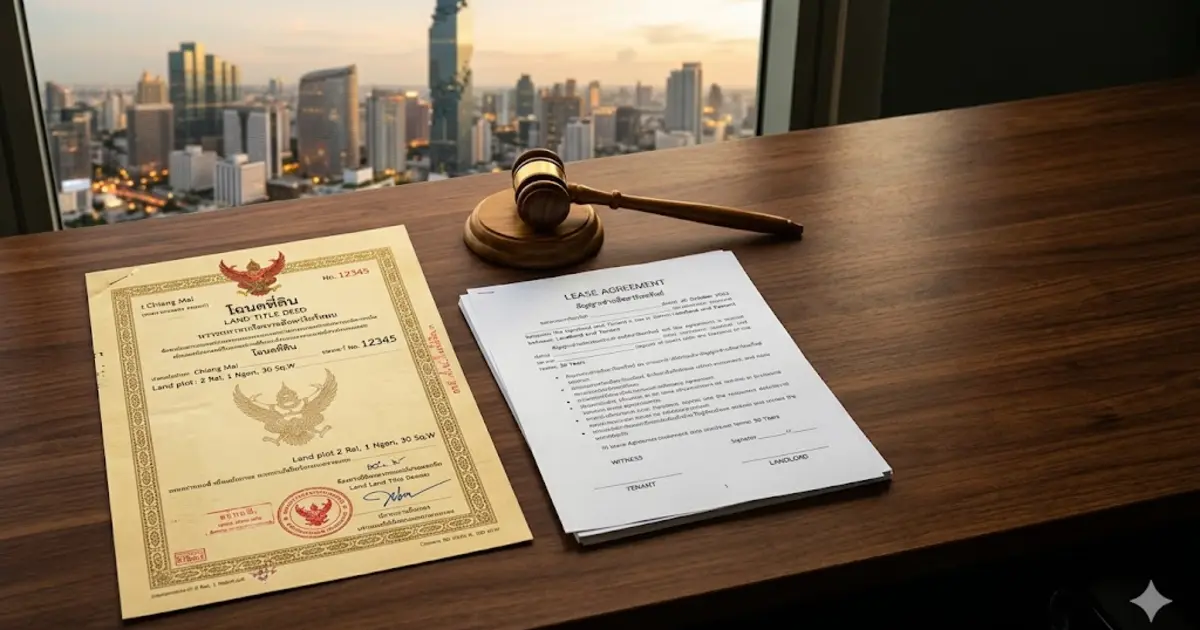
The most expensive question in Thai real estate is also the most misunderstood: when a foreign buyer signs the contract, what do they actually own? In 2026, the answer is no longer a matter of marketing brochures or developer promises — it is settled law, enforced by Supreme Court rulings and a Land Department that has finally drawn a hard line under decades of "creative" leasehold structures. This guide walks through what freehold and leasehold actually protect, what they don't, and which structure makes sense for which buyer.
The 2026 Shift: From Marketing Promises to Legal Realism
For more than two decades, foreign buyers in Thailand were sold a dream that the law never authorized. The most common version was the "30+30+30" lease — a 30-year registered lease paired with two pre-signed 30-year renewals, marketed as "effectively a 90-year freehold." Some developers went further, layering company nominee structures, Thai spouse arrangements, and superficies grants to create what looked like permanent ownership.
The 2025 Supreme Court ruling in Judgment 4655/2566 — referenced in our 2026 inheritance pillar for similar reasons — ended that era. The Court held that pre-agreed renewals beyond the initial 30-year term are void from the outset because they are designed to bypass Section 540 of the Civil and Commercial Code (TCC). The ruling matters because it reframes every pre-2026 villa contract: the 30-year term is real, but anything stamped on top of it is a personal promise that does not bind the land or its future owners.
Key Takeaway
In 2026, "what you own" is determined by what is registered on the title deed at the Land Office — not by what the sales contract promises. The most expensive mistake foreign buyers still make is conflating the two.
Freehold for Foreigners — The Four Paths and What Actually Works
Thai law (Land Code Act, Section 86) prohibits foreign nationals from owning land directly. Despite this, foreigners can hold freehold rights through four narrow structures. Three of them are flawed; one is the recommended default.
1. Condominium Freehold under the 49% Quota (recommended)
Section 19 of the Condominium Act B.E. 2522 (1979) permits foreign individuals or juristic persons to own units in their own name, provided the project's foreign-owned floor area does not exceed 49 percent of the total. The buyer's name appears on the Chanote (title deed). The unit is freely transferable, inheritable by qualified heirs, and survives developer bankruptcy because it is not part of the developer's estate.
The catch is Section 19(5): purchase funds must arrive in Thailand in foreign currency, evidenced by a Foreign Exchange Transaction (FET) form issued by a Thai commercial bank. Without the FET, the Land Office will not register the transfer. Verifying both the project's remaining 49% quota and the FET paperwork is the most important due diligence step a foreign condo buyer can take.
2. BOI-Promoted Company Structure (rarely viable)
Section 96 bis of the Land Code allows foreigners to own land if they invest at least 40 million Baht through a Board of Investment (BOI)-approved company. In 2026, the BOI manages these permissions through its e-Land system. Land use is restricted to the company's promoted activity — typically offices or housing for "operational-level workers" — and ownership is tied to the life of that activity. If BOI promotion is revoked or the business ceases, the company must dispose of the land within one year. Annual audits and Foreign Business Act compliance make this structure unsuitable for passive residential investors.
3. Thai Spouse / Sin Suan Tua (least protection)
Many foreign buyers acquire land through a Thai spouse. Land Department policy requires the couple to sign a "Letter of Confirmation" stating that the purchase funds are the spouse's personal property (Sin Suan Tua) under TCC Section 1476. The result: the land is not marital property (Sin Somros), and the Thai spouse has the sole right to sell, mortgage, or transfer it without the foreign spouse's consent. From a legal protection standpoint, the foreign partner has effectively gifted the capital with no recourse on divorce or dispute.
4. Inherited Freehold Land (Section 93 — disposal only)
Section 93 of the Land Code permits the Minister of Interior to allow a foreign heir to inherit land. The crucial caveat — often hidden in agency marketing — is that this permission is granted only for the purpose of disposal. The heir typically has one year to sell. If they fail, the Land Department can auction the property. Section 93 is a transit visa for inherited land, not a path to ownership.
The 30-Year Wall: How Judgment 4655/2566 Killed the 90-Year Lease
For buyers who want a house rather than a condo, leasehold is the only mainstream path. The legal basis is TCC Sections 537–571, the "Hire of Property" framework. Three sections matter most:
- Section 538 — any lease longer than 3 years must be in writing AND registered at the Land Office to be enforceable beyond 3 years. Registration converts the lease from a personal contract into a "real right" that follows the land if it is sold.
- Section 540 — the absolute statutory ceiling for a residential lease is 30 years. Any renewal must be made when the original term ends, and the renewal itself cannot exceed 30 years.
- Section 569 — a registered lease survives the death of the lessor and the transfer of ownership to a new buyer. The original 30-year term is binding on heirs and successors.
The crucial 2025 development was the Supreme Court's ruling in Judgment 4655/2566, available through the Office of the Supreme Court of Thailand's case database. The Court voided the 30+30+30 structure on public policy grounds: pre-signed renewals are designed to circumvent Section 540 and therefore unenforceable from the moment the contract is signed. The 30-year term itself remains valid, but the "guaranteed 60 more years" is not. After year 30, the land returns to the Thai owner — full stop.
Warning
If a sales agent in 2026 still markets a "90-year lease" or "renewable to 99 years," that is no longer a question of negotiation — it is a contractual claim that Thai courts have already ruled void. Walk away, or buy with the explicit understanding that you are paying for 30 years and nothing more.
The "Protection Stack": Lease + Superficies + Usufruct
Because foreigners cannot own land directly and the 30-year cap is absolute, the post-Judgment 4655/2566 villa market has converged on a layered approach known in 2026 as the "Protection Stack." Three rights from Book IV of the TCC do the heavy lifting:
| Structure | TCC Sections | Inheritable | Transferable | Best Use |
|---|---|---|---|---|
| Registered 30-year lease | §537–571 | Only with explicit clause | Only with lessor consent | Use of land |
| Superficies (สิทธิเหนือพื้นดิน) | §1410–1416 | Yes | Yes | Ownership of the villa structure |
| Usufruct (สิทธิเก็บกิน) | §1417–1428 | No | No | Lifetime right to use + collect rental income |
| Habitation (สิทธิอาศัย) | §1402–1409 | No | No | Lifetime free residence — useless for investors |
The recommended 2026 stack for a villa purchase is a registered 30-year lease on the land combined with a registered superficies right granting the foreign buyer ownership of the building itself. The lease covers the right to use the land; the superficies covers the structure. Both are real rights that survive the lessor's death and bind subsequent owners. A usufruct can be added on top for a foreign spouse who wants lifetime use rights, although it terminates on death and cannot be passed to children.
Three 2024-2026 Failures Every Foreign Buyer Should Know
Theoretical legal analysis is one thing. The cases that actually cost buyers their money in 2024–2026 are more instructive.
Alicha Grand Villa — Phuket, Q4 2025
In late 2025, ten foreign and Thai buyers reported losses exceeding 100 million Baht in a project marketed as "Alicha Grand" or "Alisha Property." Buyers paid deposits for luxury villas, but site visits revealed only "crude shells." The promoter did not actually own the land — the Chanote was held by a local politician — and the company office was found empty. The lesson: before paying any deposit, verify the developer's title deed (Chanote), the construction permit, and the EIA approval. Bangkok Post and The Thaiger covered the case extensively.
Nebu Hotel Cherng Talay — Phuket, 2025
Officials halted construction of a seven-story hotel in Cherng Talay after discovering the project was located in a "Yellow Zone" (low-density residential). Even buyers with valid lease or purchase agreements were exposed: zoning enforcement and EIA reviews can retroactively cancel projects, leaving foreign holders in a legal vacuum. Title deed verification is necessary but not sufficient — the project's zoning compatibility and Environmental Impact Assessment status must also be checked.
Holger Nominee Case — Koh Samui, November 2024
Police charged 16 individuals, including a German national identified as Holger, for using nominee companies (Seabreeze Two, STK INV) to acquire 10 rai of land on Chaweng Noi Hill in violation of Section 86 of the Land Code. The case triggered a 2025-2026 audit of foreign-held land companies on Koh Samui. The takeaway: the "Thai company with foreign director" structure that worked informally for years is now under active enforcement. If the 51% Thai shareholders cannot demonstrate genuine capital contribution and operational involvement, the company can be unwound and the land confiscated.
Tax & Cost Comparison: Freehold vs Leasehold (2026 Numbers)
Beyond legal protection, the choice between freehold and leasehold has a material cost difference at registration and during the holding period.
| Fee / Tax | Freehold Condo (Foreign) | Leasehold Registration |
|---|---|---|
| Registration Fee | 2.0% of appraised value | 1.0% of total lease value |
| Stamp Duty | 0.5% (only if Specific Business Tax not due) | 0.1% of total lease value |
| Specific Business Tax (SBT) | 3.3% if held under 5 years | N/A |
| Annual Land & Building Tax | 0.02% – 0.10% of appraised value | Paid by lessor; usually passed through to lessee |
| Luxury Surcharge (2026) | 2% – 5% on properties over ฿10M | N/A |
Total upfront tax for a freehold condo purchase typically ranges from 2.5% (long-held resale) to over 6% (new luxury unit) of appraised value. Total upfront tax for a 30-year leasehold registration is 1.1%. Inheritance is governed by the Inheritance Tax Act B.E. 2558 (2015): 5% for direct heirs (children and parents), 10% for siblings or partners, and a full exemption for spouses, applied only to assets in Thailand exceeding 100 million Baht per heir. Detailed rules are published on the Revenue Department site.
Geographic Reality: Where Each Structure Wins in 2026
The freehold-versus-leasehold question is not asked in a vacuum. Local supply, land scarcity, and developer behavior shape what is actually available.
Bangkok — In the core Sukhumvit corridor from Asok to Ekkamai, the 49% foreign quota is frequently exhausted in premium projects, pushing buyers toward Rama 4 and the new BTS Gold and Orange line stations where quota remains available. Average new-condo prices range from ฿180,000 to ฿300,000 per square metre, with rental yields of 4.0% to 6.0%, according to CBRE Thailand's 2026 market reports.
Phuket — Once a vacation market, Phuket is now a primary-residence hub. Because flat developable land is the binding constraint, leasehold dominates the villa segment in Bang Tao and Cherng Talay. The growth area is "branded residences" — hotel-managed leasehold structures where the operator handles compliance and resale. Foreign buyers benefit from the operator's track record but pay a yield discount.
Pattaya — More than 58,400 unsold condominium units are competing for buyers in Jomtien in 2026, according to REIC and AREA inventory data. The market is shifting from holiday speculation to long-term residency driven by the Eastern Economic Corridor (EEC) and the Mabprachan medical city. Freehold condos remain widely available because of the oversupply.
Samui and Chiang Mai — Samui combines extreme beachfront scarcity with strict post-Holger enforcement, so leasehold contracts are now scrutinised more carefully than ever. Chiang Mai is absorbing the "Myanmar wave" and DTV digital nomads, with demand concentrated in condos near international schools.
The 2026 Decision Matrix: Freehold, Leasehold, or Rent?
Cutting through the legal complexity, the choice of tenure structure in 2026 reduces to three honest options.
Choose freehold (condo) when the investment horizon is more than 15 years, the property is intended as a family legacy, and the buyer values a tenure structure whose security does not depend on any Thai counterparty. The Chanote can be passed to qualified heirs without forced disposal, and condos remain the most liquid foreign-held asset class in Thailand. For most foreign buyers in 2026, this is the default. See our step-by-step condo guide for the procedural details.
Choose leasehold (villa, with the Protection Stack) when the lifestyle requirement is a private house with land — common in Phuket, Samui, and the Hua Hin coast — and the rental yield over the first 15 years is expected to recover the capital outlay. Treat the structure as a "lifestyle expense with finite horizon" rather than wealth preservation. The 30-year cap is binding; price the asset accordingly.
Choose rent when the investment horizon is under 5 years or when capital preservation outweighs lifestyle. The 5-year DTV destination visa now offers €1,000 entry stays of up to 5 years, which removes the historical residency-driven argument for buying. Renting a high-end villa avoids the 10-15% upfront transfer cost and the legal exposure of a lease whose renewal cannot be guaranteed. In a 2026 market where the 99-year lease proposal is stalled and nominee enforcement is escalating, renting is no longer the unsophisticated choice — for many investors, it is the most rational one. The 3M Investment Visa route also remains open if visa-coupled freehold ownership is the primary goal.
The Single Question That Determines the Right Structure
If, after 30 years, the property must still be in your family's name to justify the purchase price — buy a freehold condo. If, after 30 years, you would be content for the property to revert to its Thai owner — leasehold (with Protection Stack) is acceptable. If neither answer feels right — rent.
Sources & References
- Office of the Council of State (Krisdika) — official Thai statute database (Civil and Commercial Code, Land Code, Condominium Act).
- Department of Lands (DOL) — registration procedures, foreign quota verification, FET form requirements.
- Office of the Supreme Court of Thailand — Dika judgment database — search Judgment 4655/2566 on the 30+30+30 lease ruling.
- The Revenue Department of Thailand — Specific Business Tax, stamp duty, and Inheritance Tax Act B.E. 2558 (2015) rules.
- Thailand Board of Investment (BOI) — Section 96 bis Land Code framework, e-Land system, 40M Baht investment criteria.
- Tilleke & Gibbins — Real Estate Practice — analysis on Thai spouse ownership, leasehold structures, and post-Judgment 4655/2566 implications.
- Baker McKenzie Thailand — corporate land ownership and BOI promotion compliance.
- Siam Legal International — Thailand Property Law — overview of usufruct, superficies, and habitation rights for foreign buyers.
- CBRE Thailand — Market Insights 2026 — Bangkok Sukhumvit pricing, foreign quota saturation, yield benchmarks.
- Knight Frank Thailand — Research — Phuket and Samui branded-residence trends and leasehold market analysis.
- Colliers Thailand — Pattaya/Jomtien condominium oversupply and EEC-driven demand pivots.
- Bangkok Post — Property — coverage of the Alicha/Alisha Grand Villa case, Holger nominee prosecution, and Nebu Hotel zoning halt.
- The Nation Thailand — Property — 2025-2026 enforcement actions on foreign-held land companies in Koh Samui.
- The Thaiger — Property News — Phuket developer due-diligence failures and zoning enforcement updates.
- Real Estate Information Center (REIC) — Thailand-wide condominium inventory and absorption rates.
This article was researched using Gemini Deep Research with 30+ verified sources spanning Thai government statutes, Supreme Court jurisprudence, leading law firms, and major real estate consultancies. Specific case details (Alicha Grand Villa, Nebu Hotel, Holger nominee case) were cross-referenced against Bangkok Post, The Nation Thailand, and The Thaiger reporting from 2024-2026. Written with AI assistance and reviewed for accuracy. Last updated: 5 May 2026.