Property Refurbishment ROI in Thailand: When to Renovate, When to Sell As-Is
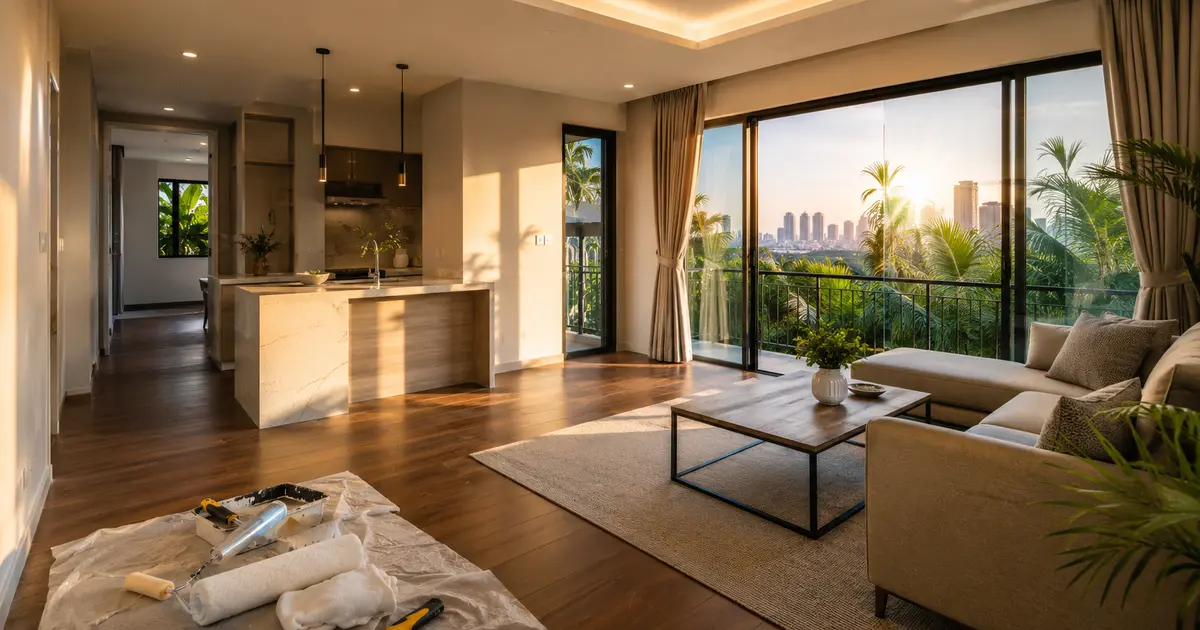
You bought a condo in Bangkok five years ago, or a house in Chiang Mai, or a villa outside Phuket. Now you're thinking about selling. The unit is liveable but dated — the kitchen has 2010s cabinetry, the bathroom tiles are beige, the air conditioning is an old window unit that rattles. Your agent says it'll sell faster if you renovate first. Your accountant says you'll never recover the cost. Both might be right, depending on the property.
This guide is for existing owners making that decision. Not developers. Not investors flipping off-plan. Owners who already hold a unit and want to know whether spending ฿200,000–฿600,000 on upgrades will net them more — or just delay the sale and drain their bank account.
The answer depends on five variables: your property's location tier, the gap between your asking price and comparable renovated units, renovation cost per sqm in your building type, how long the sale will take, and what legal hurdles apply. We'll walk through all five.
The 2026 Market Context: Why This Question Matters Now
Thailand's second-hand property market is growing fast — and heavily oversupplied. As of Q4 2025, second-hand listings nationwide hit 226,278 units, up 29.8% year-on-year, with total listed value surging 54.7% to ฿1.20 trillion, according to REIC data. Condominium listings specifically rose 79.1% in unit count and 141.7% in value — a sign of clear selling pressure.
At the same time, buyers have shifted decisively toward second-hand properties. In 2025, second-hand homes accounted for 64% of residential transfers (316,000 units total), up from 38% before COVID. Buyers are priced out of new developments and finding better-located, better-sized units in the resale market.
This creates a paradox for sellers: there are more buyers than ever for your type of property, but there are also more sellers competing for those buyers. In a crowded field, condition and presentation matter more than in a thin market. A renovated unit in the ฿3–5M range now moves meaningfully faster than an identical as-is unit in the same building — but the "meaningfully faster" only translates into a net gain if the renovation cost is controlled.
Key Market Signal
Pre-owned properties accounted for 64% of all residential transfers in Thailand in 2025 — the highest share on record. Buyers are active in the second-hand market, but so are competing sellers. Presentation now differentiates where it previously didn't need to.
The macro context also matters. Mortgage rejection rates have hit 70% for lower-priced homes, per Nation Thailand reporting. Buyers who do qualify for loans are often stretched — meaning they're looking for move-in-ready properties that minimise their post-purchase capital outlay. A well-renovated unit removes one more financial friction for a buyer who's already tapped to get the mortgage.
The Renovation Math: What It Actually Costs
Renovation costs in Thailand vary dramatically by scope, quality, and building type. Here is the realistic range you should budget against:
| Renovation Level | Cost per sqm (THB) | Typical 50 sqm Total | What You Get |
|---|---|---|---|
| Cosmetic refresh | 5,000–8,000 | ฿250K–฿400K | Paint, fixtures, lighting, deep clean |
| Mid-range renovation | 15,000–25,000 | ฿750K–฿1.25M | New kitchen, bathroom retile, flooring, AC |
| Full renovation | 25,000–40,000 | ฿1.25M–฿2M | Structural changes, premium finishes throughout |
| High-end / designer | 40,000+ | ฿2M+ | Custom built-ins, imported stone, smart home |
These figures come from established Bangkok renovation firms. Regional costs vary: Chiang Mai contractors typically run 15–20% cheaper; Phuket can run 10–15% higher due to material logistics. Building costs in Thailand have also risen — labour and material inflation since 2022 has pushed mid-range renovation costs up roughly 20–25% from pre-pandemic baselines.
The critical number to focus on is your break-even premium: the additional sale price you need to recover renovation cost plus the carrying cost of the delay (2–4 months of holding costs: maintenance fees, utilities, loan repayments if any).
Example: You spend ฿400,000 on a cosmetic refresh of a 45 sqm condo in On Nut. Carrying cost for 3 extra months assuming ฿4,000/month common area fee + ฿3,000 utilities = ฿21,000. Total cost = ฿421,000. For this to work, your renovated unit must sell for at least ฿421,000 more than an identical unrefurbished unit in the same building. If comparable renovated units show a ฿600,000 premium over as-is listings, you have a ฿179,000 net gain. If the premium is only ฿300,000, you've lost ฿121,000 and wasted 3 months.
The Break-Even Test
Before committing to any renovation: research the gap between renovated and as-is listings in your specific building on BaanRow or similar platforms. If that gap is less than your renovation cost + 3 months carrying costs, sell as-is. Do not renovate on hope.
When to Renovate Before Selling
Renovation before sale makes financial sense in a specific set of conditions. Here is when the math works in your favour:
1. You're in a mid-market building with demonstrable renovated comparables. If you can find 2–3 recently sold units in your building that fetched a meaningful premium post-renovation, you have evidence that the market rewards the work. Mid-market condos (฿2M–฿6M) in Bangkok's inner ring — Asok, On Nut, Mo Chit, Lat Phrao — show the clearest renovation premium because buyers in this range care about condition but aren't paying luxury prices for it.
2. The unit has one or two specific high-impact problems. A unit that photographs badly because of one dated bathroom or a cracked tile floor is not a unit that needs full renovation — it needs one targeted fix. Spending ฿120,000 on a bathroom retile and new toilet suite can transform photo quality and remove a buyer's negotiation anchor without triggering a ฿800,000 full reno.
3. The rental market supports a transitional tenant strategy. If you're not in a rush to sell, putting a recently refreshed unit on the rental market at ฿1,000–฿2,000/month above as-is rates while waiting for the right buyer can partially fund the renovation cost. The 30–45% rental yield uplift cited by renovation specialists is real for units in high-demand rental corridors.
4. You're targeting foreign buyers or high-income Thai buyers. International buyers and high-earning Thai professionals are less likely to negotiate hard on cosmetically imperfect units because they lack the local contractor network to manage renovation themselves. A move-in-ready unit removes their execution risk. This matters most in Sukhumvit, Silom, riverside, and Phuket resort areas.
5. The building itself is healthy. If the juristic person is well-managed, the facade is maintained, the lifts are serviced, and the common areas are clean, your individual unit renovation compounds with building-level quality. Renovating a unit in a building with peeling corridors and broken pool pumps will not overcome the building's discount.
When to Sell As-Is
Selling as-is is the right call more often than most agents will tell you. Agents benefit from higher sale prices but don't bear renovation risk — their incentive is to recommend renovation. Here is when you should push back and sell the unit in its current condition:
1. You're in a high-supply building with no verified renovation premium. In buildings where listings are piling up — common in Bangkok's outer ring and in condo projects built during the 2015–2019 boom — buyers hold power. In a buyer's market within a specific building, renovation does not command a premium; it merely keeps you at parity with other renovated listings. You spend ฿400,000 to compete, not to win.
2. The renovation cost exceeds 10% of your asking price. As a rule of thumb, renovation cost should not exceed 8–10% of the post-renovation target sale price. If you're selling a ฿3M unit and renovation quotes are ฿400,000+, you're at 13%+ of value. At that ratio, any market softness during renovation — a 5% price shift in your segment — can wipe the expected gain entirely.
3. You need to sell within 60 days. Renovation of a typical 40–60 sqm Bangkok condo takes 6–12 weeks for mid-range work. Add 2–4 weeks for contractor quoting, juristic approval, and material ordering. You're looking at 10–16 weeks minimum from decision to listing. If your sale is time-sensitive — you're relocating, settling an estate, or have loan pressure — the delay cost and execution risk outweigh the price premium.
4. The unit is in a development market. Some buildings and areas attract investor buyers who specifically want unrenovated units at a discount so they can customise to their own spec or to their rental market. In Pattaya beachfront, Hua Hin resort zones, and some Chiang Mai areas near universities, as-is sales at investor pricing can clear faster than renovation-and-sell cycles.
5. You're selling inherited property with contested family dynamics. As we covered in our guide on Thai inheritors selling parents' condos, renovation decisions in inherited estates often generate family disagreement and delay that costs more than any price premium gained. The fastest path to resolution is frequently a clean as-is sale at a modest discount.
The Investor Discount Strategy
Pricing an as-is unit at a 5–8% discount to comparable renovated listings actively attracts investor buyers who know their renovation numbers and are comfortable with the work. This is often faster than renovating yourself, and avoids execution risk entirely.
ROI by Upgrade Type: What Moves the Needle
Not all renovations are equal. In the Thai resale market, the return profile varies significantly by upgrade type. Here is how to think about it:
| Upgrade Type | Typical Cost (50 sqm) | Resale ROI | Rental Yield Lift |
|---|---|---|---|
| Fresh paint + deep clean | ฿20,000–฿40,000 | High (photo-first impression) | 5–10% |
| Lighting upgrade | ฿15,000–฿30,000 | High (low cost, big visual impact) | 5–8% |
| Inverter AC replacement | ฿18,000–฿30,000/unit | Medium-High (removes common objection) | 8–12% |
| Bathroom retile + fixtures | ฿80,000–฿200,000 | Medium (high photo impact, cost varies) | 10–15% |
| Kitchen cabinet replacement | ฿150,000–฿500,000+ | Medium (depends on spec) | 10–20% |
| Flooring (vinyl plank / tile) | ฿60,000–฿150,000 | Medium (good ROI if current floor is bad) | 5–10% |
| Smart home / digital lock | ฿15,000–฿40,000 | Low-Medium (appeals to specific segment) | 5–12% |
| Structural wall changes | ฿200,000–฿600,000+ | Low (rarely recovered in resale price) | Variable |
The highest-ROI moves are almost always at the low-cost, high-visual-impact end: fresh paint, new lighting, a cleaned and re-grouted bathroom rather than a full retile. These cosmetic fixes cost ฿50,000–฿100,000 and improve photography — which is where the buying decision happens in 2026. Buyers in Thailand's market look at photos online first, visit second. Poor photos kill showings before a buyer ever walks through the door.
The worst ROI is almost always structural changes and high-spec kitchen fitouts. A ฿600,000+ designer kitchen in a mid-market building does not command ฿600,000 more on the sale price. Buyers in that segment price on comparable unit transactions, not on fit-out cost. You're essentially funding a taste-specific customisation that a new buyer may replace anyway.
Browse current BaanRow listings to compare renovated and as-is units in your target building and neighbourhood before committing to any upgrade scope.
Legal Requirements: Permits and Juristic Approval
This section catches many owners by surprise. Renovation in a Thai condominium is not simply a matter of hiring a contractor — there is a legal layer that, if ignored, can result in forced demolition, fines, and a damaged relationship with the juristic person that complicates your sale.
Under the Condominium Act B.E. 2522, any renovation that affects common property or the external appearance of the building requires a vote of at least 50% of all co-owners. This is a high threshold — not just 50% of those present at a meeting, but 50% of all registered unit owners. In practice, this means exterior changes, anything touching shared walls, and modifications affecting common pipes or ducts require formal approval.
For internal renovations that don't affect structure or common areas, you still need the juristic person committee's written approval before work begins. Most condominium buildings in Bangkok and resort areas require you to:
- Submit a renovation plan to the juristic office with scope, timeline, and contractor details
- Pay a renovation deposit (typically ฿5,000–฿20,000) refunded after work is completed cleanly
- Restrict work hours to designated times (usually 08:00–17:00 weekdays, no weekends in many buildings)
- Ensure your contractor carries valid insurance and has a license
Under the Building Control Act B.E. 2522 (amended 2007), structural changes — anything involving reinforced concrete, steel, or load-bearing modifications — require a formal building permit from your local authority (BMA in Bangkok, municipality elsewhere). The permit application requires:
- Original land title deed or title certificate
- Full signed building plans from a licensed Thai architect
- Professional license copies of the architect and structural engineer
- Company registration documents if the unit is held by a juristic person
The authority has 45 days to approve or reject. Working without a permit carries fines of up to ฿10,000 per day and can trigger demolition orders. More practically for a seller: unpermitted structural work becomes a disclosure problem during the sale process. A buyer's due diligence inquiry at the Land Department or with the building's juristic office will surface it.
Warning: Unpermitted Work Kills Sales
Structural changes done without a permit are a disclosure obligation in any honest sale process. A buyer's lawyer or agent will ask. If you disclose, expect a price reduction. If you don't disclose and the buyer finds out post-transfer, you face legal liability. Permitted work is always worth the extra cost and wait time.
For houses and landed property outside condominiums, the same Building Control Act applies. Additionally, in certain zones — conservation areas in Chiang Mai old town, coastal setback zones in Phuket and Samui, and flood-zone areas in Bangkok — additional restrictions from municipal and environmental authorities apply. Verify zoning status with your local land office before planning any significant work.
Contractor Risks in Thailand
The Thai renovation contractor market has a well-documented quality problem. Many contractors are unlicensed, operate without insurance, and front low estimates that balloon once work starts. This is not a fringe risk — it's the most common failure mode for renovation projects in Thailand, and it's especially acute for foreign owners who are not present to supervise.
Key risks to manage:
Quote padding and scope creep. A contractor bids ฿150,000 for a bathroom renovation. Demolition begins and they discover "damaged waterproofing" requiring ฿80,000 more. Then "the tiles you chose came in 10% short." Final invoice: ฿290,000. This pattern is common enough that experienced renovators add a 20–25% contingency to any quoted figure before deciding whether to proceed.
Unlicensed contractors and no-insurance work. If a worker is injured on your unit, liability can fall on the unit owner if the contractor carries no insurance and no valid license. For structural work, the Building Control Act requires a licensed engineer to oversee — if yours doesn't have one, you carry the risk.
Absent supervision failure. For overseas owners or owners not living in the building, renovation without an on-site project manager creates quality gaps. Tile alignment, grout quality, plumbing seal depth — these require daily inspection. Budget for a professional project manager (typically ฿15,000–฿40,000 for a 2-month fit-out) if you can't be on-site daily.
Material substitution. Contractors sometimes substitute specified materials for cheaper alternatives when an owner isn't watching. Specifying Thai brand names, product codes, and grade levels in your contract — and doing a mid-project inspection — reduces but doesn't eliminate this risk.
Vetted contractor paths: seek referrals from your building's juristic office (they see contractor work every day and know who causes problems), from other unit owners in the building who've renovated recently, or from reputable agencies like Sense Property or Renovation Bangkok who offer full-service project management.
Regional Differences: Bangkok vs Phuket vs Chiang Mai
The renovation-vs-sell calculation shifts meaningfully by region. What works in Asok does not work in Rawai.
Bangkok inner ring (Sukhumvit, Silom, Ratchada, Lad Phrao). The renovation premium is most verifiable here because the market is deepest. Comparable data exists. Buyers are often corporate relocations or professionals who want move-in-ready units. Cosmetic renovation (฿80,000–฿200,000) consistently commands a premium in the ฿2M–฿6M segment. Full renovations rarely recover cost unless the unit is large enough (60+ sqm) and the building is genuinely premium.
Bangkok outer ring (Bang Na, Bangkae, Lat Krabang, Minburi). The buyer pool is heavily domestic first-home buyers, many of whom face the 70% mortgage rejection rate noted earlier. In this segment, price is the dominant variable — a ฿100,000 renovation that raises asking price by ฿150,000 may price a buyer out of their mortgage ceiling. Selling as-is at a sharper discount often moves faster here than renovating and holding.
Phuket resort areas (Patong, Kamala, Rawai, Nai Harn). Renovation premiums are visible in the ฿5M–฿15M range but require resort-grade finishes to justify. A Phuket villa buyer in that bracket expects quality throughout — a partially renovated villa signals incomplete investment. The all-or-nothing principle applies more strongly here. Renovation costs also run higher: local skilled labour is scarcer, and imported materials arrive via the mainland. Budget 15–20% above Bangkok equivalents for comparable work.
Chiang Mai (Nimman, Old Town, Santitham, Mae Rim). The market is thin compared to Bangkok, and the buyer pool includes a significant digital nomad and early-retiree foreign segment. This segment values character, natural light, and functionality over glossy finishes. Renovation that preserves or enhances character (exposed brick, warm wood tones, outdoor living integration) can command a premium. Generic Bangkok-style white laminate renovations typically don't. Costs are 15–20% lower than Bangkok, which improves the break-even maths if you get the style right.
See our Tier-2 Thailand Cities guide for a broader look at non-Bangkok real estate dynamics. Our rental management guide for absentee foreign owners covers how to manage renovation projects remotely if you're based outside Thailand.
The Decision Framework: A Practical Checklist
Run through these questions before making a final decision:
Pre-Decision Checklist
- 1. What is the renovated vs as-is price gap in this specific building? Research 3–5 recent sales or current listings. If you can't find comparable data, the market is too thin to predict renovation ROI.
- 2. Does the renovation cost + 3-month carrying cost fit within 80% of that gap? If yes, renovate. If no, sell as-is or price the as-is unit 5–8% below renovated comparables to attract investor buyers.
- 3. Can you complete renovation within 10 weeks? If timeline uncertainty is high (contractor unavailability, juristic approval delays, permit requirements), factor that risk into your calculation.
- 4. Do you have juristic person approval? Do structural changes require a building permit? Get legal clarity before any contractor starts. Unpermitted work creates a disclosure liability that reduces your sale price more than the renovation adds.
- 5. Is the building itself desirable? If the building has a poor reputation, deferred common area maintenance, or poor juristic management, individual unit renovation will not overcome the building discount.
- 6. Who is your target buyer? Foreign or high-income Thai buyers value move-in-ready condition and pay a premium. Price-sensitive domestic buyers prioritise total cost — a clean as-is unit at a realistic price may sell faster.
- 7. Are you selling an inherited unit under time pressure? If legal or family dynamics impose a time constraint, the as-is route avoids execution risk and preserves your timeline for estate resolution.
Thailand's property market in 2026 rewards sellers who know their numbers. The oversupply in the second-hand condo market means buyers have choice — they will select move-in-ready units at a fair price or as-is units at a meaningful discount. The units that sit are the ones priced like renovated but presented like as-is, or renovated at above-market spec in a segment that doesn't reward it.
For selling tools and calculators, check our rental yield calculator to model income scenarios if you're considering the rent-while-you-sell strategy, and our capital gains calculator to understand your tax position on the sale. If renovation is the path, our bathroom renovation calculator and kitchen renovation calculator give you cost estimates to anchor your contractor quotes.
Also worth reading: our Annual Compliance Calendar for Foreign Property Owners covers the tax reporting obligations on the sale side, and our guide on Thai inheritors selling inherited condos addresses the estate-specific decision layer.
Sources & References
- Nation Thailand — Q4 2025 Second-Hand Housing Supply Surges 30%, Exceeding 220,000 Units — REIC data on 226,278 units listed, 64% of transfers being second-hand
- Nation Thailand — Thailand's Property Market 2025: Navigating Crisis Whilst Developers Chart Bold 2026 Strategies — 49% collapse in new housing transactions, 70% mortgage rejection rate
- CBRE Thailand — Thailand's Real Estate Market 2026: Balancing Risk and Reward — luxury segment pricing, downtown Bangkok CBD trends
- Knight Frank Thailand — Research Library 2025 — condominium and office sector oversupply data, hotel and industrial sector growth
- CondoDee — Bangkok Condo Renovation Guide 2025: Cost, Trends, and Investment Insights — cost per sqm ranges ฿15,000–฿40,000, rental yield uplift data
- BestBKKCondos — Renovation Costs for a Property in Thailand — full renovation benchmarks ฿10,000–฿20,000/sqm for quality finish
- PropertyScout — Thai Home Renovation Laws — permit requirements, juristic committee approval process
- Siam Legal — Thailand Condominium Act, Juristic Condominium Sections 42–50 — 50% co-owner vote requirement for external/common-area changes
- ThemisParter — Thailand Building Control Act: Construction Rules and Permits 2025 — permit application process, 45-day review timeline, ฿10,000/day fine for unpermitted work
- Global Property Guide — Rental Yields in Thailand Q3 2025 — average gross yield 6.28%, CBD gross yields 3.5–4.5%
- CondoDee — Buy to Renovate vs Ready to Move In: Bangkok Condo Guide — resale vs new build pricing, CBD condo cost comparison
- REM Magazine Thailand — Building Costs in Thailand on the Rise — material and labour inflation 20–25% since 2022
- Nation Thailand — Property Past Its Low Point; Second-Hand Homes Lead, 2026 Seen Steady — second-hand market recovery trajectory, buy-renovate-sell developer strategies
This article was researched using verified property market data sources including REIC, CBRE Thailand, Knight Frank Thailand, Nation Thailand, and Global Property Guide (13 verified sources) and written with AI assistance. Cost figures reflect 2025–2026 market conditions and should be verified with local contractors before budgeting. Last updated: May 2026.