Khon Kaen, Korat, Hat Yai: The Tier-2 Thailand Cities Foreign Investors Are Quietly Discovering in 2026
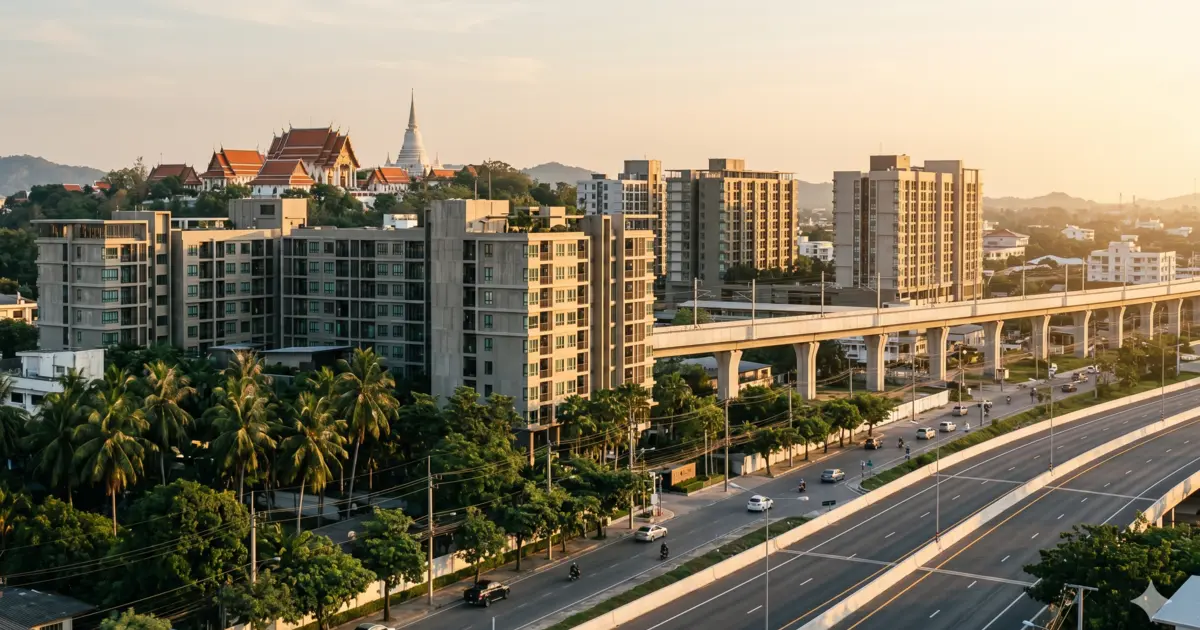
Bangkok still handles roughly 43% of all foreign condominium transfers in Thailand, but the most interesting stories in 2026 are happening 250 to 950 kilometres away from the capital. Three Tier-2 cities — Khon Kaen in the northeast, Nakhon Ratchasima (Korat) on the EEC industrial corridor, and Hat Yai at the Malaysian border — are quietly absorbing capital that no longer fits the Bangkok yield math. Foreign buyers who understand each city's underlying engine can enter at one-third of Bangkok's entry price while collecting 5.5% to 7.5% gross rental yields.
This is a structural shift, not a marketing pitch. National property prices grew only 2.71% year-on-year by mid-2025 — the slowest in a decade — and roughly 70% of Thai mortgage applications under 3 million baht are being rejected. The country is producing what analysts now openly call a "Generation of Renters," and that demographic is concentrating exactly where universities, hospitals, and industrial estates are growing fastest: the Tier-2 belt.
This guide unpacks each of the three cities in turn — economic base, property data, named developers, infrastructure timing, buyer profile — then compares them to Bangkok and ends with a practical due-diligence checklist. Every figure is drawn from 35 cited sources dated 2024 to 2026.
Why Tier-2 Cities Matter in 2026
Three macro forces converge in 2026 to create the Tier-2 entry window:
Counter-cyclical pricing. The Bank of Thailand has steadily cut the policy rate to 1.25% to 1.50% heading into 2026, and inflation hovers at 0.7% to 0.8% — historically low. Combined with single-digit property appreciation, this is the cheapest credit-and-asset combination Thailand has offered foreign buyers since 2017.
Decentralisation premium. The Bangkok-Nong Khai high-speed rail, the Eastern Economic Corridor (EEC) spillover, and the national Halal Industry Action Plan are all government-led regional growth engines — they pull capital and jobs away from Bangkok. The infrastructure premium is not yet fully baked into Tier-2 prices.
Yield gap. Bangkok luxury Sukhumvit and Silom condos now reach 315,000 THB per square metre with gross yields of 4.0% to 5.0%. Tier-2 cities trade at 40,000 to 95,000 THB/sqm with yields up to 7.5%. The gap is not arbitrage — it reflects liquidity risk and exit difficulty — but for buy-and-hold foreign owners, the math is increasingly attractive.
Key Takeaway
Tier-2 cities are not a Bangkok substitute. They are a different asset class — yield-focused, infrastructure-anchored, and best held on a 7- to 10-year horizon, not flipped.
Thailand 2024-2026 at a Glance
| Indicator | 2024 | 2025 | 2026 |
|---|---|---|---|
| GDP growth (% YoY) | 2.5% | 2.4% | 1.8% |
| GDP per capita (USD) | $7,496 | $7,830 | $8,772 |
| Inflation (avg %) | 0.4% | 0.7% | 0.8% |
| Tourist arrivals | 35.5M | 40.0M | 43.0M |
| Policy rate | 2.50% | 1.50% | 1.25% |
Sources: NESDC, Bank of Thailand, IMF, OECD, World Bank.
Khon Kaen: The Isan Medical & Digital Frontier
Khon Kaen has done something most Thai provincial capitals never managed: it stopped competing on cost and started competing on specialisation. The province of 1.8 million people now anchors the largest medical hub in the Greater Mekong Subregion, hosts a university (KKU) ranked third nationally in business and economics, and runs one of Southeast Asia's most operational Smart City programmes — to the point that its IoT flood management and smart nursing systems are now being licensed to Chiang Rai and Songkhla.
Property Market Data (2026)
| Zone | Property type | THB / sqm | Gross yield | Occupancy |
|---|---|---|---|---|
| CBD / city centre | Premium condo | 75,000 – 95,000 | 5.0 – 6.0% | 85% |
| University district | Mid-range condo | 60,000 – 75,000 | 6.5 – 7.5% | 92% |
| Sila / suburbs | Detached house | 45,000 – 60,000 | 4.0 – 5.2% | 78% |
Sources: REIC, Krungsri Research (Housing in Upcountry), Isan Real Estate.
The buyer pool remains roughly 90% Thai — civil servants, KKU faculty, hospital consultants, business owners — but the foreign 10% is concentrated in two clean profiles: retirees from China, the U.S., and Western Europe drawn by the medical hub, and Chinese investors buying small university-district units for student rentals. There is essentially no speculative-foreign segment, which is why Khon Kaen listings on BaanRow trade with notably lower price volatility than Pattaya or Phuket.
Active Tier-1 Developers
National brands have validated the market. Sansiri's flagship THE BASE Srichan is at 54% construction completion as of April 2026, with delivery scheduled for July 2026. CP Land's Metro Condo series consistently leads the mid-market segment along the Mittraphap commercial corridor. Stalled projects are rare among Tier-1 brands; the few exceptions in 2025 were small local boutique developers caught by tighter bank lending rules.
Infrastructure Catalysts
The single most important catalyst is the Bangkok-Nong Khai high-speed rail. Phase 2 (Korat–Khon Kaen–Nong Khai) is fully blueprinted, representing a USD 8.66 billion investment. Combined with airport expansion to 5 million annual passengers by 2027 and a planned Light Rail Transit network, Khon Kaen is positioning to be the only inland Thai city with full HSR + LRT + IoT layers by 2030.
Nakhon Ratchasima (Korat): The EEC's Industrial Appendix
If Khon Kaen sells specialisation, Korat sells scale. It is Thailand's second-largest province by population, sits at the literal "Gateway to Isan," and offers two distinct property markets that almost never overlap: the urban CBD around Mueang, and the luxury mountain enclave of Khao Yai / Pak Chong 90 minutes north.
The provincial economy is unusually diversified — services 51.5% of GPP, manufacturing 37.7% — and labour productivity exceeds the national average. That last detail matters: it explains why WHA Industrial Development's Nakhon Ratchasima 2 Industrial Estate (1,200 rai, Phase 1 operational Q4 2026) is already pre-committed to Japanese automotive logistics tenants under the "China-Plus-One" strategy. Industrial absorption like this is what creates real, durable rental demand for nearby townhouses and mid-range condos.
The Korat Bifurcated Market
| Category | Typical price (THB) | Annual appreciation | Target buyer |
|---|---|---|---|
| Urban condo (CBD) | 2.5M – 4.5M | 3 – 4% | Local professionals, students |
| Khao Yai villa | 15M – 50M | 5 – 8% | High net worth, foreign retirees |
| Industrial townhouse | 1.8M – 2.8M | 2 – 3% | Factory and logistics staff |
Sources: Knight Frank Thailand, REIC, UNDP Korat SDG Profile.
Foreign buyers concentrate almost entirely in Khao Yai for villa lifestyle, and in Thai-foreigner couple gated communities developed by Land & Houses or Supalai inside the city. Genuine investor demand for raw urban condos remains thin, which is exactly why entry pricing is so reasonable.
High-Speed Rail Reality Check
The Thai-Chinese HSR Phase 1 (Bangkok-Korat) is the most consequential piece of infrastructure in the province — and the most delayed. As of early 2026 it is roughly 52.4% complete, with one bottleneck contract (3-5 Khok Kruat–Korat) reporting an 81.9% delay against the original schedule.
| Contract | Section | Complete | Delay |
|---|---|---|---|
| 1-1 | Klang Dong – Pang Asok | 100% | Done |
| 2-1 | Sikhio – Kut Chik | 100% | Done |
| 3-4 | Lam Takhong – Sikhio | 99.8% | 3.2% |
| 3-5 | Khok Kruat – Korat | 17.6% | 81.9% |
| 4-7 | Saraburi – Kaeng Khoi | 70.6% | 4.2% |
Source: State Railway of Thailand progress reports, early 2026.
Despite delays, land within a 5-km radius of the planned Korat HSR station — which is being developed as a 2,300-rai mixed-use hub — has already appreciated significantly. Investors targeting that zone are betting on a 2027-2028 launch window.
Warning: Buy the Land, Not the Promise
If you are paying an "HSR premium" price for a Korat unit, verify the station siting in person. Thai land-office records of planned-station coordinates are public; do not rely on the developer's rendering.
Hat Yai: The Southern Halal & Cross-Border Gateway
Hat Yai is the most under-covered of the three cities and arguably the most internationally exposed. Sitting roughly 60 kilometres from the Padang Besar checkpoint, it functions as the de facto economic capital of Songkhla and the principal Thailand-Malaysia overland trade corridor. The Halal Industry Action Plan launched in 2024 — covering food, fashion, pharmaceuticals, cocoa, and tourism — is now being delivered with PSU Science Park acting as the R&D bridge to international Halal certification standards.
For foreign property investors, the practical effect is twofold: Malaysian and Singaporean buyers dominate the foreign segment, treating Hat Yai condos as second residences and weekend bases for cross-border business. With 5 million annual Malaysia-Thailand crossings and 9 million annual Singapore-Malaysia crossings feeding into the corridor, occupancy fundamentals are unusually strong for short-stay rentals.
Property Market Data (2026)
| Zone | Type | THB / sqm | Gross yield | Occupancy |
|---|---|---|---|---|
| Hat Yai CBD | High-rise condo | 70,000 – 85,000 | 5.0 – 6.0% | 82% |
| Kanchanavanit Rd | Mid-rise condo | 55,000 – 70,000 | 6.0 – 7.0% | 88% |
| Outskirts | Townhouse / shophouse | 40,000 – 55,000 | 4.5 – 5.5% | 75% |
Sources: FazWaz Hat Yai listings, Knight Frank regional reports.
Recent named transactions illustrate the floor: Plus Condo Hatyai 2 60-sqm duplex units have repeatedly transacted at ~3.2 million THB, delivering net ROIs around 6%. That is the kind of stable, unspectacular yield that Bangkok no longer offers at any price.
Risk: The Logistics Talent Gap and Border Perception
Hat Yai itself remains secure, but two issues hold back institutional capital: a real shortage of certified cross-border customs brokers and cold-chain managers needed for the Halal industrial build-out, and the persistent perception of risk linked to the deep south insurgency in Yala, Pattani, and Narathiwat. Both are real, both are bounded — but both depress liquidity at exit.
Tier-2 vs Bangkok: The Strategic Benchmark
The honest comparison is not "Bangkok versus Tier-2" — it is "same money, different asset class." A 5 million THB investment buys a studio in central Bangkok or a two-bedroom premium condo in any of the three Tier-2 cities. The yield, liquidity, and exit profile differ dramatically.
| Metric | Bangkok CBD | Khon Kaen | Korat | Hat Yai |
|---|---|---|---|---|
| Entry threshold (THB) | 5.5M – 10M+ | 1.8M – 3.5M | 2.0M – 4.0M | 1.5M – 3.0M |
| Typical gross ROI | 4.0 – 5.0% | 5.5 – 7.5% | 5.0 – 6.5% | 5.5 – 7.0% |
| 5-yr CAGR (proj.) | 5.5% | 4.2% | 4.8% | 3.8% |
| Liquidity (avg DOM) | 90 – 120 days | 150 – 210 days | 120 – 180 days | 180 – 240 days |
| Foreign focus | Chinese / MNC | Retirees / student rental | Thai-Farang / EEC | Malaysian / business |
Sources: REIC, CBRE Thailand, Savills, Knight Frank 2025/2026 outlooks.
The single most important number is liquidity. Days-on-market in Hat Yai can run twice as long as in Bangkok. If your investment thesis depends on selling within three years, Tier-2 is the wrong asset class. If you are happy to hold through the HSR launch window of 2027-2030 and collect rent, the math reverses entirely.
Provincial Legal & Tax Considerations
The 2024 introduction of Revenue Department Orders 161 and 162 created genuine confusion by appearing to tax all remitted foreign income regardless of when it was earned. By mid-2025 policymakers acknowledged the chilling effect on inbound capital. The 2026 Draft Decree — currently in final consultation — restores most of the pre-2024 framework but with cleaner definitions:
- Same-year remittance: Foreign-sourced income brought into Thailand within the same year it is earned (or a defined 12-24 month window) may qualify for exemption.
- Pre-2024 savings: All funds earned before 1 January 2024 remain permanently tax-free when remitted, provided origin documentation is preserved.
- LTR Visa carve-out: The Long-Term Resident visa offers a clean 10-year exemption on foreign-sourced income regardless of remittance timing — still the simplest workaround for substantial foreign earners.
Land Office Processing Differs by Province
National law is uniform, but provincial Land Offices vary in processing culture. Bangkok and Phuket process foreign condo transfers in 1-2 hours when paperwork is clean. Khon Kaen and Korat typically need 1-3 working days because complex leasehold structures trigger internal consultations. Hat Yai, despite being the most peripheral of the three, is generally efficient — its officers handle Foreign Exchange Transaction (FET) documents daily because of cross-border buyer flow.
Standard fees remain at the 2% transfer rate for foreign buyers. The 0.01% "Quick Big Win" stimulus rate that ran through 2024-2025 was restricted to Thai nationals only.
Foreign Buyer Checklist Before You Sign
This is the practical six-item list every foreign buyer in a Tier-2 city should run before contract signing. It is harder, not easier, than the equivalent list for Bangkok — provincial markets have less competitive scrutiny, so due diligence has to come from the buyer.
1. Verify the 49% Foreign Quota in Writing
Tier-2 popular projects near universities (Khon Kaen) or shopping zones (Hat Yai) can fill their 49% foreign quota faster than developers admit. Ask for a signed Juristic Person Letter certifying that your specific unit number is within the quota. No letter, no signature.
2. The FET Form Is Non-Negotiable
Funds must arrive in Thailand from an overseas account, in foreign currency (do not pre-convert to THB), with the wire instruction stating the purchase purpose. The receiving Thai bank then issues the Foreign Exchange Transaction form that the Land Office requires to register the title in a foreigner's name. Many otherwise-clean Tier-2 transactions stall at this exact step.
3. Chanote Title Only — Especially in Khao Yai
Suburban resort areas like Khao Yai sometimes carry land on lower-tier deeds (Nor Sor 3 Gor or below). Only purchase property where the land is held on a Chanote (Nor Sor 4 Jor) title. Chanote is the only deed type with GPS-verified boundaries — anything less is a future dispute waiting to happen.
4. Audit Developer Solvency
Roughly 156 billion THB in debt is maturing for listed Thai developers across 2025-2026. Stick to Tier-1 national brands with deep balance sheets — Sansiri, AP, Land & Houses, Central Pattana, Pruksa, Origin, Frasers — or established local players with ten-plus year completion track records. Skip first-time developers in this cycle.
5. The 30-Year Leasehold Reality
The Thai Supreme Court has voided multiple automatic 30+30+30 lease renewal clauses. If you are buying a villa where the land is leased rather than owned, recognise that the only statutorily guaranteed term is the first 30 years. Any extension is a contractual obligation of the original lessor that may not bind heirs or successor owners. This is exactly the trap covered in our guaranteed rental returns analysis.
6. CAM Fees and Conservative Yield Math
Tier-2 Common Area Maintenance fees are typically lower than Bangkok in absolute terms but more volatile in smaller projects. Use a conservative 15% deduction on gross rental for taxes, maintenance, and vacancy when computing net yield:
Net Yield (%) = [(Monthly Rent × 12) − (Annual CAM + Taxes + Vacancy)] ÷ (Purchase Price + Transfer Fees) × 100
Strategic Conclusion
The 2026 Tier-2 thesis is not that these cities will overtake Bangkok — they will not. The thesis is that Khon Kaen, Korat, and Hat Yai now offer something Bangkok cannot: genuine yield, infrastructure-anchored growth, and entry pricing under one-third of capital-market levels. Each city has a different engine — medical and digital in Khon Kaen, industrial and HSR in Korat, halal and cross-border in Hat Yai — which means a foreign portfolio diversified across the three is also diversified across structurally uncorrelated demand drivers.
The right move depends on your horizon. Investors who can hold through the 2027-2030 HSR launch window will likely capture the largest re-rating. Investors looking for short-term liquidity should stay in Bangkok. Either way, browse our full searchable listings by city or use the blog archive for deeper sector pieces.
Sources & References
- Bank of Thailand — 2026 Economic and Monetary Conditions Press Release.
- NESDC — Gross Domestic Product Q4 2025 report.
- World Bank — Thailand Economic Monitor, February 2025.
- IMF — Thailand 2024 Article IV Consultation Staff Report.
- OECD — Economic Surveys: Thailand 2025.
- Savills — Thailand Property Market 2026: Strategic Outlook.
- Knight Frank Thailand — Bangkok Condominium Market H1 2025.
- CBRE Thailand — Market insights and yield benchmarks.
- Krungsri Research — Housing in Upcountry 2023-2025.
- Krungsri Research — Housing in BMR 2025-2027.
- SCB EIC — Economic Outlook 2024-2025.
- Fitch Group — Thailand 2025 Economic Outlook.
- Deloitte — Thai Housing Market Outlook.
- UOB Group — Thailand Macro Note February 2025.
- BOI Thailand — Provincial investment incentives.
- Khon Kaen University — Smart City Innovations showcase.
- KKU International — World University Rankings 2025.
- Isan Real Estate — Khon Kaen Real Estate Outlook 2025.
- Sansiri — THE BASE Srichan Khon Kaen project page.
- UNDP — Nakhon Ratchasima SDG Profile, November 2024.
- Thai-China HSR — Phase 1 contract progress reports.
- State Railway of Thailand — HSR and double-track project status.
- MFA Thailand — Eastern Economic Corridor (EEC) Updates.
- PRD Thailand — Halal Industry Development in the Deep South.
- Halal Focus — Thailand Halal market coverage.
- FazWaz — Hat Yai listing pricing benchmarks.
- Hipflat — Thailand city-level property market data.
- Thailand-Property — Real Estate Market Update January 2026.
- Bangkok Post Property — Real estate news and transactions.
- The Nation Thailand — Property section.
- Thai Revenue Department — Foreign income remittance rules and 2026 Draft Decree.
- Thai Land Department — Title deed types and Land Office procedures.
- Krisdika — Condominium Act B.E. 2522 (49% foreign ownership quota).
- WHA Industrial Development — Korat 2 Industrial Estate timeline.
- Real Estate Information Center (REIC) — Authoritative national and provincial property data.
This article was researched using Gemini Deep Research (49 sources scanned, 35 verified citations) and written with AI assistance. Last updated: 27 April 2026.