Why Thai Inheritors Are Selling Their Parents' Condos at a Loss in 2026
The Contrarian Thesis: The Inherited Condo Is Often the Weakest Asset in the Family
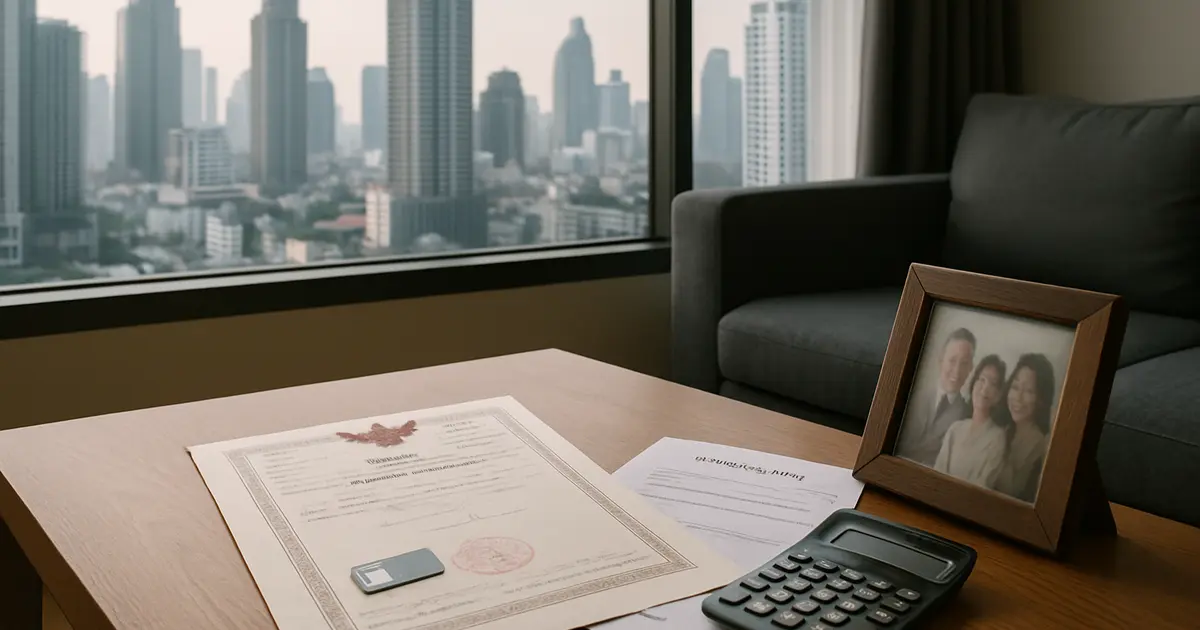
Thai families often talk about a parent-owned condominium as a gift that simply has to be transferred. In the sales brochure version of the story, the heir receives a debt-free unit, waits for the right buyer, and sells when the price feels fair. That version is comforting. It is also the wrong operating assumption for many 2026 estates.
The uncomfortable reality is that an inherited Thai condo can become the least liquid asset in the family. It arrives at exactly the wrong moment: after a death, during probate or estate administration, while heirs are trying to agree on cash division, and often when the building is no longer new enough to compete with developer promotions. The family does not sell because the condo is worthless. The family sells because the condo is awkward, slow, and expensive to hold.
This is the myth to kill: inheritance does not reset the market value of a condo. It only changes the owner. If the old owner paid peak-cycle pricing, if the building has aged into heavy maintenance, or if the unit sits in a foreign-quota segment with thin demand, the heir inherits the market problem too.
Bottom line
A debt-free inherited condo can still be a forced-sale asset. The key question is not whether the family owns it outright. The question is whether the heirs can hold it long enough, cheaply enough, and cleanly enough to wait for a real buyer.
For foreign owners, this matters twice. First, because many foreign buyers are now old enough that estate planning is no longer theoretical. Second, because a foreign-owned condo is usually easier to buy than it is to pass cleanly to the next generation. BaanRow has already covered the estate-planning side in what happens when a foreign owner dies in Thailand and the will problem in the Thai will foreign owners still do not have. This piece focuses on the market consequence: why heirs sell at painful discounts even when nobody is forcing them in a legal sense.
Why Heirs Sell Faster Than Investors
A normal investor can decide to wait. An heir often cannot. That difference explains more discounting than any single market chart.
Heirs inherit a condo, but they also inherit a family negotiation. One sibling may want cash. Another may live overseas. A surviving spouse may need liquidity. A child may already own a home and have no desire to become a landlord. The asset is indivisible, while the inheritance claim is divisible. That is the first source of pressure.
The second source is emotional. Families frequently overestimate the value of a parent's unit because the original purchase price became the mental anchor. If the parent bought a Bangkok condo for 8 million baht in a hot sales cycle, heirs can feel that selling at 6.6 million baht is a failure even when the current market says that is the clearing price. The condo becomes a memory with maintenance bills attached.
The third source is administrative fatigue. Every month of delay means common-area fees, utilities, small repairs, property tax exposure, agent coordination, and sometimes the cost of keeping a bank account, juristic-person contact, or caretaker arrangement alive. For a family that did not choose to be in the property business, a discount can look rational.
| Owner type | Decision driver | Likely pricing behavior |
|---|---|---|
| Long-term investor | Yield, vacancy, refinancing, portfolio balance | Can wait if rent covers holding cost |
| Owner-occupier | Upgrade timing and replacement-home budget | Can negotiate if not already committed elsewhere |
| Estate heir | Cash division, paperwork, family closure | More likely to accept a clean buyer at a lower price |
This does not mean every heir is distressed. It means inherited units are more likely to be sold by owners who did not build a long-term holding plan. That makes them structurally different from carefully managed rental stock listed on BaanRow condo search.
The 2026 Resale-Market Math Is Not Kind to Old Assumptions
The inherited-condo problem becomes sharper because Thailand's condo market is no longer the easy appreciation market many parents remember. Bangkok still has deep demand, but demand is selective. Newer buildings compete with financing campaigns. Older buildings compete on price, location, building management, and the condition of each unit.
Bank of Thailand residential price-index data is useful here because it strips away some of the sales-office optimism. Condo prices do not move in a straight line, and the spread between new-project asking prices and resale clearing prices can be large. Market reports from CBRE, Knight Frank, and REIC have repeatedly pointed to a cautious Bangkok condominium market, a heavy stock overhang in some segments, and buyers who compare completed units against developer promotions rather than against the seller's historic cost.
That creates a hard reset for heirs. The buyer does not care that the parent paid premium launch pricing. The buyer cares about the competing unit down the road, the transfer cost, the renovation budget, the building's age, and whether the juristic person has future capital calls coming.
Warning
The inherited unit's original purchase price is not evidence of today's value. In a soft resale market, it is often just a record of the previous cycle's optimism.
The problem is most visible in three categories. First are small investor units in mass-transit corridors where many similar rooms compete. Second are aging resort condos in Pattaya, Phuket, Hua Hin, and Chiang Mai where rental yield is seasonal and building quality varies. Third are foreign-quota units in buildings where the natural next buyer is another foreigner, but foreign demand has shifted by nationality, exchange rate, and visa profile.
That last group matters because BaanRow's recent work on Chinese buyers leaving Thailand quietly in 2026 shows how quickly a demand pool can change. If a building was marketed to a buyer group that is now less aggressive, heirs do not inherit a generic Thai condo. They inherit an asset tied to a narrower buyer universe.
The Legal Friction Most Families Miss
Thai inheritance law is not impossible, but it is procedural. That is the point families underestimate. A condo cannot be sold cleanly by people who merely feel they are the rightful heirs. The estate must have authority to transfer or sell the unit. If there is a valid Thai will, the process can be smoother. If there is no will, the family may need court appointment of an estate administrator before the Land Department will treat the sale as clean.
Thai Civil and Commercial Code rules on statutory heirs create a hierarchy, but practical authority still has to be documented. Foreign heirs add another layer because signatures, translations, notarisation, embassy steps, and power-of-attorney mechanics can slow the sale. When the asset is a condominium, the juristic person and Land Department documentation become part of the transaction path.
This is why the phrase "the child will inherit it anyway" is too casual. The child may ultimately inherit. But a buyer, bank, agent, and Land Department officer will still need a clean chain of authority.
| Estate condition | Typical market effect | Buyer reaction |
|---|---|---|
| Thai will, named executor, documents ready | Sale can be prepared like a normal resale once authority is established | Lower risk discount |
| No will, multiple heirs, all cooperative | Delay while court or estate-administrator process is handled | Buyer asks for price protection or walks away |
| No will, heirs disagree or one heir is overseas | Timeline becomes uncertain | Only opportunistic buyers stay engaged |
These are not exotic legal risks. They are ordinary estate mechanics. But ordinary mechanics are enough to damage price when the market already has other choices.
The Foreign-Quota Problem: Legal Ownership Does Not Guarantee Easy Liquidity
Foreigners can own condominium units in Thailand within the Condominium Act's foreign-ownership quota. The famous number is 49 percent of the aggregate unit area in a condominium project. That rule makes foreign ownership possible, but it also creates a resale segmentation problem.
If the inherited unit is in the foreign quota, it may be most valuable to another foreign buyer because a Thai buyer usually does not pay extra for foreign-quota status. But if foreign demand in that building is thin, the seller has to choose between waiting for the right foreign buyer or selling to a Thai buyer who prices the unit like ordinary stock. The premium may disappear at exactly the moment the heirs want cash.
If the unit is not cleanly documented, the problem compounds. A foreign heir may need to prove inheritance, satisfy Land Department requirements, and later coordinate a sale to a buyer whose own funds must comply with foreign-exchange documentation rules. Any one of those issues can be solved. Together, they create a narrower funnel.
Warning: Quota Is Not Liquidity
A foreign-quota unit can be legally valuable and still hard to sell. Legal eligibility expands who can own it; it does not guarantee a deep buyer pool at the family's target price.
This is where location matters. A unit in Bangkok may have more year-round depth than a seasonal resort unit, but Bangkok also has more competing inventory. A unit in Pattaya may attract foreign buyers, but the buyer pool can swing by nationality and geopolitics. A unit in Phuket may benefit from lifestyle demand, but building quality, juristic-person discipline, and rental-management credibility become decisive.
A Realistic Loss Model: How a "Free" Condo Turns Into a Discounted Sale
Consider a simplified but realistic inherited-condo scenario. A parent bought a Bangkok one-bedroom near a mass-transit station for 7.8 million baht several years ago. The family believes it should still be worth at least 7.5 million baht because the building is in a good area. Comparable resale listings, however, sit between 6.4 million and 6.9 million baht. Newer developer stock nearby is offering transfer-fee support and furniture packages.
The heirs do not live in the unit. They do not want to rent it because they are waiting for sale authority and do not want a tenant complicating viewings. Common-area fees, utilities, cleaning, small repairs, insurance, and agency coordination cost money every month. A buyer appears at 6.35 million baht with cash ready and a clean timeline. The family says no. Six months later, after bills and family arguments, a similar buyer offers 6.2 million baht. Now the offer feels less offensive because the heirs have learned the market through pain.
| Line item | Illustrative amount | Why it matters |
|---|---|---|
| Original family anchor price | ฿7.8M | Emotional anchor, not market value |
| Current realistic resale range | ฿6.4M-฿6.9M | Comparable buyer alternatives |
| Six-month hold cost and repairs | ฿120K-฿250K | Cash leakage while waiting |
| Clean-buyer discount accepted | ฿200K-฿500K | Price paid for certainty and closure |
| Effective loss versus family anchor | ฿900K-฿1.6M | The gap families feel as "selling at a loss" |
This is not a forecast for every building. It is a model of the mechanism. The loss is rarely caused by one dramatic event. It is caused by stale pricing, thin demand, family urgency, and holding costs adding up.
Before accepting any offer, heirs should run the same numbers a rational seller would run: net proceeds after transfer-related costs, expected holding period, realistic rent if delayed, renovation budget, tax exposure, and opportunity cost of trapped family capital. BaanRow's Thailand transfer-fee calculator and rental-yield calculator are useful starting points, but estate-specific advice still needs a Thai lawyer and tax professional.
What Owners Should Do Before Inheritance Happens
The practical fix is not to panic-sell. The fix is to stop treating estate planning as a document you can write later. The best time to protect a condo's resale value is before heirs are forced to make decisions under stress.
First, make a Thai will that specifically identifies the condominium, intended beneficiary, executor, and supporting documents. If the owner has assets in more than one country, coordinate Thai and foreign wills so they do not contradict each other. Second, keep the purchase documents, title deed copy, foreign-exchange paperwork, juristic-person contact, tax records, and maintenance-fee receipts in one place. Missing paperwork is not just an inconvenience. It slows the sale and gives buyers a reason to negotiate harder.
Third, write a liquidation plan. This is different from a will. A will says who receives the asset. A liquidation plan says what the family should do with it. It should include the minimum acceptable net price, whether the heirs should rent before selling, which agent or lawyer to call, and what repairs are worth doing before listing.
Fourth, review the building honestly every two years. If the condo is aging badly, if the juristic person is underfunded, or if the area has lost rental demand, the owner may be better off selling while alive and converting the asset into a more divisible form. That sounds emotionally cold, but it may be kinder to heirs.
The owner-side rule
Do not leave heirs an asset that only you understand. If the next owner cannot explain the title, quota status, costs, realistic value, and selling process in one folder, the condo is not estate-ready.
For buyers, the lesson is equally direct. If you are looking at a resale unit from an estate, do not assume distress automatically means danger. It may mean the family is rational and wants certainty. But check authority to sell, title status, maintenance arrears, juristic-person liabilities, renovation needs, and foreign-quota documentation before treating the discount as a bargain.
That is the mature version of the contrarian claim. Thai heirs are not selling parents' condos at a loss because they are foolish. They are often selling because the original owner left them an asset that was legally ownable but operationally awkward. In 2026, the families who prepare will still get decent outcomes. The families who rely on the old belief that "property always takes care of itself" are the ones most likely to learn the discount lesson in public.
Sources & References
- Bank of Thailand — Real estate sector statistics — Residential price-index and real-estate indicators used for market context.
- Real Estate Information Center (REIC) — Thailand housing-market and transfer-data source for supply and demand conditions.
- CBRE — 2026 Thailand Real Estate Market Outlook — Professional market outlook for Thailand property demand and residential conditions.
- Knight Frank Thailand Research — Bangkok condominium and residential-market research library used for resale-market framing.
- Tilleke & Gibbins — Inheritance of Condominium Units by Foreigners — Legal note on foreign inheritance of Thai condominium units.
- Thailand Condominium Act B.E. 2522 translation — Condominium Act reference, including foreign ownership quota mechanics.
- Thai Civil and Commercial Code, Succession sections 1599-1649 — Succession-law reference for heirs and estate administration context.
- Thai Revenue Department — Tax information for property transactions — Official tax reference for sale-side cost considerations.
This article was researched using AI-assisted source review with 8 verified sources and written with AI assistance. Last updated: 19 May 2026.