Off-Plan vs Resale in Thailand: Which Is Right for Foreign Buyers in 2026?
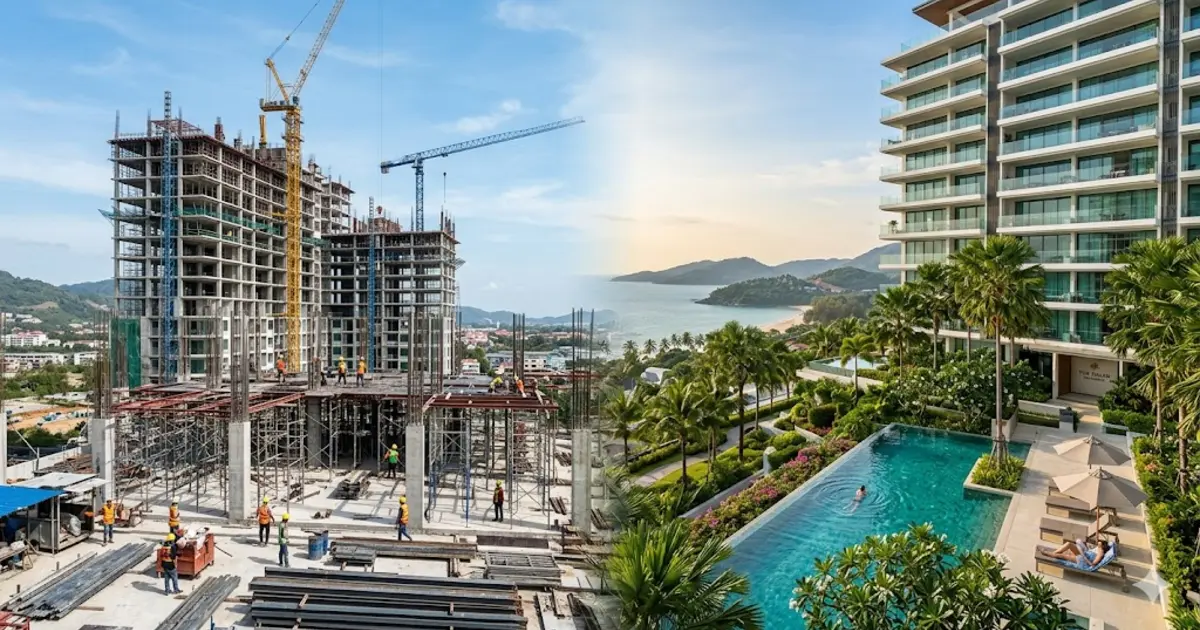
Every foreign buyer in Thailand eventually faces the same fork in the road: buy a shiny new condo that exists only as a scale model in a developer's showroom, or purchase a completed unit you can walk through, inspect, and move into tomorrow.
Both paths lead to freehold condominium ownership under the same Condominium Act. But the risks, pricing dynamics, tax implications, and exit strategies are fundamentally different. In the 2025-2026 market, getting this decision wrong can cost you 10-30% of your investment before you even collect your first month's rent.
This guide breaks down the real numbers, legal traps, and strategic advantages of each approach, based on data from CBRE Thailand, Knight Frank, JLL, Colliers, and over 70 verified sources.
What Off-Plan Actually Means in Thailand
Off-plan (or pre-construction) means you sign a contract and pay deposits for a condominium unit that has not yet been built. You are buying based on architectural renderings, a showroom model, and the developer's promise to deliver a finished unit in 18 to 36 months.
The payment lifecycle works as a staged financing mechanism:
| Stage | Amount | When |
|---|---|---|
| Reservation Fee | 50,000-200,000 THB | Day 1 (often non-refundable) |
| Contract Signing Deposit | 10-30% of price | Within 14-30 days |
| Construction Installments | 10-20% of price | Monthly over 18-36 months |
| Transfer Day Balance | 50-70% of price | Upon completion and handover |
This structure effectively gives you interest-free financing during construction. You spread 20-30% of the cost over two years, then pay the bulk when you receive the keys. For developers, your deposits fund construction. For you, this is the primary financial advantage of buying off-plan.
EIA Warning
Any residential project with 80+ units or over 4,000 sqm requires an Environmental Impact Assessment (EIA) from ONEP. Developers frequently collect reservation fees before EIA approval. If the EIA is rejected, construction cannot legally begin, and recovering your deposit can take years of legal battle. Always verify EIA status before signing.
How the Resale Market Works
Resale means buying a completed, previously-owned condominium unit. You can physically inspect every tile, test the air conditioning, check the view, and talk to existing residents about building management before committing a single baht.
The Thai secondary market operates through three main channels:
- Direct owner sales listed on DDproperty, Hipflat, or PropertyGuru
- Real estate agents (3-5% commission, paid by seller)
- Developer buyback inventory from units returned or forfeited during construction
The transaction is straightforward: negotiate price, conduct due diligence, arrange foreign exchange transfer with proper FET documentation, and complete the ownership transfer at the Land Department. The entire process can close in 30-60 days, compared to 18-36 months for off-plan.
Price Comparison: Real Numbers from Major Developers
The central question: how much cheaper is off-plan compared to completed units?
Analysis of 2025-2026 pricing data from Thailand's top publicly listed developers reveals that off-plan units typically launch at 10-20% below the projected completed value. But the details vary significantly by developer strategy:
| Developer | Strategy | Typical Off-Plan Discount |
|---|---|---|
| Sansiri | Aggressive promotions, year-end clearances | Up to 500K-3M THB per unit |
| AP Thailand | VVIP tiered pricing on transit corridors | 3-5% escalation per milestone |
| Origin Property | Early-bird phases near BTS/MRT | 10-15% below completed value |
| SC Asset | Premium positioning, limited units | 5-10% early commitment discount |
| Ananda Development | Ultra-transit-adjacent pricing | 8-12% launch discount |
| Land & Houses | Mixed portfolio (houses + condos) | 10-15% on suburban projects |
However, here is the counterintuitive reality: resale units in the same neighborhoods often trade 10-30% below new launches. In central Bangkok, new projects command 300,000-500,000 THB per square meter, while prime resale units in identical locations trade at 140,000-180,000 THB per square meter. This "Great Divergence" means that buying resale can actually be cheaper than buying off-plan, depending on the specific property and building quality.
Key Insight
Off-plan is cheaper than the same project's completed price. But resale in an older building nearby can be cheaper than both. The real comparison is not off-plan vs. completed-same-project. It is off-plan vs. the entire available inventory in your target area.
The 49% Foreign Quota: Why It Matters More Than You Think
Under Thailand's Condominium Act B.E. 2522, foreigners can own freehold title (Chanote) in their own name, but only up to 49% of a building's total registrable floor area. The remaining 51% must be Thai-owned.
This quota creates a two-tier pricing reality:
- Foreign-quota units often carry a 5-10% premium because they come with freehold rights
- Thai-quota units are priced lower to match domestic purchasing power
- Once the foreign 49% is full, new foreign buyers can only purchase under leasehold (30-year terms)
For off-plan buyers, this means popular projects fill their foreign quota fast, sometimes during pre-launch. If you hesitate, you may be offered only a leasehold position, which carries significantly less resale value and cannot be used as mortgage collateral with most international banks.
For resale buyers, you must verify the Foreign Ownership Quota Letter from the building's juristic office before committing. If the quota is full and you are buying from a Thai owner, transferring the unit into foreign freehold is legally impossible.
2026 Nominee Crackdown
The Department of Business Development (DBD) and Central Investigation Bureau (CIB) are aggressively pursuing foreigners using Thai nominee shareholders to own land or bypass condo quotas. Administrative Orders No. 1/2567 and No. 2/2568 now require Thai shareholders to produce three months of bank statements proving legitimate source of capital. The Supreme Court has voided titles in multiple cases. Nominee structures are no longer a grey area. They are a criminal liability.
Off-Plan Risks: Delays, Bankruptcy, and Quality Gaps
Developer Bankruptcy
When an undercapitalized developer runs out of cash, your deposits are trapped in an unfinished building. Notable cases in the Thai market include:
- Sarasiri: Faced severe liquidity crisis and underwent corporate restructuring, eventually absorbed into Angpao Assets Public Company Limited
- Nova Group (Pattaya): Multiple reports of stalled projects and prolonged delays in a saturated resort market, with buyers requiring legal intervention to recover funds
The Escrow Illusion
Thailand's Escrow Act B.E. 2551 (2008) technically allows buyer funds to be held by neutral third parties until construction milestones are met. In practice, almost no developer uses escrow accounts. Your deposits are co-mingled with the developer's operational capital. If the company fails, your money goes down with it.
Quality Gaps
Developers legally reserve the right to substitute materials of "equivalent quality" if supply chain issues arise. Buyers frequently report:
- Floor layouts that differ from showroom models
- Lower-grade finishing materials than advertised
- Common area facilities that are scaled back from original plans
Legal Protections That Actually Work
The Consumer Protection Act B.E. 2522 provides real safeguards:
- 5-year structural warranty from the date of ownership registration
- 2-year warranty on non-structural components (plumbing, fixtures, finishing)
- Daily penalty fees if the developer fails to transfer by the contracted date
- Contract termination rights with full refund plus interest if delays exceed statutory thresholds
- The OCPB (Office of Consumer Protection Board) mediates disputes without requiring court proceedings
Resale Challenges: Depreciation and Liquidity Traps
The resale market offers zero construction risk and immediate occupancy, but it comes with its own set of challenges that developers will never mention.
The Depreciation Problem
Unlike Western markets where property values generally trend upward, Thai condominiums frequently depreciate over a 10-year horizon. The physical unit loses value even when the underlying land appreciates. Bank of Thailand data for Q4 2025 shows:
| Market Segment | Price Change (YoY) |
|---|---|
| Nationwide residential | +3.79% |
| Bangkok & vicinity | -0.70% |
| Prime CBD resale condos | -4% to -6% |
| Mid-market suburban resale | -8% to -10% |
The drivers are clear: Thailand's tropical climate accelerates building deterioration, oversupply in the mid-market segment keeps downward pressure on prices, and poorly managed Common Area Maintenance (CAM) fees can cripple a building's long-term value.
The Liquidity Trap for Foreign Sellers
When you want to sell, your buyer pool shrinks dramatically. A foreigner holding a unit within the 49% foreign quota can only realistically sell to another foreigner. Thai buyers have no reason to purchase foreign-quota units at premium prices when they can access the 51% Thai quota at 5-10% less. This restriction significantly extends time-on-market and reduces negotiating power.
Agent commissions of 3-5% (paid entirely by the seller) further erode your exit returns.
The Value Arbitrage Opportunity
Despite these challenges, the resale market offers the best opportunity for immediate rental yields. Purchasing an undervalued unit in a well-managed building, renovating it to modern standards, and placing it on the rental market can generate 6-8% gross yields, significantly outperforming the 3-4% typical of overpriced new launches.
Taxes and Transfer Fees: The Full Breakdown
Thailand has no annual property tax burden worth worrying about (under 0.1%), and no punitive foreign buyer stamp duties like Singapore or Hong Kong. But the one-time transfer costs range from 2.5% to over 6.3% of the appraised value.
| Tax / Fee | Rate | Who Pays | Notes |
|---|---|---|---|
| Transfer Fee | 2.0% | Split 50/50 | Developers sometimes absorb this on off-plan |
| Specific Business Tax | 3.3% | Seller | If owned less than 5 years. Replaces Stamp Duty |
| Stamp Duty | 0.5% | Seller | Only if owned 5+ years (SBT waived) |
| Withholding Tax | ~1.0-2.5% | Seller | Based on holding period and income brackets |
Foreigners Excluded from 2025-2026 Stimulus
The Thai government reduced Transfer Fees to 0.01% and Mortgage Registration Fees to 0.01% for properties under 7 million THB, effective until June 2026. This applies only to Thai citizens. Foreign buyers pay the full 2% transfer rate regardless of property value.
Off-Plan vs. Resale Tax Differences
For off-plan purchases, the developer (as seller) pays the SBT and WHT. These costs are baked into the unit price. Some developers absorb the full transfer fee as a sales incentive, meaning your out-of-pocket closing costs can be as low as 0-1%.
For resale purchases, the individual seller pays SBT (if under 5 years) and WHT, while the transfer fee is split. Your closing costs as buyer are typically 1-1.5%, but the seller's heavy tax burden (up to 5.8%) often inflates the asking price to compensate.
Financing Options for Foreign Buyers
Thai retail banks do not offer mortgages to foreigners unless you hold permanent residency, a long-term work permit with substantial Thai income, or are married to a Thai national. Your options:
| Option | LTV | Works For | Key Limitation |
|---|---|---|---|
| UOB Singapore | Up to 70% | Completed condos | SGD/USD servicing = FX risk |
| ICBC Singapore | Up to 70% | Completed condos only | No off-plan. SGD only. 3-15 year terms |
| MBK Guarantee | ~50% | Existing Thai property as collateral | Must already own Thai assets. THB lending |
| Developer installment | 20-30% | Off-plan only | Interest-free but short-term (construction period) |
Critical Financing Gap
International lenders like ICBC only finance completed units. Off-plan buyers must have the full cash available for transfer day. If you plan to use leverage, the resale market is your only option.
Location Guide: Which Markets Favor Which Strategy
| Location | Recommended | Expected Yield | Why |
|---|---|---|---|
| Bangkok | Resale | 4.0-6.5% | Massive price gap between new and secondary stock. Best value arbitrage in Thailand |
| Phuket | Off-Plan (caution) | 7.0-10.0% | Highest yields but nominee crackdown threatens villa market. Condos only for freehold |
| Pattaya | Resale | 5.0-8.0% | History of developer insolvency. Stick to completed projects. EEC rail is upside |
| Chiang Mai | Resale | 3.0-5.0% | Limited off-plan supply. Digital nomad rental demand. Low capital appreciation |
| Hua Hin | Resale | 3.0-5.0% | Stable retirement market. Buyers want immediate lifestyle, not speculative upside |
The data is clear: four out of five major Thai property markets favor the resale strategy for foreign buyers in 2026. Only Phuket's exceptional rental yields justify off-plan risk, and even there, the nominee crackdown demands extreme legal caution.
Due Diligence Checklist for Both Options
Off-Plan Checklist
- EIA approval status verified (not just "pending")
- Developer is publicly listed on SET or mai (financial transparency)
- Foreign quota availability confirmed in writing
- Sale and Purchase Agreement reviewed by independent Thai lawyer
- Construction timeline with penalty clauses for delays
- Underlying land title is Chanote (Nor Sor 4 Jor)
- Developer's past projects inspected physically
- No escrow reliance: verify developer's financial health independently
Resale Checklist
- Foreign Ownership Quota Letter obtained from juristic office
- Title deed is clean Chanote with no encumbrances or mortgages
- Building's Sinking Fund balance is healthy (ask for financial statements)
- CAM fees are reasonable and consistently collected
- Physical inspection of unit, common areas, and building exterior
- FET documentation prepared: wire transfer must state unit number and project name
- Seller's ownership period verified (affects SBT vs. Stamp Duty)
- Existing tenant contracts reviewed if purchasing as investment
The Verdict: Which Should You Choose?
| Factor | Off-Plan | Resale |
|---|---|---|
| Entry Price | 10-20% below completed value | 10-30% below new launches |
| Construction Risk | High (delays, bankruptcy) | Zero |
| Inspection | Showroom only | Full physical access |
| Time to Income | 18-36 months | Immediate |
| Financing | Developer installments only | International bank mortgages available |
| Foreign Quota | Usually available early | Must verify (may be full) |
| Capital Appreciation | Potential 10-20% by completion | Limited (depreciation common) |
| Rental Yield | 3-4% (premium pricing) | 6-8% (discounted entry) |
| Ideal For | Cash-rich, long-term, specific unit preference | Yield seekers, leveraged buyers, risk-averse |
Choose off-plan if: You want a specific unit in a specific new project, you have full cash liquidity for transfer day, you are buying from a tier-one SET-listed developer with verified EIA approval, and you are comfortable waiting 2-3 years for returns.
Choose resale if: You want immediate rental income, you need international bank financing, you prefer to inspect before you buy, or you are targeting Bangkok's massive price gap between new and secondary stock.
For most foreign buyers entering the Thai market in 2026, the data points firmly toward resale. The value arbitrage, immediate yield potential, zero construction risk, and access to international financing create a fundamentally stronger investment profile than the speculative upside of off-plan. The exception is Phuket's resort condo market, where off-plan yields can justify the risk, but only with bulletproof legal structure and a tier-one developer.
Whatever path you choose, the non-negotiable foundation is the same: verify the foreign quota, secure your FET documentation, hire an independent Thai lawyer, and never, under any circumstances, use a nominee shareholder structure. In 2026, the Thai government is watching, and the consequences are no longer theoretical.
Start your property search on BaanRow.com to browse 587 verified listings across Thailand, or explore our complete library of buyer guides for more data-driven insights.
Sources & References
- CBRE Thailand - 2026 Thailand Real Estate Market Outlook
- JLL Asia Pacific - Resilient Fundamentals in Thailand's Real Estate Market for 2026
- Cushman & Wakefield - Thailand Real Estate Market Outlook 2025-2026
- Savills - The Foreign Buyer's Complete Guide to Thai Property Law (2025 Edition)
- Tilleke & Gibbins - Using Thailand's Escrow Act in Property Development Transactions
- Siam Legal International - Buying Property in Thailand in 2025
- Siam Legal International - Buying Off-Plan: The Sales and Purchase Agreement
- Global Property Guide - Thailand Residential Property Market Analysis 2026
- Forbes & Partners - Thailand Property Transfer Fees & Tax Guide (2025/2026)
- Juslaws & Consult - Nominee Shareholders in Thailand: How to Stay Compliant in 2026
- Australian-Thai Chamber of Commerce - Thailand's Unprecedented Crackdown on Illegal Nominee Structures
- Hawook - Off-Plan Property in Thailand Explained for Foreign Buyers (2026)
- Siam Real Estate - Top 5 Property Developers in Thailand (2026 Investment Guide)
- The Nation Thailand - Thailand's Property Market 2025: Developers Chart Bold 2026 Strategies
- Siam Legal International - Title Deeds in Thailand
This article was researched using Gemini Deep Research (74 verified sources including CBRE, JLL, Cushman & Wakefield, Savills, Tilleke & Gibbins, Siam Legal, Global Property Guide, and Bank of Thailand data) and written with AI assistance. Last updated: April 2026.