Why First-Time Thai Buyers Are Outbidding Foreigners in 2026
The Labour Day 2026 Plot Twist
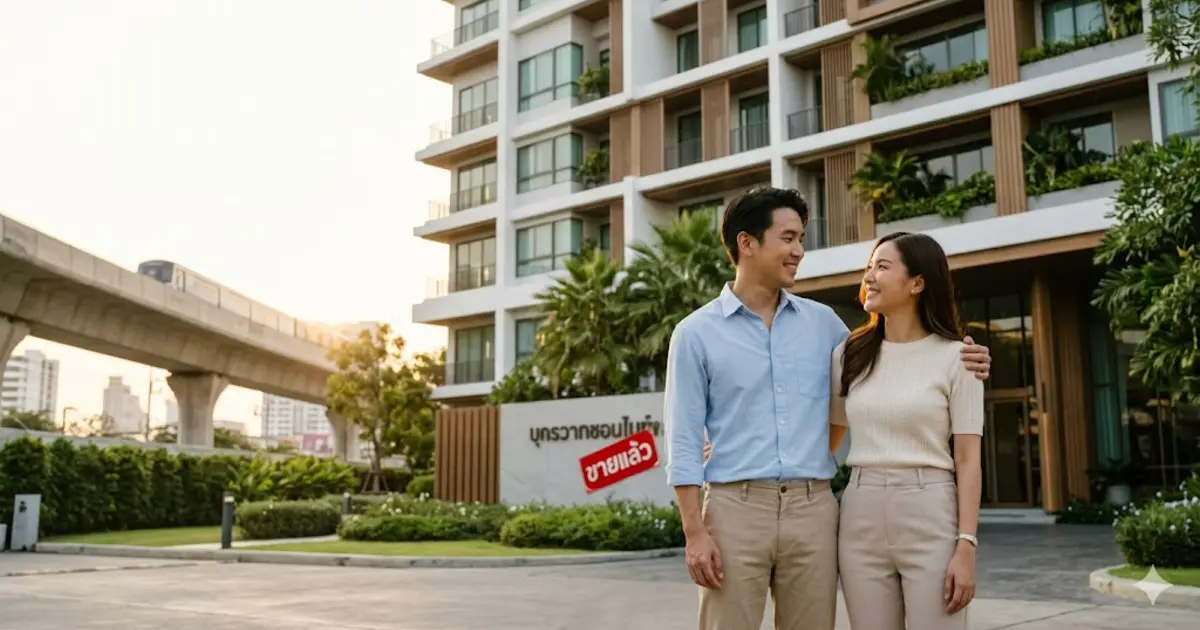
Thailand's property cycle has a new lead character — and for the first time in two decades it isn't a foreign investor wearing a hard hat at a Phuket pre-sale. As the country observes Labour Day on 1 May 2026, the more interesting story isn't the daily wage debate. It's that Thai first-time buyers are now outbidding foreign cash on the same condo units that used to be ours by default.
For years the standard pitch to foreign buyers ran on autopilot. Bangkok GDP-growth multiples, weak baht, 49% freehold quota, foreign capital is the marginal price-setter. That model is breaking in 2026 — not because of a crash, but because the Thai government has spent eighteen months weaponising domestic buying power. The result: in the 3M–7M baht segment that used to be a foreign comfort zone, the local buyer now has a structural cost advantage of more than 200,000 baht and can borrow at one-fifth our interest rate.
This piece is the unsentimental version. We'll show you exactly where Thai buyers are winning, where foreign capital still owns the field, and what to do with the next sixty days before the stimulus cliff arrives on 30 June 2026.
Key Takeaway
The "outbidding" thesis is segment-specific, not universal. Sub-5M baht condos near transit are now Thai-buyer territory. Luxury, branded residences, and Phuket pool-villa lifestyle assets remain firmly foreign. The winning play in 2026 is rotation, not retreat.
The "Quick Big Win": How Thailand Subsidised Its Citizens
The single most important policy change behind the 2026 shift is the "Quick Big Win" ministerial regulation, in force from 22 April 2025 and now extended to 30 June 2026. It collapses two of the largest closing costs on residential transactions under 7M baht — but only when the buyer is a Thai national on their primary home.
| Closing Cost | Pre-2025 Rate | 2026 Rate (Thai) | Saving on 7M THB |
|---|---|---|---|
| Ownership Transfer Fee | 2.0% | 0.01% | ฿139,300 |
| Mortgage Registration Fee | 1.0% | 0.01% | ฿69,300 |
| Total Upfront | ฿210,000 | ฿1,400 | ฿208,600 |
That ฿208,600 saving doesn't sound revolutionary in a London or Hong Kong context. In Bangkok's mid-market, it is. It is roughly six months of mortgage payments for the same unit. It is the difference between a Thai buyer hesitating and a Thai buyer signing the same day a foreigner asks for "a few weeks to think." And every Thai buyer in the room knows the foreigner doesn't get the discount.
Layered on top: the Bank of Thailand temporarily lifted Loan-to-Value rules to 100%, including financing for furniture, with the policy rate cut to 1.00%. For a Thai buyer, that combination doesn't just lower the bar to entry — it removes it entirely.
The 40-Year Mortgage Revolution
The second leg is the credit pivot. The Government Housing Bank (GHB) and Krungthai Bank have rebuilt their 2026 mortgage lineup around 40-year terms — not 30 — at first-year rates that look like a typo to anyone borrowing in foreign currency.
| Product | Target Borrower | Year-1 Rate | Max Term |
|---|---|---|---|
| GHB Precious Home Loan | Income > ฿50K/mo | 1.79% | 40 yr |
| Happy Home Loan | General retail | 1.75% | 40 yr |
| Govt Personnel | Civil servants | 2.00% | 40 yr |
| Krungthai Refi Special | Existing holders | 1.53% | 40 yr |
For a 1M baht loan, the monthly payment now drops to roughly ฿2,900 — frequently lower than the rent on the same unit. The buy-versus-rent maths has flipped. In transit-corridor neighbourhoods where gross rental yields run 4–6%, a Thai buyer using these subsidised rates achieves neutral-to-positive cash flow on a primary residence from day one. That is real demand, not speculative demand. It is also the demand foreign capital is colliding with.
Compare that to the foreign side of the table. The handful of Thai banks willing to lend to international borrowers are pricing prime customers at 6.30%–7.10%. The interest-rate gap with a domestic Thai buyer is roughly 400 basis points — a chasm no rental yield in the mid-market can paper over.
The Sub-5M Warzone Where Foreigners Are Losing
Where exactly are Thai buyers winning? The 3M–5M baht condominium bracket along Bangkok's mass-transit corridors — Ratchada-Lad Phrao, On Nut, Bang Sue, Rama 9. The ownership math turns this into a quiet auction we keep losing.
| Corridor | Foreign Share | Foreign Avg (M฿) | Thai Avg (M฿) | Gap |
|---|---|---|---|---|
| CBD (Sukhumvit / Silom) | 44.2% | 8.23 | 6.85 | +16.8% |
| On Nut (Sukhumvit Mid) | 26.2% | 3.75 | 3.12 | +16.8% |
| Nationwide | 14.7% | 4.84 | 4.09 | +18.3% |
That 18% gap is the "Thai discount". Foreigners are buying the same physical concrete for an extra fifth of the price, almost entirely because the 49% freehold quota creates artificial scarcity on the foreign-eligible side of the building. While we're calculating yields off ฿8.23M, our Thai buyer next door is calculating them off ฿6.85M. The maths is brutal — the foreigner is buying the yield the Thai is hoping to earn.
Warning
The Ratchada-Lad Phrao corridor shows an unusual 80.3% foreign share — analysts attribute most of this to nominee structures and Thai-company purchases by foreign principals, which the authorities are now investigating with increased rigour. If you've used or are considering a nominee structure in 2026, get specialist legal review before transferring.
Co-Borrowing & the Floor-Plan Pivot
The 40-year mortgage has done something nobody priced into 2024 forecasts — it changed Thai household composition on paper. Multi-generational co-borrowing (parents plus a young professional, or two siblings) is now the dominant first-home structure. By bringing in a younger co-borrower, families stretch the loan to 40 years and crush the monthly payment to recession-proof levels.
Floor plans followed. Demand for "1-bedroom plus" and 45–60 sqm two-bedroom layouts is up roughly 20% — units large enough for a co-borrowing family to actually live in. That sounds like an inventory note, but it isn't. It's an exit-liquidity warning. If you own the classic 28–32 sqm "investment unit" that used to flip easily to the next foreign buyer, your domestic resale market is moving past you. The Thai buyer of 2026 wants more square metres, not fewer.
Layered on top, employees of SET-listed companies are increasingly using ESOP and EJIP equity holdings as secondary collateral on mortgage applications, which is improving approval rates for younger buyers who would have looked overleveraged in 2023. The SET's 2026–2028 strategic plan formalises this as policy, not coincidence.
Developer Pivot: Sansiri, AP, Origin
You don't need to take this from analysts — the major Thai developers have already restructured their entire 2026 launch calendars around the domestic buyer. Three case studies.
Sansiri has pioneered a "build-to-complete" model: finish construction first, sell second. Traditionally, off-plan sales meant Thai buyers paid both rent and instalments simultaneously for two to three years — the "double-rent trap" that capped how many domestic households could participate. Selling completed inventory to a 100% LTV-leveraged buyer eliminates that trap, and Sansiri has built its 2026 plan around it: 33 projects, ฿51 billion, 80% medium-to-premium, with sales staff trained as pre-loan consultants. Their reported mortgage-rejection rate is roughly 10% versus a market average closer to 50%. By the time the foreign sales channel opens, the Thai quota is frequently already gone.
AP Thailand has gone in a completely different direction — geographic. AP's 2026 strategy ventures into 19 new provinces including Hua Hin, Saraburi, and Chon Buri. Provincial low-rise townhomes and detached houses are seeing presales rebounds of 25.5%. The foreign buyer assumed provincial Thailand would sit dormant until the "retirement villa" thesis came back. AP saw the local buyer arrive first.
Origin Property has revived its entry-level "The Origin" brand with units starting at ฿1.2M targeting Gen Z first-home buyers near tech hubs and universities. These projects sell out before they hit the foreign sales channel at all. They're not cheap; they're fast.
Foreign Buyer Pullback: China, Russia, Myanmar
Domestic surge is only half the picture. Foreign demand is also rotating in ways that compound the squeeze.
- China: Total transfer value to Chinese nationals fell 30.2% in the first three quarters of 2025, while unit count only fell 15%. That gap means Chinese buyers are migrating down to smaller, cheaper units — directly into the same sub-5M segment where Thai first-home buyers are subsidised. This is competition, not retreat.
- Myanmar: Up 42.2% in unit transfers, but with an average ticket of just ฿3.0M. This is crisis-mitigation buying, not yield-seeking, and it doesn't help foreign yield economics.
- Russia: Up 17.8% in transfer value, concentrated in Phuket and Pattaya primary residences, mostly cash. The Russian market remains structurally healthy — but it's a resort-market story, not a Bangkok mid-market story.
And then there's the currency-and-rate problem. Even with the BOT cutting policy rates to 1.00%, Thai banks lending in foreign currency to international buyers price prime borrowers at 6.30%–7.10%. Capital is global; mortgages are local. That gap doesn't close.
Where Foreigners Still Win
If you've read this far and concluded "sell everything, leave Thailand," reread the piece. The outbidding pattern is sharply segment-specific. Three places where foreign capital still has the structural edge in 2026:
Super-luxury and branded residences in Sukhumvit, Silom, and Sathorn — Dusit, Ritz-Carlton, and similar partnerships — are seeing 93% sales rates and prices up to 15% YoY. Thai buyers, even high-net-worth ones, are cautious here. International buyers see safe-haven assets. That arbitrage isn't closing.
Phuket lifestyle and managed villas in the Bang Tao / Cherng Talay corridor are forecast at 8–10% annual price growth through 2026, with branded residences yielding 5–8%. The Thai buyer is not, as a rule, buying a ฿35M Phuket pool villa as a primary residence. Browse our Phuket listings if this is your lane.
Buy-to-rent in dense Bangkok — counterintuitively, the rise of "Generation Rent" among Thai youth is good news for foreign condo owners. Bangkok rental demand was up 9% in Q1 2026 and low-cost rental (sub-฿10K) up 11%. Thai buyers are outbidding us for ownership; meanwhile they're creating the most stable tenant base Bangkok has had in a decade. If you bought in 2018 and held, your unit's resale may be uglier — but its rental cash flow has never looked better.
Strategic Reframe
Don't fight the domestic policy advantage. Rotate around it. The losing trade is sub-5M condos in transit corridors. The winning trades are luxury freehold downtown, branded resort assets, and operating Bangkok rentals as cash-yield vehicles.
The 30 June 2026 Cliff
Mark this date. The "Quick Big Win" stimulus expires on 30 June 2026. That is roughly 60 days from this article's publication. After that, the closing-cost differential between Thai and foreign buyers collapses — the 0.01% rates revert to 2-3%, taking back the ฿208,600 advantage on a ฿7M unit overnight.
What that means in practice:
Before 30 June 2026 — Sellers
If you're a foreign owner sitting on a sub-7M unit you've been thinking about exiting, this is your last subsidised buyer pool. After 30 June, your Thai resale buyer faces an additional ฿200K+ in closing costs that most won't absorb without a price cut. Move the listing now.
After 30 June 2026 — Buyers
Cash-rich foreign buyers should expect a temporary dip in domestic transaction volume in July-August 2026. Developers facing a sudden drop in subsidised traffic become more flexible on negotiation. This is your re-entry window — but it's narrow.
What Foreign Buyers Should Do Now
Five concrete moves for the next sixty days:
- Audit your Thai portfolio by segment. Anything sub-5M in a transit corridor — that's a candidate to list now, while the Thai buyer pool is still subsidised. Use the BaanRow search to benchmark current asking prices in your building.
- Don't chase new sub-5M condo launches. The 18% Thai discount on the same physical unit means your effective entry yield is materially worse. Walk away from the warzone.
- Look hard at branded residences and luxury freehold. Foreign demand is the marginal price-setter here, supply is constrained, and Thai buyers are not a competitive force. If you're using the 3M Investment Visa pathway, this segment also satisfies the holding requirement cleanly.
- Phuket west-coast managed villas remain the cleanest yield play. Cash purchase removes the foreign-mortgage rate penalty. Browse our Phuket inventory for current openings.
- If you're a long-term Bangkok holder — reframe to rental yield. The Thai resale market is moving away from your unit type, but the rental tenant base has never been larger. A 5-year buy-to-rent forecast looks better than a 5-year resale forecast for the same asset.
The Great Domestic Pivot of 2026 is not a foreign-buyer crisis. It is an end of a particular era — the "buy any Thai condo, hold, profit" era — and the start of a more selective one. The market is more honest now. Capital that knows where to stand still does very well.
Sources & References
- Bank of Thailand — Financial Stability Review 2025 — official LTV easing policy and household-debt context
- CBRE Thailand — 2026 Real Estate Market Outlook — segment-by-segment market analysis and developer launch pipeline
- Savills Thailand — Property Market 2026: Strategic Outlook — luxury and branded-residence performance data
- JLL — Thailand Real Estate Fundamentals 2026 — resilience analysis and segment forecasts
- Cushman & Wakefield Thailand — Market Outlook — challenges and opportunities
- Bangkok Post — AP Ventures Into New Provinces in 2026 — provincial expansion case study
- Nestopa — Thailand Property Fee Cuts 2025 Update — Quick Big Win stimulus mechanics
- HLB Thailand — Registration Fee Reductions — legal interpretation of ministerial regulation
- Baker McKenzie — Thailand Social Security Wage Base 2026 — Section 33 ceiling changes
- Tilleke & Gibbins — Social Security Base and Benefits — implementation phases
- Stock Exchange of Thailand — Listed Equities Overview — SET-listed employer base for ESOP collateral
- ASEAN Exchanges — SET 2026–2028 Strategic Plan — capital-market human-resource focus
- Krungthai Bank — Interest Rates — domestic mortgage rate reference
- Bangkok Bank — Property Loan Rate Sheet — foreign vs domestic borrower spreads
- RE/MAX Thailand — Foreign Quota Condo Explained — 49% rule mechanics
- Thairath English — Property Market Interview 2026 — domestic buyer profile reporting
- The Nation — Sansiri 2026 Plan — build-to-complete model and rejection rate
- Money & Banking — GHB Mortgage Suite 2026 — Year of the Horse product list
- Top Thai Real Estate — Foreign Luxury Condo Demand 2026 — counter-evidence on luxury segment
- Global Property Guide — Thailand Price History — long-run price reference
This article was researched using Gemini Deep Research (50 verified sources, of which 20 are cited above) and written with AI assistance. Last updated: 1 May 2026.