Where Thai Property Demand Actually Went in H1 2026 — And What Foreign Buyers Missed
Introduction: The H1 2026 Numbers Everyone's Misreading
The lazy reading of Thailand property in 2026 is simple: the market is weak, foreigners are cautious, and mortgage approvals are hard. That is true at the headline level, but it is not a useful investment map.
The more useful question is not who is buying. We covered that competition story in May in Why First-Time Thai Buyers Are Outbidding Foreigners in 2026. That article was about auction pressure and buyer identity. This H1 stocktake is different: it asks where Thai demand actually went, which price bands held up, and which regional micro-markets kept moving while foreign-facing sales decks stayed loud.
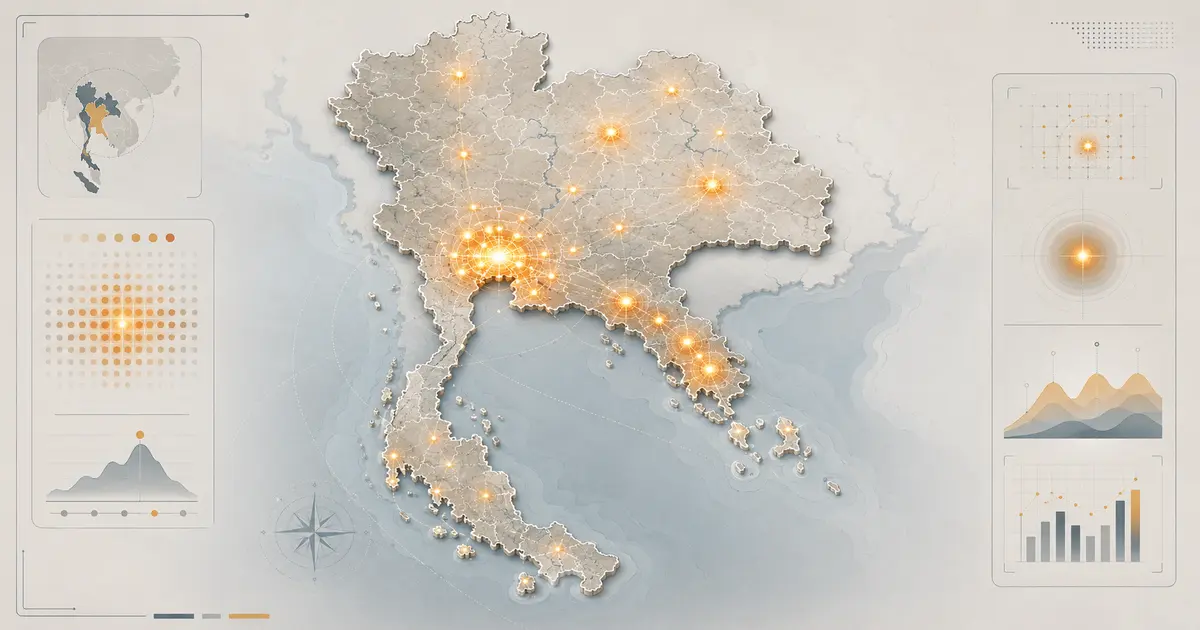
As of 25 May 2026, full H1 transfer data is not yet published. So this is an H1-to-date stocktake using Q1 2026 banking and macro data, REIC's late-2025 and 2026 outlook releases, portal demand signals, listed-developer commentary, and consultant reports. The conclusion is contrarian: domestic demand did not disappear. It narrowed, moved outward, and became more price-disciplined.
Key Takeaway
The H1 story is not "Thai buyers versus foreigners." It is that Thai demand flowed toward practical affordability: peripheral Bangkok, commuter provinces, selected regional hubs, and projects that fit monthly-payment reality.
The Macro Picture: BOT Rate Hold + Baht Moves + Mortgage Tightening Created a Specific Flow
The Bank of Thailand cut the policy rate to 1.00% in February, then held it there at the 29 April MPC meeting. The April statement matters because it did not describe a clean easing cycle. It described weak growth, supply-driven inflation risk, volatile exchange rates, and subdued credit growth.
For property, that combination is specific. Lower policy rates help sentiment, but they do not automatically reopen the mortgage tap. BOT's Q1 banking brief still showed banks watching loan quality closely, while industry groups continued to warn that mortgage rejection rates were blocking the mass market. In practice, buyers with stable income could transact; buyers just below bank thresholds stayed stuck.
That is why demand did not flow evenly. The safest borrowers did not necessarily buy the most expensive units. They bought units where the total monthly obligation still made sense after common fees, commuting costs, school access, and family balance-sheet risk. On BaanRow search, that means a different filter set: not just "BTS" or "foreign quota", but province edge, price band, usable size, and livability.
| Macro Signal | Property Effect | Where Demand Moved |
|---|---|---|
| Policy rate held at 1.00% | Borrowing costs eased, but banks stayed selective | Stable-income buyers, not speculative borrowers |
| Baht volatility | Foreign buyers delayed FX-sensitive decisions | Domestic payment-driven demand became clearer |
| High household debt | Sub-฿3M buyers faced rejection risk | Cash-light buyers rented; bankable buyers traded up carefully |
| Transfer and mortgage fee cuts | Helped closing math more than demand creation | Ready units and resale stock with clean title |
Where Demand Actually Went: Peripheral Bangkok Districts
Foreign buyers often read Bangkok as a central-condo market: Sukhumvit, Sathorn, Rama 9, Riverside, maybe a few BTS extensions. Thai household demand reads it differently. It sees the metropolitan region as a work-and-family system stretching into Bangkok, Nonthaburi, Samut Prakan, Pathum Thani, and Nakhon Pathom.
REIC's Bangkok-metropolitan analysis for Q4 2025 and its 2026 outlook showed the whole market under pressure year-on-year, but also pointed to a quarter-on-quarter lift in transfers helped by fee reductions and LTV relaxation. That matters because the recovery was not led by trophy foreign-quota stock. It was led by practical completion, mortgage readiness, and developers clearing inventory.
Nonthaburi and Pathum Thani benefit from the same basic logic: they offer larger usable area at prices that can still pass a household bank test. Samut Prakan benefits from the eastern job corridor, airport access, and industrial employment. Nakhon Pathom is not glamorous, but it sits inside the westward family-house search radius. These are not "emerging lifestyle destinations." They are where real buyers can still assemble a deposit, a mortgage, and a commute.
For a foreign investor entering H2, the lesson is uncomfortable. The loudest English-language listings are often not where Thai end-user depth is strongest. The domestic bid is more visible in commuter belts, completed low-rise estates, and condos priced for monthly affordability rather than Instagram appeal.
Where Demand Actually Went: Regional Micro-Markets
The same pattern appeared outside Greater Bangkok. Broad regional headlines say "slowdown"; micro-market reading says "selective demand." Krungsri's upcountry housing outlook for 2026-2028 expects pressure from weak purchasing power and high household debt, especially among lower- and middle-income groups. But it also identifies stable real demand in provincial centers tied to universities, government complexes, logistics, tourism, and industrial employment.
Peripheral Chiang Mai is a good example. The foreign conversation usually clusters around Nimman, the Old City, and mountain-view lifestyle homes. Thai demand often moves through San Sai, Hang Dong, Doi Saket, Mae Rim edges, and family-house zones where school runs and road access matter more than cafe density. That makes Chiang Mai less of a nomad story and more of a household-formation story.
In the Eastern Seaboard, foreign capital keeps watching Pattaya and resort-facing condos. Thai demand is more mixed: Sriracha, Chonburi industrial housing, Rayong employment corridors, and townhome estates serving workers with stable income. In central-western markets, Nakhon Pathom and Ratchaburi are not foreign-buyer magnets, but they can support real domestic absorption when pricing is honest.
The micro-market lesson is simple: a province can be weak and still contain strong submarkets. A city can be popular with foreigners and still have a thin Thai resale bid in the wrong price band.
The Segment Shift: ฿2-5M Sweet Spot vs Foreign-Target ฿8M+ Compression
The most important H1 shift was not geographic alone. It was the price band. Thailand's mass-market under-฿3M segment remains constrained by mortgage rejections. Nation Thailand reported that banks were rejecting nearly 40% of loan applications for homes and condos under ฿3M, which explains why cheap does not automatically mean liquid.
The more resilient domestic zone is often the ฿2-5M practical band: enough price to imply a more bankable borrower, still low enough to fit a Thai family balance sheet, and broad enough to include townhomes, compact detached houses, and commuter condos. This is where demand can exist even when the headline market is soft.
By contrast, foreign-target stock above ฿8M faces a different problem. It can be excellent property, but its buyer pool is narrower and more FX-sensitive. CBRE's 2026 outlook still sees strength in luxury and super-luxury downtown condominium launches, supported by high sales rates in existing supply. That is not the same as saying the entire ฿8M+ market is liquid. Prime projects can work; generic foreign-facing stock can sit.
Investors should separate two questions: "Is this attractive to foreigners?" and "Is there a deep local exit bid?" In H1-to-date, those answers often pointed to different maps.
What Foreign Capital Did Instead
Foreign capital did not vanish. It concentrated. Phuket remained the clearest flight-to-safety market for internationally mobile buyers, especially in the west-coast condo and villa ecosystem. Colliers' Phuket 2025-2026 report describes a market that rebounded strongly after the pandemic but now faces absorption pressure in undifferentiated condominium supply. Nation Thailand separately reported that Phuket's sales pace was faster than Bangkok's, despite high prices.
That creates a split-screen market. Foreign buyers look at Phuket, prime Bangkok, and branded lifestyle assets because those markets feel legible: English-speaking agents, legal infrastructure, rental-management promises, and comparable foreign buyers. Thai demand looks for where the payment works.
Neither side is irrational. They are solving different problems. A foreign buyer may prioritize legal simplicity, freehold quota, rental yield, and lifestyle resilience. A Thai buyer may prioritize school access, family support, work corridors, and bank approval. The mistake is assuming foreign capital's map is Thailand's demand map.
The Data Foreigners Missed: REIC, DDproperty, and Mortgage Trends
Three data streams matter more than the usual "hot area" pitch.
First, REIC's quarterly breakdowns show where transfers, new supply, completions, and inventory are moving. The March 2026 research page makes clear that the latest full official market reports still cover Q4 2025 and the 2026 outlook, not completed H1 2026. That timing matters: anyone claiming final H1 conclusions before late June is selling certainty too early.
Second, portal demand signals point to affordability stress. Public summaries of DDproperty's Q1 2026 data showed purchase demand down, rental demand up, condo demand more resilient than landed demand, and strong interest in lower monthly rent brackets. Even if portal behavior is not the same as land-office transfers, it tells us where search pressure is building.
Third, banking data explains why some demand does not become a sale. Krungsri Research expects 2026 residential demand to remain constrained by slow growth and household debt. BOT's banking-sector brief shows loan quality remains a live concern. That is why mortgage-ready buyers matter more than raw inquiry counts.
Warning
Do not treat search demand, presales, and completed transfers as interchangeable. In 2026, mortgage rejection is the gap between wanting property and completing a transaction.
Named Project Examples: Where Thai-First Pricing Worked in Q1 2026
The clearest Thai-first examples were not always glamorous. They were projects and product lines built around price discipline, smaller tickets, and commuter logic.
Lumpini-style compact condos in outer Bangkok remain relevant because the product promise is simple: low total ticket, manageable common fees, and access to work corridors. Sena Kith-type suburban projects fit the same pattern in Nonthaburi and west/north Bangkok edges: smaller units, practical pricing, and a domestic buyer persona that is not trying to impress a foreign rental market.
In the low-rise market, Supalai and AP Thailand family-house formats in peripheral districts show why Thai demand often follows roads before rail hype. The buyer is not buying a postcard. The buyer is buying bedrooms, parking, and a monthly payment that survives a bank underwriter.
For investors browsing transfer-fee scenarios, the lesson is to model the buyer after you, not just the buyer before you. If your exit buyer is Thai, the product must work for a Thai household's financing, not merely for a foreign investor's yield spreadsheet.
H2 2026 Signals to Watch
H2 will decide whether the H1-to-date pattern becomes a durable recovery or just a selective bounce. Watch four signals.
BOT's Q3 meeting matters because the April hold was not a victory lap. If inflation risk stays supply-driven and growth stays weak, the central bank may hold longer than property bulls want. If credit stays tight, rate cuts alone will not rescue weak borrowers.
REIC's Q2 report is the first hard checkpoint for this thesis. If transfers improve in commuter provinces and practical price bands, the domestic-flow argument strengthens. If improvement is only in prime or resort markets, then H1 was more polarized than the current evidence suggests.
BOI and FDI data matter for the Eastern Seaboard and industrial housing corridors. Foreign factory investment can create Thai rental and owner-occupier demand far away from foreign condo marketing.
Developer presales by price band will show who really has pricing power. A company can launch fewer projects and still do well if the product is correctly priced. A developer chasing prestige launches into a thin buyer pool may report visibility without liquidity.
BaanRow Verdict + Action Framework: Buy Where Demand Is Strong, Not Where the Foreign Pitch Is Loudest
The contrarian verdict is this: Thailand's 2026 property market is weak only if you read it as one market. It is better understood as a series of separated demand pools.
Foreign demand is concentrated in places that feel safe and legible: Phuket, prime Bangkok, selected resort corridors, and professionalized rental ecosystems. Thai demand is more practical and more dispersed: commuter provinces, regional household markets, employment corridors, and the ฿2-5M affordability band. The winner in H2 is not the buyer who follows the loudest English-language pitch. It is the buyer who can identify where the next buyer already exists.
Use this framework before entering any H2 deal:
| Question | Good Answer | Red Flag |
|---|---|---|
| Who is the exit buyer? | Specific Thai household or specific foreign niche | "Everyone will want this" |
| Can the local buyer finance it? | Monthly payment fits bankable income | Yield model ignores mortgage rejection |
| Is supply differentiated? | Scarcity, location utility, or clear product fit | Generic condo in a crowded corridor |
| Does the data confirm the pitch? | REIC, BOT, portal, and developer signals align | Sales deck relies on foreign-buyer hype |
Start with the demand map, then choose the property. That sounds obvious, but H1 2026 showed how many buyers still do it backwards.
Sources & References
- REIC Bangkok Metropolitan Q4 2025 and 2026 outlook — official REIC analysis of transfers, supply, fee cuts, and LTV support.
- REIC nationwide housing research archive — quarterly nationwide housing-market reports and publication timing.
- Bank of Thailand MPC Decision 2/2026 — April 29 rate hold at 1.00% and credit-growth commentary.
- Bank of Thailand MPC Decision 1/2026 — February rate cut, baht appreciation, and household liquidity context.
- BOT Banking Sector Quarterly Brief Q1 2026 — loan quality and bank caution context.
- Krungsri Thailand Industry Outlook 2026-2028 — national residential demand constraints and household-debt view.
- Krungsri Housing in Upcountry Outlook 2026-2028 — regional housing-market segmentation and real-demand drivers.
- CBRE 2026 Thailand Real Estate Market Outlook — luxury condominium, low-rise inventory, and resale-market comments.
- Colliers Phuket Residential Report 2025-2026 — Phuket supply, rebound, and absorption-pressure context.
- Knight Frank Bangkok Condominium Market Q1 2025 — Bangkok condo demand and price-level baseline used for comparison.
- Nation Thailand on sub-฿3M mortgage rejections — low-end housing stress and bank rejection rates.
- Nation Thailand on 2026 property slowdown forecasts — weak demand, household debt, and lending conditions.
- Nation Thailand on industry groups urging demand support — transfer fees, LTV rules, and fragile recovery.
- Nation Thailand on Phuket's 2026 property ranking — Phuket sales-rate comparison with Greater Bangkok.
- DDproperty Thailand property platform — portal demand and search-market context.
- Reuters via MarketScreener on April 2026 BOT hold — market expectation and central-bank rate context.
This article was researched using live official releases, property-consultancy reports, and market news sources (16 linked sources) and written with AI assistance. Last updated: 25 May 2026.