The Sukhumvit BTS Corridor Condo Oversupply Map: Station-by-Station Data 2026 Foreign Buyers Are Missing
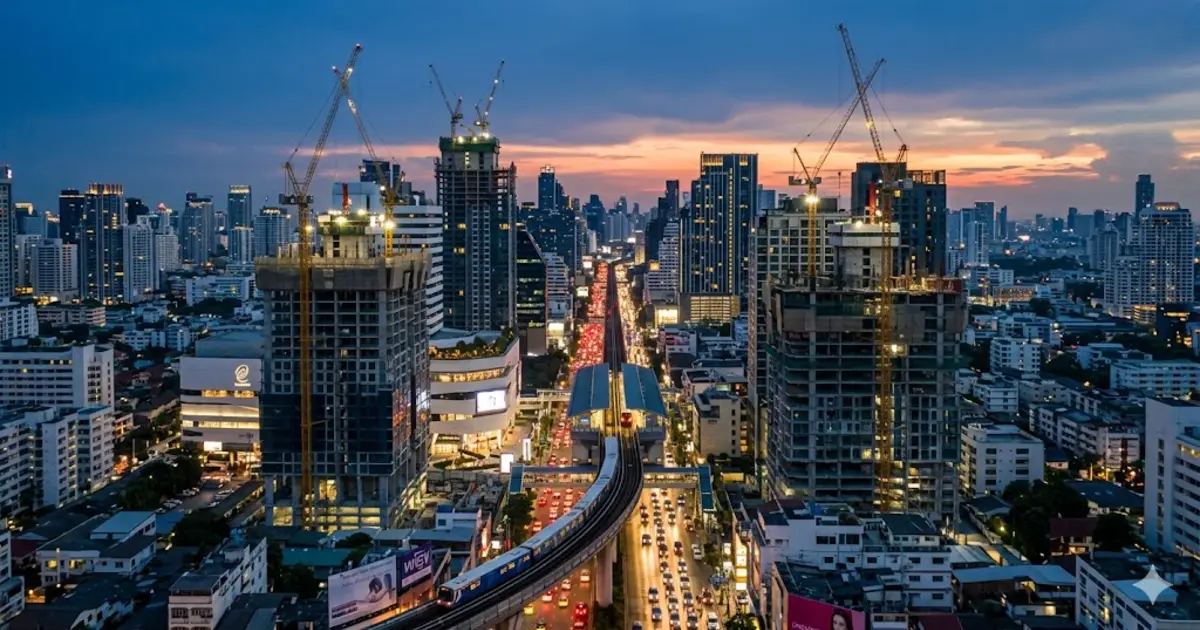
The "Sukhumvit BTS" Myth
Foreign-buyer brochures often sell **Sukhumvit BTS condos** as one clean idea: buy near the train, collect premium rent, and wait for capital growth. That is too broad. From Asok to Bang Na, the Sukhumvit Line is not one market. It is ten station markets if both endpoints are counted, with different tenant bases, land prices, building ages, developer clusters, and resale depth.
This article is the station-level follow-up to BaanRow's earlier framework on why buying near BTS can be a weak investment in 2026. That post explained the generic BTS-premium trap. This one narrows the map to Sukhumvit and asks which stations still protect capital, and which are carrying too much near-identical condo stock.
The warning is not "avoid Sukhumvit." Phrom Phong, Thong Lo, and parts of Asok still have real scarcity. The warning is against treating Bang Chak, Punnawithi, Udom Suk, and Bang Na as if they have the same tenant depth as the inner stations. Colliers Q4 2025 called Bangkok a two-speed condo market, while CBRE's Q4 2025 Bangkok review pointed to slower condominium demand under tight lending. The same BTS logo cannot erase those gaps.
Station-by-Station Completion 2024-2026
The clean way to read Sukhumvit is by completion pressure, not by station fame. Knight Frank's Bangkok Condominium Market Q2 2025 and Q1 2025 research show the broader launch slowdown, but also the split between prime scarcity and weaker mass-market absorption. Cushman & Wakefield Q4 2025 described 2025 as a clear slowdown. That does not hit every Sukhumvit stop equally.
The inner stretch from Asok to Thong Lo is old, dense, and expensive to assemble. New supply comes, but it is usually higher priced, smaller in count, or tied to rare plots. Ekkamai and Phra Khanong sit in the middle: still close enough for many tenants, but with more redevelopment sites and more resale competition. From On Nut eastward, the product becomes more repeatable: one-bedroom towers, larger land plots, and developer plans built around the promise that "one more stop out" will be the next growth story.
| Station | 2024-2026 completion pressure | Main stock type | Buyer risk |
|---|---|---|---|
| Asok | Low to medium | CBD fringe, office tenant stock | Price paid too high, not empty towers |
| Phrom Phong | Low | Luxury, Japanese-family, embassy-adjacent units | Foreign quota and entry price |
| Thong Lo | Low to medium | Luxury and older large units | Overpaying for brand |
| Ekkamai | Medium | Lifestyle towers and resale stock | Too many similar investor units |
| Phra Khanong | Medium to high | Mid-market towers near Rama IV and Sukhumvit | Rent gaps between old and new buildings |
| On Nut | High | Large condo clusters and retail-linked towers | Tenant churn and discount resale |
| Bang Chak | High | Compact one-bed investor stock | Inventory competes on price first |
| Punnawithi | High | Tech-district towers around True Digital Park | Future demand priced in early |
| Udom Suk | Very high | Affordable rentals and new launches | Rent ceiling below sales pitch |
| Bang Na | Medium to high | Older large units plus extension stock | Distance discount is real |
Unsold Inventory Map
No public agency publishes a perfect station-by-station unsold count. The practical buyer method is to triangulate developer remaining units, resale listings, rental listings, building age, and nearby completions. REIC tracks national and Bangkok inventory and transfers. DDproperty's Phrom Phong station page, Bang Chak station page, Punnawithi station page, and Udom Suk station page are useful live proxies, even though listing portals contain duplicates and agent reposts.
Using those inputs, the screening map looks like this. Treat the percentages as a due-diligence flag, not a valuation certificate. Before buying, the buyer still needs the building's own juristic-person occupancy and owner-occupier data.
The direction matters more than the exact decimal. If a station has many active sale listings, many active rental listings, and several recently completed towers, the buyer should assume weak pricing power until proven otherwise. If a station has high listing counts but most of the stock is older, larger, and owner-held, the risk is different: resale may be slow, but rent competition can be less brutal because the units are not identical.
| Station cluster | Available or unsold pressure | Read |
|---|---|---|
| Phrom Phong / Thong Lo | 14-20% | Tightest. Expensive, but deep tenant demand and fewer cheap substitutes. |
| Asok / Ekkamai | 18-25% | Still liquid, but price discipline matters. Generic one-bed units can sit. |
| Phra Khanong / On Nut | 24-33% | Middle-risk zone. Good buildings work; weak buildings need discounts. |
| Bang Chak / Punnawithi | 32-40% | High surplus signal. Newer towers compete with each other, not just older stock. |
| Udom Suk / Bang Na | 30-42% | Lowest rent ceiling. Upside story needs tenant absorption, not just a BTS name. |
Warning
A 30% surplus signal does not mean every unit is bad. It means your resale buyer and tenant have many substitutes. That weakens rent growth, negotiation power, and exit speed.
Occupancy + Rent Reality
The best rent is not the highest asking rent on a portal. It is the rent a normal tenant renews for after seeing five similar rooms. Hipflat's Bangkok rental listings and DDproperty's Bang Chak rental page show why the eastern stations are sensitive: many one-bed units sit in the THB 16,000-30,000 range, and Udom Suk has a large pool of listings below THB 15,000. That is a hard ceiling for yield once common fees, vacancy, leasing fees, and repairs are deducted.
Inner Sukhumvit can still command rent per square metre above the extension stations. Phrom Phong listings include luxury rents above THB 1,000 per sqm, while Bang Chak and Udom Suk samples often sit around THB 300-700 per sqm. The capital price does not always fall enough to compensate. That is why BaanRow's rental-yield reality guide tells buyers to model net yield, not brochure gross yield.
Occupancy also has to be read building by building. A tower can report healthy occupancy because many owners keep units locked for personal use, while the rental pool still has weak tenant demand. For an investor, the right question is narrower: how long does a similar room take to rent at the asking price after the previous tenant leaves?
Debt makes this sharper. If a foreign buyer is using leverage, the spread can vanish quickly. See BaanRow's foreign-buyer mortgage math and DSR and LTV guide before accepting a "rent pays the loan" pitch.
Why the Oversupply Concentrates Eastward
Oversupply follows land math. Inner Sukhumvit land is scarce, fragmented, and costly. A developer buying near Phrom Phong or Thong Lo has to aim at high prices because the land cost demands it. East of On Nut, larger plots and older low-rise uses made it easier to build more units at lower absolute ticket sizes. The result is not one bad developer decision. It is a repeated market pattern.
Origin, Sansiri, AP, SC Asset, MQDC, and other large developers have all used the eastern Sukhumvit story in different ways: compact rooms, shared facilities, station proximity, tech-district branding, and lower entry prices than inner Sukhumvit. Some projects are well managed and rentable. The problem is that many are aimed at the same buyer and tenant profile. When several towers deliver similar one-bed rooms within a few BTS stops, the landlord with the weakest price or furniture loses first.
The legal side matters too. The Department of Lands' English Condominium Act translation and the Thailand.go.th foreign condo ownership summary show the 49% foreign quota rule. In a building that foreign buyers like, quota can be scarce even when Thai-quota or resale inventory is high. BaanRow covered that in the Bangkok foreign-quota squeeze. Inventory surplus and quota scarcity can exist in the same tower.
The "BTS Extension Premium" Trap
The extension premium story says every station farther east should rise because Bangkok keeps growing along rail. That is partly true for access, but not automatically true for condo returns. Ridership is not evenly converted into rent. BTS Group's SET filings and quarterly disclosures show the rail system's passenger recovery, but a train rider is not always a condo tenant at the nearest tower. Many riders continue to cheaper low-rise homes, workplaces, schools, and retail nodes beyond the station.
The buyer mistake is to pay today's price for tomorrow's tenant pool. True Digital Park helped Punnawithi. Bangkok Mall and Bang Na mixed-use plans help the east. But those demand sources must absorb thousands of small units already built or launched. If the rent today is THB 12,000-18,000 and the sale price assumes THB 25,000 rent, the station story has already been overbought.
BOT data adds another caution. The Bank of Thailand residential property price index uses mortgage data and controls for distance to mass transit. That is useful, but it is still a broad Bangkok-vicinity index. It does not protect a buyer who pays too much for one generic unit in one crowded station cluster.
What Foreign Buyers Should Actually Ask
Before committing to any Sukhumvit BTS unit, ask for station data and building data. A good agent or seller should be able to answer without hiding behind "near BTS."
- How many completed condo units sit within 800 metres of the station?
- How many more units complete within the next 24 months?
- What is the building's real occupancy, not just the developer's sales rate?
- How many units are for rent in the building today, and at what achieved rent?
- How many resale units compete with this one in the same size band?
- Is the foreign freehold quota open in writing, and will it stay open through transfer?
- What is the juristic-person budget, sinking fund, and repair history?
- Who managed the building after handover, and did the developer stay involved?
- What net yield remains after one month vacancy, leasing fee, common fees, repairs, and tax?
For a quick first screen, compare live choices on BaanRow property search with your target building's direct competitors. If ten similar units are cheaper, newer, or closer to the station, your negotiation starts there.
Where Sukhumvit BTS Still Makes Sense
Sukhumvit BTS still makes sense when scarcity is real, not just printed on a brochure. The strongest cases are quota-cleared freehold units in tight stations, older larger units bought below replacement cost, buildings with stable owner-occupier communities, and projects where the surrounding completion pipeline has been quiet for five years or more.
Phrom Phong and Thong Lo remain strong for buyers who can handle the entry price and do not need fantasy yields. Asok works when the unit is genuinely walkable to both BTS and MRT and priced against real resale comparables. Ekkamai and Phra Khanong can work if the building is clearly better than the nearby substitutes. On Nut eastward is not an automatic avoid, but the discount must be large enough to pay you for vacancy, slower resale, and tenant choice.
The contrarian rule is simple: buy the building and station, not the BTS logo. Sukhumvit is not one market. A good station can protect capital. A crowded station can turn "near BTS" into a rent-cutting contest.
FAQ
Is Sukhumvit BTS still the best Bangkok condo corridor for foreign buyers?
It can be, but only station by station. Inner Sukhumvit has deeper tenant demand. Eastern extension stations need stronger discounts and better building-level checks.
Which stations look most exposed to oversupply in 2026?
Bang Chak, Punnawithi, Udom Suk, and parts of Bang Na show the clearest surplus signals because many similar units compete for price-sensitive tenants.
Which stations look tightest?
Phrom Phong and Thong Lo remain the tightest in this screen, followed by selected Asok buildings. The risk there is overpaying, not broad vacancy.
Should foreign buyers avoid BTS extension stations?
No. They should demand a larger discount, verify actual rents, and avoid assuming future infrastructure will fix today's weak yield.
How does foreign quota change the decision?
A tower can have many units available but little foreign freehold quota. Always get written quota confirmation before paying a serious deposit.
Sources & References
- Colliers Bangkok Condominium Market Q4 2025 - Bangkok launch volume, absorption, and two-speed market comments.
- CBRE Bangkok real estate market review Q4 2025 - residential slowdown and cautious buyer conditions.
- Knight Frank Bangkok Condominium Market Q2 2025 - supply and absorption context for Bangkok condominium demand.
- Knight Frank Bangkok Condominium Market Q1 2025 PDF - launch slowdown and market segmentation context.
- Cushman & Wakefield Bangkok Condominium MarketBeat Q4 2025 - 2025 slowdown and stock-clearance setting.
- JLL Bangkok Residential Market Update Q1 2025 - rent and prime-condo demand context.
- Real Estate Information Center (REIC) - Thailand housing inventory, condominium transfer, and foreign-buyer data hub.
- Bank of Thailand Residential Property Price Index - Bangkok-vicinity residential and condominium price index methodology and series.
- BTS Group Holdings SET disclosures - quarterly rail ridership and operating-disclosure source.
- DDproperty Phrom Phong BTS condo sale listings - live station listing proxy.
- DDproperty Punnawithi BTS condo sale listings - live station listing proxy.
- DDproperty Udom Suk rent listings below THB 15,000 - rent-ceiling proxy for eastern Sukhumvit.
- Hipflat Bangkok condo rentals - rental-market listing proxy.
- Nation Thailand foreign buyers gain ground in Bangkok condos - foreign-buyer share and prime/transit concentration reporting.
- Department of Lands Condominium Act English translation - condominium registration and foreign-ownership framework.
- Thailand.go.th foreign condominium ownership fees summary - government summary of the 49% foreign ownership limit.
This article was researched using 16 linked public sources, including market reports, official statistics, legal references, and live listing proxies. Last updated: 27 May 2026.