Real Thailand Rental Yields 2026: 3-5% (Not the 6-8% Developers Promise)
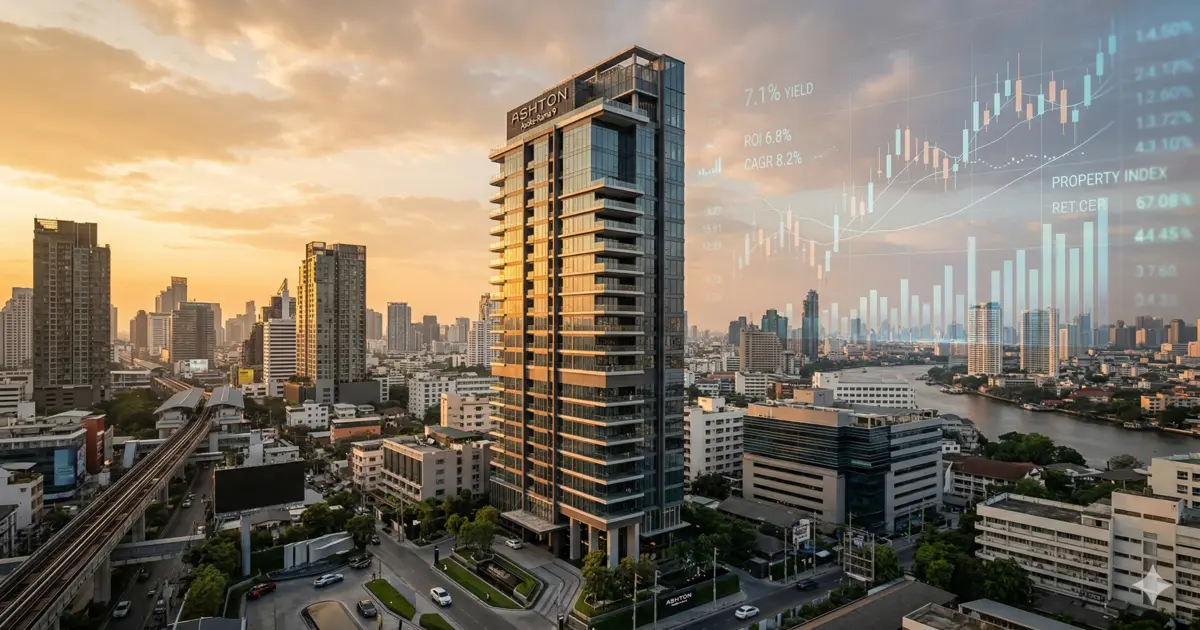
Walk into any property showroom in Bangkok, Phuket, or Pattaya, and you'll hear the same pitch: "6 to 8 percent guaranteed rental returns." The brochures are glossy. The projected income spreadsheets look bulletproof. The developer's sales team will explain how your Thai condo practically pays for itself.
There's just one problem: those numbers are almost always wrong.
After analyzing data from CBRE Thailand, Knight Frank, Savills, JLL, the Bank of Thailand, and 130+ verified sources, we found that actual net rental yields for foreign owners in Thailand typically compress to 3% to 5% once you account for the costs that brochures conveniently omit. For some investors, the real return is even lower.
This isn't a hit piece on Thai real estate. Thailand remains one of Southeast Asia's most compelling property markets. But if you're investing based on advertised gross yields, you're making decisions with incomplete data. Here's the complete picture.
The Promise: 6-8% Returns Everywhere
Developers calculate gross yield using the simplest possible formula: divide projected annual rent by purchase price. A THB 5 million condo renting for THB 30,000 per month? That's THB 360,000 annually, or a tidy 7.2% yield.
This calculation ignores every single cost of ownership. No maintenance. No management fees. No taxes. No vacancy. No currency risk. It's the financial equivalent of calculating your salary without mentioning income tax.
Warning: "Guaranteed Returns" Are Often Self-Funded
Many developers offering "guaranteed 8% returns for 5 years" simply inflate the purchase price by 30-40% and fund the guarantee from your own capital. When the guarantee period ends, you're left with an overpriced asset in an area with no organic demand.
The Global Property Guide reports gross yields for Thailand ranging from 3.03% to 6.69% depending on location and unit size. But even these figures only tell half the story.
The Hidden Costs Nobody Mentions
The gap between gross and net yield is where Thailand property investments live or die. Here's what's actually eating your returns in 2026:
1. CAM Fees and Sinking Funds
Every condominium in Thailand charges Common Area Maintenance (CAM) fees to the building's juristic person. In central Bangkok, these run THB 40 to 90 per square meter per month. For a standard 60-sqm unit at THB 70/sqm, that's THB 50,400 per year whether or not your unit is rented.
On top of that, you pay a one-time sinking fund contribution at purchase (THB 300-900/sqm) for future structural repairs. As buildings age, special assessments for major repairs become increasingly common.
2. Property Management Fees
If you don't live in Thailand, you need a property manager. For long-term rentals, management fees run 8-12% of gross rent. But the real shock comes with short-term rentals: professional Airbnb management in Thailand costs 25-35% of gross revenue. That's not a rounding error. That's a quarter to a third of your income, gone.
3. The Land and Building Tax
The Land and Building Tax Act (2019) introduced an annual property tax that directly impacts foreign investors. Rental properties and secondary residences face rates of 0.02% to 0.30% of government-appraised value. The critical detail: the generous exemptions for primary residences (first THB 50 million) require your name on the house register (Tabien Baan) as of January 1st. Foreign investors renting out units don't qualify.
4. Vacancy: The Cost of Empty Months
No property runs at 100% occupancy. Even in prime Bangkok locations, expect 5-15% vacancy annually from tenant transitions, seasonal dips, and renovation periods. In tourist-dependent areas like Koh Samui, low-season vacancy can hit 30-40%.
5. Furnishing Depreciation
Thailand's tropical climate, with its high humidity and intense heat, accelerates the deterioration of furniture, HVAC systems, and appliances. Budget 1-1.5% of property value annually just to maintain the interior standard tenants expect. Skip this, and your vacancy rate climbs.
6. Utility Gaps During Vacancy
The Consumer Protection Board now mandates that landlords cannot charge above official government utility rates. Security deposits are capped at three months' rent. During vacant periods, you absorb 100% of utility holding costs, and you can no longer offset them through markup.
The Math: How 7% Becomes 3%
Let's run the numbers on a real scenario: a THB 10 million premium condominium in Bangkok, marketed at 7% gross yield.
| Expense Category | Brochure Model | Reality |
|---|---|---|
| Annual Gross Rent | THB 700,000 | THB 630,000 (10% vacancy) |
| CAM Fees | Not mentioned | -THB 60,000 |
| Management Fee (25% blended) | Not mentioned | -THB 157,500 |
| Land & Building Tax | Not mentioned | -THB 20,000 |
| Maintenance & Depreciation | Not mentioned | -THB 75,000 |
| Insurance & Utility Voids | Not mentioned | -THB 15,000 |
| Net Annual Cash Flow | THB 700,000 | THB 302,500 |
| Effective Yield | 7.00% | 3.02% |
The Bottom Line
That "7% yield" condo actually returns 3.02% after real-world costs. The brochure omitted THB 327,500 in annual expenses. That's nearly half your gross rent.
Location Breakdown: Where Yields Actually Hold Up
Thailand's rental market isn't uniform. Yields vary dramatically by location, driven by acquisition costs, tourism volume, and local tenant demand. Here's what 2026 data actually shows:
| Location | Avg. Price/sqm | Long-Term Yield | Short-Term Yield | Primary Driver |
|---|---|---|---|---|
| Bangkok CBD | $7,580 | 3.0-4.5% | 6.0-8.0% | Corporate expats |
| Bangkok Suburbs | $2,215 | 6.0-6.7% | N/A | "Generation Rent" |
| Phuket | $4,295 | 6.0-9.0% | 9.0-12.0% | Luxury tourism |
| Koh Samui | Variable | 5.0-8.0% | 7.0-10.0% | Private villa premium |
| Pattaya | $2,500 | 5.5-7.0% | 8.0-10.0% | EEC industrial growth |
| Chiang Mai | $2,200 | 5.0-6.5% | 7.0-9.0% | Digital nomads |
| Hua Hin | $2,900 | 4.5-6.5% | 7.0-9.0% | Retirees, Bangkok elites |
Key Insight
Bangkok CBD condos are wealth preservation vehicles, not cash-flow generators. The best yields come from Bangkok suburban units near new BTS/MRT stations (cheap to buy, strong demand from local "Generation Rent" tenants) and Phuket luxury properties (high tourism demand, premium pricing power). Search Bangkok condos on BaanRow.
The "Generation Rent" Opportunity in Bangkok
One of Thailand's most underreported trends is the emergence of "Generation Rent" in the capital. Young Thai professionals are structurally locked out of homeownership by tight mortgage lending standards and the country's high household debt levels. This creates stable, long-term demand for rental units near mass transit. Properties within walking distance of new MRT and BTS extensions in areas like Ratchada, Rama 9, and Bang Na consistently achieve 85-95% occupancy at modest but reliable rents.
Phuket: High Reward, High Knowledge Required
Phuket's yields look spectacular on paper, but success is hyper-localized. Bang Tao, Cherng Talay, and Kamala command premium rates driven by scarcity (limited beachfront land) and high-end tourism demand. Generic inland developments 20 minutes from the beach? Severe oversupply and liquidity problems. Know the micro-market or don't invest.
The Airbnb Trap: Legal Risks of Short-Term Rentals
The math behind Airbnb in Thailand looks irresistible. A condo earning THB 1,500/night for 200 nights generates THB 300,000 compared to THB 180,000 from long-term rent. But here's what the Airbnb yield calculators don't account for: it's illegal without a hotel license.
The Hotel Act and the 30-Day Rule
Under Thailand's Hotel Act B.E. 2547 (2004), any property providing accommodation for less than 30 days is classified as a hotel and requires a commercial hotel license. A 2023 amendment allows small-scale operators (4 rooms or fewer, under 20 guests) to register as "non-hotels," but this exemption is practically unavailable to most foreign investors due to Thai nationality requirements and condominium building restrictions.
Juristic Person Enforcement
Most residential condominiums in Bangkok and tourist zones explicitly prohibit short-term rentals in their bylaws. Juristic persons (building management committees) are increasingly aggressive about enforcement, levying fines of up to THB 50,000 plus THB 5,000 per day for ongoing violations.
Government Crackdowns in 2025-2026
The Thai government launched unprecedented multi-agency crackdowns on illegal short-term rentals through 2025-2026. The Tourism Police, Immigration Bureau, and Ministry of Interior are conducting coordinated raids targeting unlicensed properties in Bangkok, Phuket, and Chiang Mai. The TM30 regulation requires landlords to report foreign guests within 24 hours. Airbnb now requires Thai hosts to confirm legal compliance, and properties caught in violation face permanent delisting.
Warning: Risk-Adjusted Airbnb Returns
When you factor in potential fines, legal fees, platform delisting risk, and the inability to operate legally without a hotel license, the risk-adjusted yield of unauthorized Airbnb operations drops dramatically. The theoretical 10% gross becomes a precarious gamble, not a reliable income stream.
The Exit Tax Surprise: What Happens When You Sell
Many foreign investors model their returns based on rental income alone, treating eventual property sale as pure upside. The reality: Thailand's exit costs are among the highest in Southeast Asia.
| Cost | Rate | When It Applies |
|---|---|---|
| Transfer Fee | 2.0% | Always (typically split buyer/seller) |
| Specific Business Tax | 3.3% | If sold within 5 years of purchase |
| Stamp Duty (alternative) | 0.5% | If held over 5 years (replaces SBT) |
| Withholding Tax | 1-3%+ | Progressive scale on appraised value |
| Total Exit Cost (under 5 years) | 4-6.3% | Of gross sale value |
Important: government stimulus measures sometimes reduce transfer fees to 0.01%, but these reductions frequently exclude foreign buyers. Always confirm eligibility before modeling reduced exit costs.
Pro Tip: The 5-Year Rule
Holding for over 5 years avoids the 3.3% Specific Business Tax, reducing total exit costs to approximately 2.5-3.5%. This alone can save you THB 330,000 on a THB 10 million property. Plan your holding period before you buy.
The Leasehold Crisis: A Supreme Court Ruling Changed Everything
For decades, foreign buyers who wanted Thai villas relied on the "30+30+30" leasehold structure: a 30-year registered lease with contractual promises for two automatic renewals. Developers marketed this as "effectively 90-year ownership." It was always legally fragile. In 2023, it broke.
Supreme Court Decision 4655/2566 ruled that automatic lease renewal clauses exceeding the statutory 30-year maximum are void and unenforceable. The Court determined these clauses improperly circumvent Section 540 of the Civil and Commercial Code.
What this means in practice: if your landowner refuses to renew at year 30, or if the land is sold to a third party, you have zero legal recourse to enforce the extension. Billions of baht in foreign-owned leasehold properties saw their long-term value fundamentally degraded overnight.
Impact on Investment Returns
If you hold a leasehold villa, you must now model your returns assuming you have only the registered 30-year lease. The "renewal" periods that justified your purchase price may be worthless. This also severely impacts resale liquidity, since informed buyers now discount leasehold properties accordingly.
Who Actually Makes Money (And Who Loses It All)
The Failure Profile
The classic failure story follows a predictable pattern:
- Buys off-plan in an oversupplied area, lured by "guaranteed 8% returns"
- Purchase price was inflated 30-40% to fund the developer's guarantee
- Guarantee period ends, management company dissolves
- Unit sits empty in an area with no organic demand
- Can't sell without a massive loss due to inflated entry price
Reports indicate that over 60% of property fraud cases in Thailand involve exploitation by fellow nationals acting as unlicensed brokers. The victims are almost always foreign investors who didn't conduct independent due diligence.
The Success Profile
Profitable foreign investors in 2026 share specific characteristics:
- Buy freehold condominiums only in high-demand, transit-adjacent areas
- Target long-term corporate tenants to bypass Hotel Act restrictions
- Maintain 85-95% occupancy by pricing competitively in proven micro-markets
- Actively manage taxes: file Thai returns to claim the 30% standard deduction and recover excess withholding
- Hold for 5+ years to avoid the 3.3% Specific Business Tax
- Invest in hotel-licensed branded residences when pursuing short-term rental income legally
Tax Recovery Tip
Thai tax law allows a 30% standard expense deduction against gross rental income, plus a THB 60,000 personal allowance, without requiring receipts. If your manager withholds 15% at source, filing a return could recover a significant portion. Most foreign investors don't file and leave money on the table.
How Thailand Compares to Dubai, Vietnam, Bali & More
Capital is mobile. If Thailand doesn't deliver, where else should you look? Here's how it stacks up against the most popular alternatives in 2026:
| Country | Gross Yield | Foreign Ownership | Key 2026 Factor |
|---|---|---|---|
| Dubai | 6.5-7.5% | 100% freehold | Zero income tax; 100K unit supply risk |
| Vietnam | 6.0-8.0% | 30% quota, 50yr lease | New Land Law; Viet Kieu capital wave |
| Thailand | 5.0-6.5% | Condo freehold only | Airbnb crackdown; leasehold ruling |
| Bali | 6.0-8.0% | Leasehold / PT PMA | Uluwatu arbitrage; regulatory ambiguity |
| Malaysia | 4.5-5.5% | Freehold land allowed | Strict MM2H deposit mandates |
| Philippines | 4.5-5.5% | 40% condo quota | 19% vacancy; stalled appreciation |
| Portugal | 4.0-5.0% | Full freehold | AL licenses unfrozen; Golden Visa |
Dubai currently outperforms Thailand on pure yield mathematics: higher gross returns, zero income tax, and 100% freehold foreign ownership. But Dubai carries its own risks, particularly a massive supply pipeline of 100,000 units by 2027.
Vietnam is Southeast Asia's growth story with 6.3% GDP growth projected for 2026 and yields of 6-8% in Ho Chi Minh City. The 2024 Land Law has made the market significantly more accessible to overseas Vietnamese investors.
Thailand's competitive advantage isn't raw yield. It's the lifestyle-integrated investment thesis: world-class tourism infrastructure, excellent healthcare, relatively low cost of living, and a mature service economy that makes property management straightforward. For investors who need a place to live part of the year, Thailand offers a combination that pure investment markets like Dubai can't match.
The Smart Investor's Playbook for Thailand 2026
Based on 130+ sources and real-world data, here's what actually works:
7 Rules for Profitable Thailand Property Investment
- Buy freehold condominiums only. After Supreme Court ruling 4655/2566, leasehold structures carry unacceptable renewal risk.
- Model NET yield, not gross. Subtract CAM, management, tax, vacancy, depreciation, and insurance before making decisions. If it doesn't work at 3-4% net, don't buy.
- Plan to hold for 5+ years. The 3.3% Specific Business Tax on early exits destroys returns. Time is your most powerful tax optimization tool.
- Target long-term tenants near transit. Corporate expats and local "Generation Rent" provide stable occupancy without Hotel Act risk.
- File your Thai tax returns. The 30% standard deduction means you likely overpay through withholding. Recover your money.
- Budget for currency hedging. A 6% Baht depreciation can wipe out your entire annual yield. At minimum, understand your exposure.
- Never trust "guaranteed returns." If a developer offers 8% guaranteed, ask yourself: why would they give you that instead of keeping it? Read our guide to property scams.
Thailand's property market in 2026 isn't broken. It's bifurcated. The domestic mass market faces oversupply and stagnant prices. But the foreign-facing luxury segment, transit-adjacent urban rentals, and professionally managed branded residences continue to perform. The key is approaching the market with institutional discipline rather than developer-fed optimism.
The brochure promises 7%. The reality delivers 3%. But 3% net yield in a lifestyle destination with strong tourism fundamentals, excellent healthcare, and low cost of living isn't a failure. It's a realistic baseline on which to build a sustainable investment strategy. Just make sure you're building on reality, not marketing.
Ready to explore Thailand property with real data? Search our listings to see actual asking prices and rental comparisons across 587 properties in Thailand. For more on the legal landscape, read our guides on foreign ownership rules, hidden costs, and Thailand's property tax system.
Sources & References
- CBRE Thailand — 2026 Thailand Real Estate Market Outlook
- Cushman & Wakefield — Thailand Real Estate Market Outlook 2025-2026
- Savills — Thailand Property Market 2026: Strategic Outlook & Emerging Trends
- JLL — Resilient Fundamentals in Thailand's Real Estate Market for 2026
- Global Property Guide — Gross Rental Yields in Thailand: Bangkok and 5 Other Cities
- Bank of Thailand — Residential Property Price Index 2026
- Krungsri Research — Industry Outlook 2025-2027: Housing in BMR
- Tilleke & Gibbins — New Land and Building Tax Act in Thailand
- HLB Thailand — New Property Tax Law in Thailand
- Thai Law Online — Airbnb In Thailand: Laws, Licenses & Legal Risks
- Rental Tax Thailand — Crackdown on Short-term Condo Rentals
- Siam Legal International — Thailand Property Outlook 2026
- Global Property Guide — Thailand Residential Property Market Analysis 2026
- Mordor Intelligence — Thailand Residential Real Estate Market Analysis
- Titan Wealth International — Thailand New Tax Law for Expats
This article was researched using Gemini Deep Research (130+ verified sources including CBRE, Knight Frank, Savills, JLL, Bank of Thailand, and Global Property Guide) and written with AI assistance. All data points are sourced from publicly available reports and verified against multiple sources. Last updated: April 2026.