Phuket Low Season Is the Worst Time to Buy Property — Here's What the Rains Hide
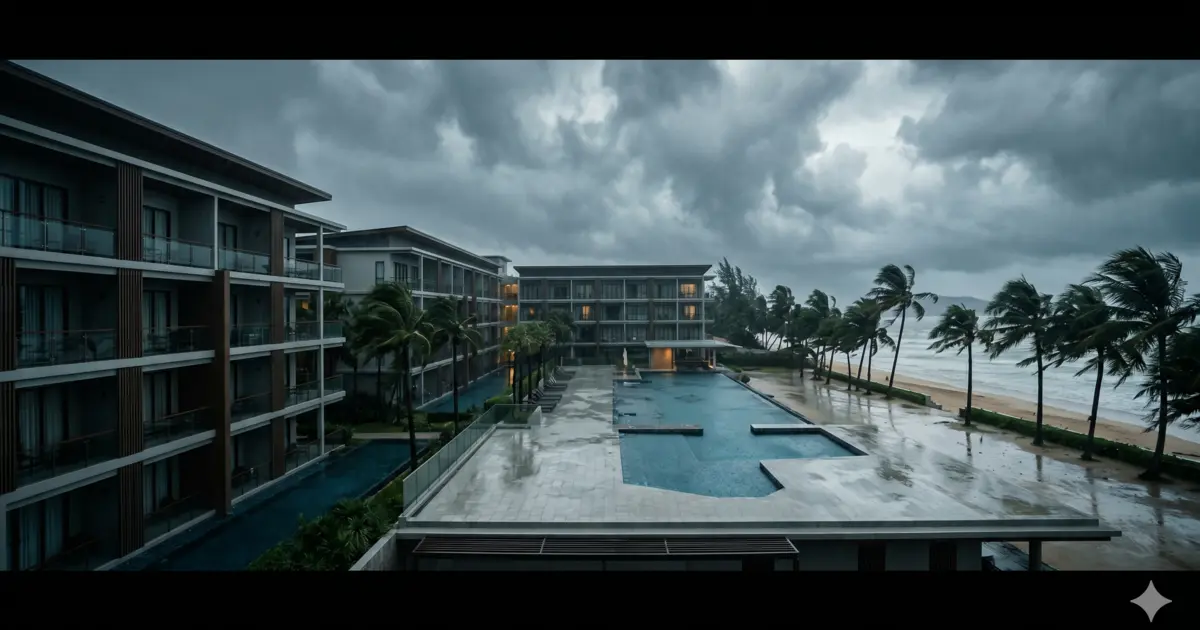
The Low Season Fallacy — Why "Best Deals" Is a Trap
Walk into any Phuket property office in July and the pitch is identical: "Low season is when sellers get nervous. Fewer tourists, more inventory, real bargaining power. Come during the rains and you'll save 5 to 10 percent." It is, in short, the conventional wisdom of every glossy real estate brochure on the island.
The problem is that the conventional wisdom is selling you the wrong frame. The "low season" is the worst possible window in which to evaluate a Phuket property — because the very stresses that determine whether the building, the neighbourhood and the rental case actually work are invisible from May to October. You can negotiate harder, yes. You also cannot see what you are buying.
Key Takeaway
Phuket has two completely different operating modes. Monsoon mode (May to October) hides utility load, traffic, and community signals. Peak mode (December to March) reveals them brutally. Buying after a low-season inspection is buying half the data.
This article — built on data verified by Knight Frank Thailand, CBRE Thailand, the Real Estate Information Center (REIC), and AirDNA — walks through six places where a low-season inspection lies to you, with exact roads, districts and yield numbers. At the end you get two checklists: one for peak-season due diligence, and one for the few useful things only the rains will show you.
Section 1 — Hidden Failures Visible Only in Peak Season
The District Map of Drainage Failure
The August 2024 Nakkerd Hills landslide in Karon — 13 fatalities and over 200 homes destroyed — was not just a natural disaster. It was a structural revelation: many hillside developments in Karon and Kata lack the retaining infrastructure to hold soil saturation through the late monsoon. The rain in July looks dramatic from a balcony. The damage is structural, and it shows up later.
Drainage failure in Phuket is district-specific, not island-wide:
| District | Dominant Risk | Specific Failure Points 2024-2025 |
|---|---|---|
| Patong | Low-lying basin flooding | Flash flooding in central town; drainage backflow on beach roads |
| Karon | Gradient saturation, landslide risk | Nakkerd Hills (Big Buddha) instability; Soi Patak 2 structural failures |
| Kata | Surface runoff and erosion | High-velocity hillside runoff hitting lower-tier luxury villas |
| Rawai | Coastal inundation | Pier-area flooding; Saiyuan Road drainage bottlenecks |
| Chalong | Low-elevation accumulation | Chalong Circle drainage failure; Soi Sunrise inundation at high tide |
| Cherngtalay | Construction-site runoff | Flash floods on Soi 14 and 16; canal overflow in Layan-Pasak corridor |
A buyer in low season sees a wet road and frowns. They don't see the more dangerous condition: tide-locked drainage in the high season, when sea levels rise alongside heavy rain and the water has nowhere to go. Old Town Phuket, despite being prone to flash floods, actually has a more historically tested drainage network than the rapidly developed Cherngtalay-Bang Tao corridor.
The Peak-Season Utility Paradox
Low season's problem is too much water. Peak season's problem — paradoxically — is too little. In early 2025, several luxury pool villa developments in the Layan and Pasak corridors had to buy water from private tankers when 90 percent island-wide occupancy broke the local municipal supply. That cost lands on the Homeowners Association sinking fund. It does not show up in the brochure.
Warning
Inspect a villa in July and the pool is crystal clear, the water pressure is excellent, and the pump room is quiet. None of that tells you whether the building has water security in February. Ask for the HOA's emergency water tanker invoices for January-March — that's the only honest answer.
Power and bandwidth follow the same load curve. January 2025 hit 92 percent island occupancy and Bang Tao and Kamala suffered transformer overloads from simultaneous AC use. 5G that delivers 200 Mbps in June can collapse to 5 to 20 Mbps in January as towers saturate. If you are buying for digital nomad rental income, you are buying bandwidth — and bandwidth gets tested only when neighbours are home.
The Renovation Cycle Trick
Under the Building Control Act B.E. 2522, most Phuket condominium juristic persons (the management body) restrict heavy renovation work to the months of May through October — to protect peak-season guests from noise. So a buyer who visits in July, charmed by the quiet, is often signing a contract on a building that will be a construction zone the following summer. The "true noise floor" of a community — neighbours, pumps, walls' acoustic integrity — is only audible when the building is at 100 percent capacity.
Section 2 — The Rental Yield Illusion (Peak-Only Maths)
The most common deception in Phuket sales decks is the "average yearly yield" — quietly calculated using only the December 15 to January 15 festive peak. In 2024 the Average Daily Rate (ADR) for upper-upscale Phuket hotels and villas surged 43 percent. Developers use that outlier to promise "guaranteed" 8 to 10 percent net yields. The reality, when you factor in low-season void periods, is much closer to 5 to 8 percent — and the variance between projected and realised matters enormously.
| Metric | Peak (Dec-Mar) | Low (May-Oct) | Annual Blended |
|---|---|---|---|
| Occupancy Rate | 82 to 92 percent | 51 to 60 percent | ~65 percent |
| Luxury Villa ADR | THB 18,000 to 45,000 | THB 6,000 to 12,000 | THB 11,400 |
| Condo Net Yield | 7.5 percent (projected) | 2.5 percent (realised) | 5.0 to 6.1 percent |
| Villa Net Yield | 12.0 percent (projected) | 4.0 percent (realised) | 7.2 to 8.4 percent |
And those "net yields" are themselves frequently gross. Operating costs for short-term rentals consume 25 to 33 percent of gross income — platform fees alone (Airbnb, Agoda, Booking) take 15 to 20 percent, before cleaning, peak-season utility surcharges and management. If you are looking at a glossy ROI calculator from a developer, ask which of those costs has been deducted. Usually it's none of them.
Phuket Versus Bangkok Versus Pattaya
Phuket offers the highest reward in the Thai market — and the highest seasonal risk. Bangkok is the loyalty market, with corporate and expat tenants delivering 5 to 7 percent net yields year-round. Pattaya has a Friday-Sunday domestic spike that stabilises its low season. Phuket's low season relies almost entirely on the volatile Russian and Indian inbound markets — and a buyer who has never seen the building when those markets are off is buying optionality without seeing the exercise price.
Section 3 — The Ghost-Town Community Problem
In Phuket's low season, many condominium developments run below 30 percent occupancy. A buyer visiting a development in June walks the corridors, sees the empty pool, and concludes they have found a private oasis. By December the same building is at 90 percent — frequently because 70 percent of the units are short-term rentals. The "oasis" turns into a hotel with strangers wheeling suitcases through the lobby at 3 AM.
Warning: The True Vacancy Rate
The number that matters is not "occupancy" — it's the percentage of units owned by full-time residents versus short-term rental investors. Walking the building at 8 PM in the high season and counting balcony lights gives you that. Walking it in low season tells you nothing.
Building management is the same. Any juristic person can keep a quiet building clean. The real test is whether the lift wait times, trash systems, security response to "party villas," and pool maintenance hold up at 90 percent capacity. A low-season inspection is a car test that never gets above 30 km/h.
Section 4 — Infrastructure and the 2025-2026 Oversupply
The Light Rail Promise (And Its Real Timeline)
Every developer pitch in Phuket leads with the Light Rail Transit (LRT). The actual timeline as of 2025 is far less generous than the brochure. Cabinet approval for the Public-Private Partnership is not projected until February 2027, with construction starting September 2028 and full operations December 2031. A buyer paying a "proximity premium" today is subsidising six years of construction noise before the first train runs.
The 50-billion-baht "Synthesis Ark" Smart City project on Thepkrasattri opens its first phase (NEXUS) in 2028. These projects matter long-term — they shift Phuket toward a primary-residence hub for digital nomads and Thai elites — but they do nothing for traffic this year.
High-Season Traffic Is the Hidden Tax
| Road / Area | Peak-Season Reality | Low-Season Sales Pitch |
|---|---|---|
| Route 402 Northbound | 1km tailbacks at Heroines Monument and Koh Kaew | "Fast access to airport" |
| Patong Beach Road | 1 hour to cross 3km of town | "Easy parking, central access" |
| Chao Fa East | 90 minutes to Phuket Town on weeknights | "Convenient school-run location" |
| Cherngtalay Soi 14/16 | 3km journey takes 1.5 hours due to construction | "Emerging quiet luxury zone" |
Police officials have publicly admitted to having "no specific strategy" for the worsening high-season traffic. A villa in Bang Tao that maps as "15 minutes to airport" in May is "90 minutes to airport" in January. That is not a sales-pitch issue — it is a fundamental rental-yield issue, because guests notice immediately and the reviews follow.
The 2025-2026 Supply Pipeline
The supply data tells its own story. Knight Frank and CBRE recorded 14,454 condo units launched in 2024 alone. By H1 2025, launches and sales had contracted more than 50 percent year-on-year, leaving 10,466 unsold units valued at THB 88 billion. The market is cooling — and certain districts are at extreme oversupply risk.
- Bang Tao: 59.6 percent of all 2024 launches landed here. The branded-residence pipeline alone is unprecedented.
- Cherngtalay and Layan: Massive branded-residence pipeline that may struggle to hit projected occupancy.
- Naiharn and Rawai: Limited land but high density of compact condos competing against an active resale market.
The single most expensive miscalculation a foreign buyer makes is the off-plan vs resale gap. In 2024, off-plan averaged THB 121,000 per square metre while resale (often in better locations) averaged just THB 68,000. That is a 78 percent newness premium for an asset entering a saturated market in 2026. A low-season buyer who only visits new developer showrooms never sees the resale comparison. A peak-season buyer can walk into the lobby of the building they are pricing and see what the upstairs neighbour is actually asking.
Section 5 — Foreign Quota, FX, and the Songkran Paperwork Trap
The Currency That Eats the Discount
The Thai Baht has been notably volatile against the USD, EUR, and RUB through 2024 and 2025. A foreign buyer waiting for a "low-season 5 percent discount" can easily lose 7 percent on currency in the same window. A 2 to 5 percent surcharge applies as of 2025 to properties valued above THB 10 million (~$300,000 USD), which most international buyers do not budget for. The "deal" becomes maths-neutral very quickly.
Foreign Quota: First-Come, First-Served
The Thai Condominium Act B.E. 2522 caps foreign freehold ownership at 49 percent of a building's sellable area. In high-demand projects in Bang Tao and Kamala, that quota typically sells out during pre-launch or the December-January rush. A buyer arriving in low season is left with leasehold options — and despite agent assurances about "30+30+30 year renewals," the law caps registration at 30 years.
Warning: The March 2025 Supreme Court Ruling
A landmark Supreme Court decision on 18 March 2025 reinforced that contractual lease renewals are not automatically enforceable against future landowners. Buying leasehold in low season — when freehold quota is gone — is structurally inferior, not just paperwork.
The Songkran and Buddhist Lent Slowdown
From mid-April Songkran through the end of Buddhist Lent in October, the Phuket Land Office and municipal departments operate on skeleton crews. Title checks, lien searches and building permit verifications take twice as long. A buyer on a 10-day inspection trip in August often cannot complete title due diligence before flying home — which leads to a "reservation" signed on incomplete data, which leads to lawyers' bills.
Many emerging-zone developments (Phru Champa, Manik) sit on Nor Sor 3 Gor titles rather than full Chanote. Upgrading those titles requires a 30-day public notice and a precise survey — which is materially harder during the monsoon, when surveyors cannot establish accurate boundaries. "Boundary creep" disputes with neighbours then surface a year later.
Peak-Season Stress-Test Checklist (December to March)
If you are serious about Phuket, the inspection trip you should be paying for is the one at peak. This is what to actually test:
- Utility stress test. Visit the development at 8 PM during a 90 percent occupancy week. Run the unit's water — if the pressure is low, the pumps are failing under load.
- Traffic mapping. Use a GPS app to time the commute from the property to the airport at 4 PM on a Tuesday. If it exceeds 60 minutes, the short-term rental case is compromised.
- Acoustic vetting. Spend one hour in the unit with the balcony door open. Can you hear the beach club bass from a kilometre away? In low season they are quiet — in peak they are a 2 AM noise liability.
- Management audit. Request the juristic person's sinking-fund report for February. If they are dipping into reserves to pay for emergency water tankers, the HOA fee is going up.
- Mobile bandwidth check. Run a 5G speed test in the unit at 9 PM peak streaming. Below 20 Mbps means the building lacks the localised infrastructure for digital nomad tenants.
Low-Season Inspection Checklist (May to October)
The low season is not useless — it is the only window for certain inspections. Use it deliberately:
- Drainage integrity. Visit during a heavy downpour. Look for pooling in underground parking and cascading water on hillside retaining walls.
- Monsoon mould check. Inspect the back of built-in wardrobes and the undersides of bathroom sinks. Black spots mean the ventilation system cannot handle Phuket's 90 percent humidity.
- Renovation log. Ask for a list of all work permits issued for the building in the next 12 months. If 20 units are scheduled for renovation, the building will be a construction zone next summer.
- Landslide risk for hillside. For Karon or Kata properties, demand an independent soil-stability report or an Environmental Impact Assessment that specifically addresses the post-2024 Nakkerd Hills saturation data.
Bottom Line
"Buy low, sell high" works for stocks. For Phuket property, buy after a peak-season stress test and use the low-season visit to verify drainage, mould and renovation cycles. The 5 percent low-season discount is not worth the 30 percent operational reality you cannot see in July.
If you want to start with a more honest browse, see current Phuket listings, or read our analysis of other Thai real estate myths on the blog. On our platform we cross-list both off-plan and resale, which is the comparison most low-season buyers never see.
Sources and References
- Knight Frank Thailand Research — 2024-2025 Phuket condominium and villa supply, off-plan vs resale pricing data
- CBRE Thailand Insights — H1 2025 launch contraction and unsold inventory analysis
- Real Estate Information Center (REIC) — Official Thai property registry data and supply pipeline figures
- Krisdika — Office of the Council of State — Condominium Act B.E. 2522 and Building Control Act B.E. 2522 source text
- AirDNA Phuket Market Data — 2024-2025 short-term rental ADR and occupancy by district
- The Phuket News — August 2024 Nakkerd Hills landslide reporting and district flood incidents
- Bangkok Post Property Section — Thai Baht volatility and luxury property surcharge coverage
- The Thaiger — Phuket Light Rail Transit timeline updates and Smart City project reporting
- Coconuts Bangkok — Peak-season traffic congestion reporting and Phuket police statements
- Tilleke and Gibbins Legal Insights — March 2025 Supreme Court ruling on lease renewal enforceability
- Mazars Thailand — Foreign quota due diligence and Chanote vs Nor Sor 3 Gor title verification
- FazWaz Phuket Analytics — District-level rental yield and occupancy benchmarks
This article was researched using Gemini Deep Research across 46 verified sources and written with AI assistance. Last updated: 4 May 2026.