Property Inheritance in Thailand: What Happens When a Foreign Owner Dies (2026)
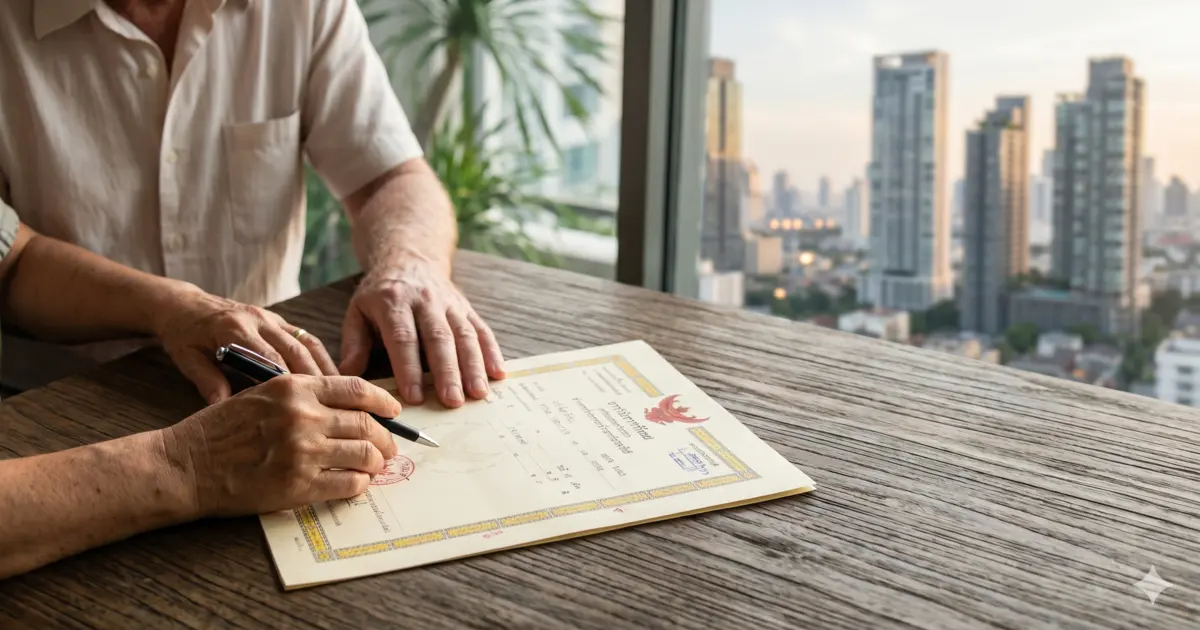
A foreign-owned condo in Bangkok or a Phuket villa held through a Thai company looks the same on the day you buy it as it does the day before you die. What changes is everything that happens next. By 2026, Thailand has tightened nearly every inheritance pathway that foreign owners used to rely on — the March 2026 Ministerial Regulation on Will registration, the 2025 Supreme Court ruling that killed the "90-year lease" myth, and the Department of Business Development's anti-nominee crackdown under Orders 2/2568 and 1/2569 have collectively turned soft "we'll figure it out later" planning into hard liability.
This is the pillar guide for foreign owners and Thai-foreign families. It covers what the Civil and Commercial Code, the Land Code, and the Condominium Act actually say about your estate — with section numbers, real costs in Thai baht, and the mistakes that cost real heirs real money. If you own anything in Thailand and you do not have a Thai will, this is the page to read first.
The 30-Second Version
Thai assets devolve to your heirs the moment you die (CCC §1599) — but no bank or Land Office will move a baht without a Thai court order. Foreigners can inherit a condo if the building's foreign quota allows it; otherwise the heir has 1 year to sell. Foreigners can inherit land but must dispose of it within 1 year. A Thai will plus a separate home-country will is the cleanest setup. Inheritance tax kicks in only above 100 million THB per heir.
Why Inheritance Planning Matters More in 2026
Three regulatory changes in the last 18 months have closed the soft edges of Thai estate planning:
- March 2026 Ministerial Regulation on Wills — district offices (Amphur) now perform formal mental-capacity verification before accepting a will for registration, and they can refuse if they suspect coercion. The bar is higher than the casual signing process most owners assumed.
- Supreme Court Judgment 4655/2566 (March 2025) — the Dika court held that pre-agreed lease renewals signed on the same day as the original lease are void because they evade the 30-year statutory cap in Civil Code §540. The "30+30+30 = 90-year lease" sales pitch is now legally indefensible.
- DBD Order 1/2569 (April 2026) — directors of Thai companies that hold land face personal criminal liability (up to three years' imprisonment) for false declarations that the Thai shareholders are not nominees. Inheritance is when these structures get audited the hardest, because heirs trigger corporate filings.
The pattern is clear: 2026 rewards owners with documented, transparent structures and punishes anyone relying on side agreements, undated promises, or "trust me, my Thai partner is fine."
Thai Inheritance Law: the Foundation
Thai succession is codified in Book 6 of the Civil and Commercial Code (CCC), Sections 1599–1755. Two principles drive everything else.
1. The estate transfers at the moment of death (§1599)
The estate of a deceased person — called the de cujus in Thai legal parlance — devolves on the heirs immediately upon death. This is a legal fiction: in practice, no Land Office, bank, or condo juristic person will record a transfer until a Thai court appoints an estate administrator. The fiction matters because it means assets never sit in an ownership vacuum, which protects against creditors trying to claim "abandoned" property.
2. Six classes of statutory heirs (§1629)
If you die without a will (intestate), Thai law distributes your estate strictly down a class hierarchy. A higher class excludes lower classes — except parents (Class 2), who share with descendants (Class 1).
| Class | Statutory Heirs | CCC Section |
|---|---|---|
| 1 | Descendants (children, grandchildren) | §1629(1) |
| 2 | Parents | §1629(2) |
| 3 | Brothers and sisters of full blood | §1629(3) |
| 4 | Brothers and sisters of half blood | §1629(4) |
| 5 | Grandparents | §1629(5) |
| 6 | Uncles and aunts | §1629(6) |
3. The surviving spouse gets a separate floating share (§1635)
The spouse is not in the six-class hierarchy — they sit on top of it. How much they get depends on which class of relatives also survives:
| Surviving heirs alongside spouse | Spouse's share | Section |
|---|---|---|
| Children (Class 1) | Equal share with one child | §1635(1) |
| Parents or full siblings (Class 2/3) | One-half of the estate | §1635(2) |
| Other relatives (Class 4–6) | Two-thirds of the estate | §1635(3) |
| No statutory heirs at all | Entire estate | §1635(4) |
This matters in mixed-nationality marriages. If a foreign husband dies intestate, his Thai wife does not automatically inherit everything — she shares with his parents back in his home country, or with children from previous marriages. That sharing process can paralyze a probate for years if those relatives cannot be located.
4. No forced heirship — full testamentary freedom
Thailand does not impose the "reserved portion" (legitime) found in France, Japan, or Spain. Under §1608, a testator can disinherit any statutory heir explicitly, and a will can dispose of the entire estate to anyone — partner, charity, foundation. This is one of the most foreigner-friendly aspects of Thai law: your will, not your family tree, controls your estate. But it only works if the will exists, is valid, and is enforceable in a Thai court. Anything not specifically mentioned in the will reverts to intestate distribution.
Condominium Inheritance: the 49% Quota and the 1-Year Rules
A condominium is the only freehold real property a foreign individual can hold in Thailand. The framework comes from the Condominium Act B.E. 2522 (1979) and its amendments, particularly Section 19 bis, which caps foreign ownership of any single building at 49% of the total saleable floor area. Inheritance interacts with that cap in three different ways depending on who the heir is.
For background on how foreigners buy condos in the first place, see our complete 2026 condo-buying guide — it explains the FET form (Foreign Exchange Transaction certificate) which becomes critical at inheritance.
Heir is a "qualified" foreigner under §19, quota has room
This is the easy case. A "qualified" heir is anyone who meets the §19 criteria: permanent resident, BOI investment certificate holder, or — most commonly — someone with FET-form proof of foreign currency remittance. If the deceased owner had a valid FET form on file, the Land Department's standing interpretation is that the heir inherits the qualifying status. The heir does not need to remit a fresh equivalent sum from abroad. Provided the building's foreign quota stays at or under 49%, the title transfers normally after probate.
Heir is qualified but quota would be exceeded — §19 quinque
If registering the unit in the foreign heir's name would push the building over 49%, §19 quinque kicks in. The heir cannot register and must sell within 1 year. This is the rule that surprises Thai-foreign families the most: even a fully-qualified foreign spouse can be forced to liquidate an inherited unit purely because the building's foreign-quota count moved while they were not paying attention.
Heir is not qualified — §19 septem
If the foreign heir does not meet any §19 criteria — they have no FET-tied funds, no PR, no BOI certificate — they fall under §19 septem. They must:
- Notify the Land Department in writing within 60 days of acquisition.
- Sell the unit within 1 year.
If you miss the 1-year deadline
The Director-General of the Land Department has statutory authority to auction the property. The government deducts a 5% fee from the gross proceeds before the balance — net of taxes and costs — is returned to the heir. This is not a hypothetical penalty; it is the published default outcome.
Documents needed at the Land Office
The estate administrator presents the following at the local Land Office to register the inherited unit:
- Original title deed (โฉนด, Chanote, or condo unit title)
- Certified copy of the court order appointing the estate administrator
- Death certificate, translated and legalized through the Thai Ministry of Foreign Affairs
- Original will (if applicable)
- Original FET form or other §19-qualification evidence from the deceased's purchase
- "No Debt" certificate from the condo juristic person confirming common-area fees are paid
The registration is then subject to a 30-day public notice period to allow other potential heirs or claimants to surface.
Land Inheritance: Why Foreigners Cannot Keep What They Inherit
The Land Code B.E. 2497 (1954) is the constitutional document of Thai property restrictions. Under §86, foreigners cannot acquire land except via a treaty — and no such treaty currently exists. This is the rule that creates the most painful inheritance outcomes.
§93 — inherit the land, but you have to sell it
A foreigner can receive land as a statutory heir (e.g., from a Thai spouse). But §93 requires the heir to apply for ministerial permission to retain ownership, and that permission is essentially never granted in practice. Instead, the heir is given 1 year from the date of registered transfer to dispose of the land. Failure triggers §94, the forced-sale provision.
Note the timing: the 1-year clock does not start at death. It starts when the title is finally registered into the heir's name after probate concludes. So a slow probate gives the heir more selling runway — but also more time for the property to deteriorate, the market to move, or family disputes to harden.
§96 bis — the 40-million-baht exemption does not transfer
The 1999 amendment to the Land Code added §96 bis, allowing high-net-worth foreign investors to own up to 1 rai (1,600 m²) of residential land if they invest 40 million THB in approved Thai bonds or assets and hold the investment for at least five years. If you hold land under this provision, here is the critical point: the exemption is personal and non-transferable. Upon your death, your foreign heirs do not inherit the §96 bis status. The land falls back under the standard §93 disposal rule — sell within one year.
If §96 bis sounds familiar, it is the same regulatory family as the recent 3M Investment Visa programme — both reward documented capital inflow but neither survives the original investor's death intact.
Thai-company-owned land — shares pass, but the company gets audited
The most common workaround for foreigners who want practical control over land is the 49/51 Thai limited company: 49% foreign-owned shares, 51% Thai-owned. The shares themselves are personal property and can pass to foreign heirs without the §93 1-year rule. But the moment heirs file to take control of the company, they trigger DBD review.
Under DBD Orders 2/2568 and 1/2569, any change in directors or shareholders in a foreign-involved company now requires Thai shareholders to produce 3-month bank statements proving they used their own funds for the original share purchase. If the inheritance reveals that the Thai shareholders were nominees — proxies funded by the deceased — the company can be ordered to dispose of the land, and the surviving directors face criminal liability under the Foreign Business Act. Inheritance is when nominee structures get caught.
Leases, Usufructs, Superficies — What Survives Death
Beyond freehold, foreigners often hold real-property rights through long-term leaseholds (30 years), usufructs (สิทธิเก็บกิน), superficies (สิทธิเหนือพื้นดิน), or rights of habitation (สิทธิอาศัย). These rights have very different outcomes at death.
| Right | Survives Death? | Why |
|---|---|---|
| Leasehold (30 years) | No, unless succession clause | Personal right (jus in personam) under Civil Code |
| Usufruct | No — terminates automatically | Ends at usufructuary's death |
| Superficies | Yes — inheritable | Real right (jus in rem) attached to title |
| Habitation | No — terminates automatically | Personal residential right only |
The 90-Year Lease Myth Is Dead
Supreme Court Judgment 4655/2566 (March 2025) held that pre-agreed renewal clauses signed on the same day as the original lease are void as evasion of the 30-year cap in Civil Code §540. Heirs cannot enforce a "90-year" lease the seller promised — they get whatever years remain on the original 30-year term, and only if a written succession clause exists.
The practical takeaway: if you hold a long-term lease, check whether your contract contains an explicit succession clause that binds the lessor to register a fresh lease for your heirs. If not, your lease may evaporate at your death and the landlord can lawfully retake the property. Many investors in 2026 are layering a registered superficies (which does inherit) on top of the lease so heirs at least retain ownership of the buildings while the land question gets renegotiated.
Wills in Thailand: 5 Types and the Two-Will Strategy
Thai law recognizes five types of valid will under CCC §1656–1672. They are not equally robust.
The five forms
- Ordinary Written (§1656) — typed, signed by testator in the presence of two witnesses who also sign. Most common for professionally drafted wills. Adequate if witnesses are findable years later.
- Holographic (§1657) — entirely handwritten, dated, and signed by the testator. No witnesses needed. One typed word renders it void. The most common cause of holographic-will failure is mixing in a printed letterhead.
- Public Document (§1658) — testator declares wishes orally to a District Officer (Nai Amphur) before two witnesses; the officer records and registers the will. Highest evidentiary weight in court — recommended for foreign owners post-March 2026 regulation.
- Secret Document (§1660) — sealed in an envelope and lodged with the District Office. Less common; useful if testator wants confidentiality during life.
- Oral Will (§1663) — only valid in extreme emergencies (war, imminent death). Two witnesses must report immediately to a District Officer. Almost never relevant in practice.
Foreign wills are recognized — but slow
Under the Conflict of Laws Act B.E. 2481, a foreign will is legally valid in Thailand if it was validly executed under the laws of the country of execution. In practice, enforcing one in 2026 is administratively heavy:
- Translate the entire will into Thai through an MFA-certified translator.
- Notarize and legalize the document at the Thai Embassy in the country of execution.
- Petition a Thai court to formally recognize the will — this can add several months to probate while the court verifies foreign legal standing.
The two-will strategy (recommended)
The professional standard for foreign owners with assets in multiple countries is to maintain two separate wills:
- A Thai will covering only Thai-situated assets (condo, bank accounts, vehicles, shares in Thai companies)
- A home-country will covering everything else
Each will should explicitly carve out the other jurisdiction's assets to prevent revocation conflicts. With this setup, the Thai probate can begin immediately on the Thai assets without waiting for foreign probate to conclude — typically saving 6–12 months of administrative drift.
Marriage Does Not Revoke a Thai Will
Unlike English law, marrying in Thailand does not automatically revoke an existing will. But it does add a statutory heir whose claims can complicate distribution. If you marry after writing your will, redo the will — do not assume the marriage rewrote it.
Probate (จัดการมรดก): Timeline, Costs, Documents
Probate is the court process of validating a will (if one exists) and appointing an estate administrator (ผู้จัดการมรดก) to actually move the assets. Thai banks freeze accounts on receipt of a death certificate; Land Offices refuse to record any transfer; condo juristic persons withhold common-area access. Without a court-issued administrator order, the estate is paralyzed — even with a flawless will.
Typical 2026 timeline
| Phase | Duration | Activity |
|---|---|---|
| Preparation | 1–3 weeks | Document gathering, translations, MFA legalizations |
| Petition Filing | ~1 week | File at the Civil Court of the deceased's last domicile |
| Court Public Notice | 60–90 days | Mandatory notice for creditors and rival claimants |
| Court Hearing | 1 day | Petitioner testifies in person (generally required) |
| Order Issued | 2–4 weeks | Court issues official appointment order |
| Appeal Period | 30 days | Mandatory wait before order becomes final |
| Total | 3–9 months | Then assets can actually be transferred |
Realistic 2026 costs
- Court filing fee: 200 THB (statutory)
- Lawyer fees: 50,000–300,000 THB depending on complexity, asset count, and contested status
- Translation and MFA legalization: 10,000–30,000 THB for a standard foreign estate (death certificate, foreign will, birth/marriage certificates of heirs)
- Court appearance travel: budget for at least one round trip to Thailand for a foreign petitioner, or hire a Thai-resident administrator to appear on the heirs' behalf
An uncontested foreign estate with a clean Thai will and a Thai-resident administrator usually lands at the lower end of the range. A contested estate with foreign-only heirs, no Thai will, and assets in multiple provinces can easily exceed 500,000 THB in legal fees alone.
Death certificate legalization in 2026
Thailand's Ministry of Foreign Affairs replaced the traditional green-stamp legalization with a digital QR code and transparent security seal in 2025. Heirs presenting older legalized documents may be asked to re-legalize under the new format. Budget extra time for this if the death occurred outside Thailand and the certificate was legalized abroad.
Thai Inheritance Tax: the 100M Threshold
The Inheritance Tax Act B.E. 2558 (2015) applies equally to Thai and foreign heirs receiving assets situated in Thailand. The structure is unusually generous compared to most developed jurisdictions because it taxes only the portion per heir exceeding 100 million THB from a single decedent. Most estates pay nothing.
| Heir Relationship | Tax Rate Above 100M THB |
|---|---|
| Surviving spouse | 0% — fully exempt |
| Descendants and ancestors (children, parents) | 5% |
| All other heirs (siblings, friends, charities, etc.) | 10% |
How property is valued
Real estate is valued at the government appraised value recorded by the Land Department, not the open-market price. Government appraisals run roughly 30–50% below market in most areas, which often pushes single-property estates well below the 100M THB threshold. Listed securities and bank deposits are valued at the date-of-death balance.
Filing timeline
Heirs must file the inheritance tax return and pay any tax due within 150 days of receiving the inheritance. The Land Department now automatically notifies the Revenue Department when a registered transfer occurs, so the deadline is increasingly hard to miss without consequence. Late-filing penalties compound monthly.
Real-World Scenarios with Numbers
Scenario 1 — British husband, Thai wife, no Thai will
James, a 62-year-old British national, dies of a heart attack at his Bangkok condo, valued at 15 million THB. He has a Thai wife and two adult children from his first marriage in the UK. He never wrote a Thai will.
Distribution under §1635(1): estate is divided equally between wife and two children — three equal shares of 5 million THB each.
Practical complication: the Thai wife must locate, notify, and obtain consent letters from both UK children before probate can complete. If either child refuses to sign or cannot be reached, the case stalls. Realistic delay: 12–24 months.
Tax: 0 THB. Each heir's share is well below the 100M THB threshold.
Scenario 2 — Australian couple, jointly owned condo
An Australian couple co-owns a Phuket condo, both qualified §19 buyers with FET forms. The husband dies. The condo is held 50/50, valued at 12 million THB total.
Outcome: the surviving wife inherits the husband's 50% via a properly drafted Thai will. Because she inherits the §19 qualification, the Land Department transfers the title to her as a qualified foreigner — provided the building's foreign quota remains under 49% (which it almost always does in foreigner-heavy projects).
Tax: 0 THB — spousal exemption.
Scenario 3 — Foreign owner of a Thai-company-held villa, dies suddenly
A 55-year-old American holds a Phuket villa through a Thai limited company: 49% his foreign shares, 51% held by his Thai gardener and accountant as nominees. He dies of a stroke.
Outcome: His foreign shares pass to his US-based daughter as personal property. To take operational control of the company, she must appoint herself or a representative as director. Under DBD Order 1/2569, the new director must submit an Investment Confirmation Letter and the existing Thai shareholders must produce 3-month bank statements proving they originally funded their shares.
Risk: the gardener and accountant cannot produce the bank statements (they did not actually pay for their shares). The DBD flags the company as a nominee structure. The land may be ordered for forced sale, and the surviving directors face potential criminal liability. The daughter inherits a 5–8M THB legal nightmare instead of a 25M THB asset.
Scenario 4 — 30-year leaseholder dies at year 10
A French national signed a 30-year lease on a Hua Hin villa in 2016 for 10M THB upfront. He dies in 2026, with 20 years of theoretical lease remaining.
If the lease has a written succession clause binding the lessor to register a fresh lease for the heirs: the heirs continue, subject to a new registration and its associated 1.1% Land Department fee.
If the lease has no succession clause: it terminates at death. The lessor lawfully reclaims the villa. The heirs lose the unamortized 10M THB. This is the single most common foreign-leasehold inheritance loss in Thailand.
2026 Estate Planning Checklist
If you own anything in Thailand and you have not done these six things, do them this year:
- Draft a jurisdiction-specific Thai will. Cover only Thai-situated assets. Use a qualified Thai lawyer. Cost: 10,000–30,000 THB.
- Appoint a local executor or administrator. Name a trusted Thai-resident person or law firm. They must be able to physically appear at the Civil Court when probate is heard.
- Register the will at the Amphur as a Public Document (§1658). This adds the strongest possible evidentiary weight against later challenges. District office fees: 200–400 THB plus your lawyer's accompaniment fee.
- If you hold land via a Thai company, audit the structure now. Make sure your Thai shareholders have legitimate 3-month bank statements showing they paid for their shares. If they cannot, restructure before death — not after.
- Review every leasehold for a succession clause. Confirm it explicitly binds the lessor to the heirs. If missing, renegotiate before relying on the lease as inheritable wealth.
- Keep your FET forms and §19-qualification proof in a single accessible folder. Tell your heirs where it is. Without these documents, qualified-heir status is provable but slow; without them at all, it is a §19 septem case.
For those still in the buying phase, our 2026 best-areas buying guide walks through how to choose a property type that simplifies inheritance from day one — single-name freehold condos in foreigner-friendly buildings consistently produce the cleanest probate.
Red Flags and Common Mistakes
"I'll just put it in my Thai wife's name"
If the funds came from your foreign account and your Thai spouse signed the standard "Sin Suan Tua" declaration that the funds were her separate property, the land is protected from being treated as a foreign asset — but you also have zero legal claim if she dies first or the marriage ends. Without a registered usufruct in your name, you become a tenant in your own home.
English-only wills
A foreign will written only in English requires MFA-certified translation before Thai courts will entertain it. The MFA legalization queue can run 4–8 weeks. A bilingual Thai will (or two separate wills) eliminates this delay.
Missing the 150-day inheritance tax window
Heirs of larger estates (above 100M THB) often miss the 150-day filing deadline because they are still untangling probate. Late-filing penalties compound monthly and can exceed 100,000 THB per month on a substantial estate. File a provisional return inside the window even if exact valuations are still pending.
Holding land via an inactive shell company
In 2026, the DBD uses AI-driven database cross-checks to flag inactive Thai companies. A company that holds land but files zero revenue, has no employees, and shows no operating expenses is now a presumptive nominee structure. Inheritance audits start here. If your land-holding company has been dormant for years, restructure or wind it down deliberately — do not let your heirs discover the problem.
Sources & References
- Office of the Council of State of Thailand (krisdika.go.th) — official source for Civil and Commercial Code, Land Code, Condominium Act
- Siam Legal — Civil and Commercial Code: Statutory Inheritance (Sections 1620–1628)
- Siam Legal — Statutory Heirs (Sections 1629–1631)
- Juslaws — Thai Civil and Commercial Code, Book VI Succession (full English translation)
- Siam Legal — Condominium Act: Ownership (Sections 19/1–19/11)
- Siam Legal — Land Act 2497: Limitations of Foreigner Rights (Sections 86–96)
- Thailand Law Online — Full Translation of the Thailand Land Code Act
- terms.law — Thailand Land Code §96 bis: the 40M THB Investment Provision
- Thailand Revenue Department — Inheritance Tax Act B.E. 2558 (English translation, official)
- Revenue Department — Ministerial Regulation: Assets Subject to Inheritance Tax (Government Gazette Vol. 133, Part 15a)
- Revenue Department — Personal Income Tax (English site)
- FOSR Law — Thai Supreme Court Shuts Door on Long-Term Lease Loopholes (Judgment 4655/2566)
- AustCham Thailand — Supreme Court ruling on long-term leases (foreign-investor commentary)
- Thailand Law Online — Case Law Summary 4655/2566
- FOSR Law — Summary of New Ministerial Regulation on Wills (March 2026)
- Silk Legal — Thailand Standardises Wills and Inheritance Procedures Before District Offices
- Siam Legal — Thailand Updates Its Will and Inheritance Laws (2026)
- FOSR Law — Thailand Nominee Shareholding 2026 DBD Crackdown
- AIM Bangkok — Navigating the 2026 Thailand Anti-Nominee Rules
- Acclime Thailand — Tighter Company Registration Rules for Foreign Investors
- One Asia Legal — DBD Measures Against Nominee Arrangements
- Thailand Law Online — Succession of Foreign Condominium Ownership
- AIM Bangkok — How Foreigners Can Inherit Condominium Units in Thailand
- Samui For Sale — Inheritance and Foreign Ownership of Condos in Thailand
- Thai Law Online — Inheriting Property in Thailand: Guide for Foreign Heirs
- Expat Tax Thailand — Thai Probate Explained for Overseas Families
- Thai Law Online — Probate in Thailand: Estate Administration
- Siam Attorney — How to File a Probate Application in Thailand
- Anglo-Siam Law — Making a Will in Thailand: Costs (2026)
- Savills — The Foreign Buyer's Complete Guide to Thai Property Law (2025 Edition)
- Bangkok Post — Inheritance of Condominium Units by Foreigners in Thailand
- VBA Partners — Cross-Border Estate Planning Under Thai Inheritance Law
- Thailand Law Online — Legalization of Documents in Thailand
This article was researched using Gemini Deep Research (86 verified sources from Thai government bodies, Supreme Court records, and major Thai law firms including Siam Legal, FOSR Law, AIM Bangkok, Tilleke & Gibbins-affiliated commentary, and Acclime), then written and fact-checked with AI assistance. It is general legal information for educational purposes — not a substitute for advice from a qualified Thai lawyer on your specific estate situation. Last updated: 3 May 2026.