Solar + Battery ROI for Thai Homes in 2026: The Pillar Guide
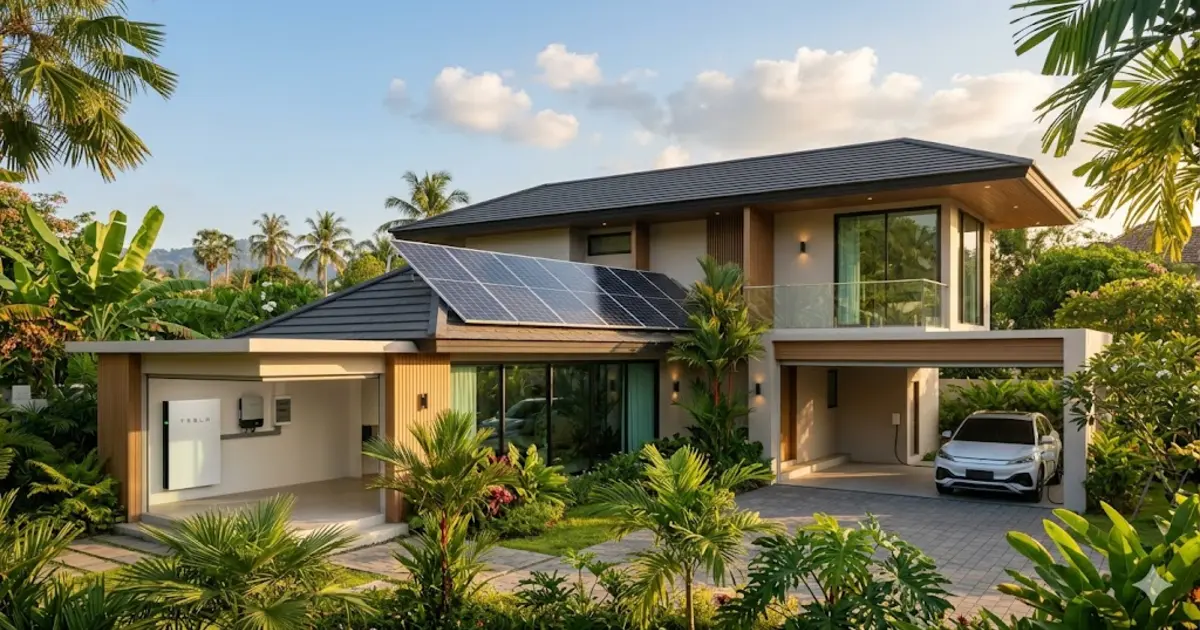
If you own a house, villa, or townhouse in Thailand and you’ve looked at the May 2026 electricity bill, you’ve already had the thought: maybe it’s time to put solar on the roof. The thought is right. What’s usually wrong is the math behind it — the brochure math from the installer’s sales deck, the YouTube math from a Vlogger in California, or the “break-even in 4 years” figure that quietly assumes you’re home running air conditioning all day.
This is the pillar guide we wished existed when we started recommending solar to Bangkok, Hua Hin, and Chiang Mai homeowners. It uses Thailand’s actual tariff structure, real 2026 installed prices from local installers, the Energy Regulatory Commission’s current net-metering rules, and the awkward truths nobody puts in a sales brochure — like why batteries usually don’t pencil out yet, and why a Bangkok condo owner reading this almost certainly cannot install solar even if they want to.
The 60-second answer
For a typical Thai house drawing 800–1,200 kWh/month, a 5 kW grid-tied solar system installed in 2026 costs roughly ฿160,000–220,000 and pays back in 5–7 years at MEA/PEA residential tariffs. Adding a battery (5–10 kWh) adds ฿120,000–220,000 and pushes payback to 11–15 years — longer than most lithium battery warranties. Solar yes; batteries only if you have specific reasons (outages, no daytime occupancy with no net-metering credit, or off-grid land). The rest of this guide is the math behind that answer.
Why 2026 Is the Year the Solar Math Finally Works
Three things changed between 2020 and 2026 that flipped Thai residential solar from “hobby project” to “defensible financial decision.”
Panel prices collapsed. In 2020 a tier-1 monocrystalline panel landed in Bangkok at roughly ฿12–14 per watt. In 2026 the same physical panel — usually a 550–620W bifacial module from JinkoSolar, Trina, Longi, or JA Solar — lands at ฿5–7 per watt wholesale. Inverters from Huawei, Sungrow, SMA, and Growatt followed the same curve. The hardware that used to be 60% of system cost is now closer to 30%. What hasn’t fallen is labor and racking, which is why installed prices fell less dramatically than panel prices — but they still fell about 35–45% in five years.
Tariffs went the other way. The Metropolitan Electricity Authority (MEA) and Provincial Electricity Authority (PEA) residential tariffs sit at roughly ฿4.18–4.42 per kWh in 2026 once the Ft (fuel adjustment) charge is included — up from about ฿3.80 in 2020. Combined with the 7% VAT and the demand charge structure that punishes high-AC-use households, the effective marginal cost of the kilowatt-hour you would otherwise draw from the grid is the number that solar offsets. Higher tariffs mean every solar kWh saves more baht.
The Energy Regulatory Commission opened proper net-metering for residential. Until 2024, the only realistic option for homeowners was self-consumption (use what your panels make in real time, lose the surplus). The 2025–2026 ERC rules allow registered residential systems up to 10 kW to export surplus to the grid and receive credit at a published buyback rate — currently around ฿2.20–2.69 per kWh depending on the program window. That’s lower than the retail rate you pay (which is the catch), but it means surplus generation isn’t wasted.
Add Thailand’s 1,400–1,800 kWh/m²/year of usable solar irradiance — among the best in Southeast Asia — and the equation finally closes. A panel installed on a Hua Hin roof generates roughly 1,400–1,650 kWh per kW per year, depending on tilt, shading, and how often you remember to clean it after the dust storms in March.
How Thai Electricity Billing Actually Works (And Why It Decides Your ROI)
Most homeowners cannot tell you what their effective per-kWh rate is. They look at the total bill and divide. That’s wrong, and the error matters because the “break-even years” you see in solar quotes depends entirely on which kWh the panels are offsetting.
Thai residential billing has three components: a service charge (small, fixed), a tiered energy charge (the kWh price, which steps up as you use more), and the Ft charge (a quarterly fuel adjustment, currently positive — meaning it adds to your bill). VAT 7% sits on top of all three.
| Monthly Usage | Tariff Type | Effective ฿/kWh (incl. Ft + VAT) | Solar Saves |
|---|---|---|---|
| Under 150 kWh/month | Type 1.1 (low-use residential) | ~฿3.20–3.60 | Almost nothing — payback > 12 yrs |
| 150–400 kWh/month | Type 1.2 (mid) | ~฿3.90–4.20 | Marginal — consider 3 kW system only |
| 400–800 kWh/month | Type 1.2 (upper) | ~฿4.20–4.42 | Sweet spot — 5 kW system, 6–8 yr payback |
| 800–1,500 kWh/month | Type 1.3 (high-use) | ~฿4.42–4.60+ | Best ROI — 8–10 kW, 5–7 yr payback |
| 1,500+ kWh/month | Type 1.3 (peak) | ~฿4.60+ | Excellent — consider 10 kW + battery |
Three things follow from that table. First, the higher your bill, the better solar pays — because each offset kWh comes off the most expensive tier. Second, low-use households (single occupant, condo, frequently traveling) often shouldn’t install at all — the savings don’t outrun the capital. Third, the buyback rate for surplus exported to the grid is around ฿2.20–2.69, which is roughly half what you pay to buy a kWh. That asymmetry is why self-consumption matters more than total generation: a kWh used in your own house at 1pm offsets a ฿4.42 retail kWh; the same kWh exported to the grid earns ฿2.20–2.69. Two-to-one in favor of using it yourself.
The self-consumption rule
Solar payback is largely set by what fraction of your generation you consume in real time. A system that achieves 70% self-consumption pays back roughly 1.5× faster than the same system at 35% self-consumption. Working from home, running pool pumps in daylight, or shifting your washing machine and water heater to noon all directly improve your ROI.
Sizing a System for a Real Thai House or Villa
Sales reps will quote whatever the homeowner can afford. The right way is to back-calculate from your actual annual consumption and your home’s daytime load profile.
Pull your last 12 monthly bills (MEA and PEA both have apps; PEA Smart Plus and MEA Smart Life). Add up total kWh and divide by 12. That’s your average monthly draw. A reasonable solar system covers 70–90% of that — not 100%, because Thailand has cloudy stretches in monsoon season (June–October), occasional weeks of low irradiance, and you’ll always import some grid power at night.
Rule of thumb: each 1 kW of installed solar generates roughly 4.0–4.5 kWh per day on average across the year in central Thailand (slightly more in the south, slightly less in the north and during the rainy season). So:
- 5 kW system → ~600–680 kWh/month generation. Right size for a household using 800–1,000 kWh/month.
- 8 kW system → ~960–1,080 kWh/month generation. Right size for 1,200–1,500 kWh/month households (large house, pool, multiple AC units).
- 10 kW system → ~1,200–1,350 kWh/month generation. The cap for residential net-metering. Worth it only if your bill is consistently 1,500+ kWh/month.
Going larger than 10 kW is legal but pushes you out of the residential net-metering window into commercial-scale rules, which require additional permits and a different connection agreement. For 95% of Thai households, the question is 5 kW or 8 kW, not bigger.
Roof matters more than people realize. South-facing pitched roofs are ideal. East-west splits are common in Thailand and lose roughly 8–12% versus south-facing — usually fine. Flat concrete roofs (common in modern villas) work well with adjustable racking, and you can tilt panels to a 12–15° angle to optimize for Bangkok’s latitude. Avoid: roofs shaded by trees, roofs older than 15 years (you’ll re-roof in the panel’s lifespan), and clay-tile roofs without proper hooks (some installers will skip the hooks — those are the leaks you’ll fight in monsoon season three years from now).
The Battery Question: When It Pays, When It Doesn’t
This is the section every battery vendor will hate. We’ll write it anyway.
A 10 kWh lithium-iron-phosphate (LFP) battery from a brand worth buying — BYD, Pylontech, Huawei, Dyness, EcoFlow Power — lands installed in Thailand at roughly ฿180,000–240,000 in 2026. A 5 kWh unit is about ฿110,000–150,000. These are real installed numbers, not Lazada price-comparison numbers.
The savings a battery generates depend on how many cycles it does per day and the spread between your retail rate and the export buyback rate. If you generate a 4 kWh surplus during the day and store it in the battery to discharge that night, you’ve avoided buying 4 kWh of grid power at ฿4.42 instead of selling it back at ฿2.20–2.69. That’s an arbitrage of roughly ฿1.73–2.22 per stored kWh.
Run the math: 4 kWh stored per day × ฿2.00 saved per kWh = ฿8 per day = ฿2,920 per year. A ฿180,000 battery against ฿2,920/year in arbitrage savings is a ~62-year payback — which is comically longer than the 10-year warranty most LFP batteries carry. Even doubling the daily storage to 8 kWh and assuming aggressive utilization gets payback to 30+ years.
When the battery math does work
Off-grid land where utility connection costs ฿200,000+ to extend; properties in PEA areas with frequent or extended outages where running a generator costs ฿15–20/kWh in fuel; or households with no daytime occupancy and zero net-metering eligibility (you’d otherwise just throw away the surplus). For a city or suburban household with normal grid reliability and net-metering enabled, the battery is almost always a comfort purchase, not a financial one.
What changes the answer: battery prices are still falling roughly 8–12% per year in Thailand. If a 10 kWh LFP at ฿180,000 today becomes ฿120,000 in 2028, the math gets meaningfully better. The honest move for most homeowners is to install solar without a battery now, leave space in the inverter and electrical panel for one later, and revisit the battery decision in 18–24 months when prices drop another tier.
Real 2026 Installed Prices in Thailand (Not Brochure Prices)
Installer markups vary wildly. The cheapest quotes (often from new entrants on Facebook) come in 25–40% under tier-1 quotes from established firms like SCG Solar Roof, ARV Solar (a PTT subsidiary), Solartron, Schneider partners, or Bangchak Solar. Cheap quotes tend to skip three things that bite later: roof penetration waterproofing, surge protection on the AC side, and proper bonding to your existing earth system. The premium isn’t pure margin — some of it is real engineering.
| System | Budget Tier (฿) | Tier-1 Installer (฿) | Annual Generation (kWh) | Annual Saving (฿) |
|---|---|---|---|---|
| 3 kW grid-tied | ~110,000–130,000 | ~150,000–180,000 | ~4,300–4,800 | ~17,000–21,000 |
| 5 kW grid-tied | ~160,000–195,000 | ~210,000–260,000 | ~7,200–8,000 | ~28,000–34,000 |
| 8 kW grid-tied | ~240,000–290,000 | ~310,000–380,000 | ~11,500–12,800 | ~45,000–54,000 |
| 10 kW grid-tied | ~290,000–340,000 | ~370,000–450,000 | ~14,400–16,000 | ~56,000–67,000 |
| 5 kW + 5 kWh battery | ~280,000–330,000 | ~360,000–430,000 | ~7,200–8,000 | ~32,000–38,000 |
| 8 kW + 10 kWh battery | ~400,000–480,000 | ~520,000–620,000 | ~11,500–12,800 | ~50,000–58,000 |
The “annual saving” column assumes a typical mix — about 60% self-consumption and 40% net-metered export — against a Type 1.2–1.3 effective tariff. If your home has full daytime occupancy and you can push self-consumption above 75% (for example by running pool pumps, water heaters, and AC during the day) the savings rise about 15–20%. If your home is empty all day, expect savings 15–25% lower than the table.
What’s not in those prices: replacing your meter (some MEA/PEA areas charge ฿5,000–15,000 for a bidirectional smart meter), structural reinforcement on older roofs, and the application fees for the various permits. Budget another ฿15,000–30,000 for these soft costs.
Three Payback Models: Bangkok Condo, Hua Hin Villa, Chiang Mai Family Home
Let’s run the numbers on three real archetypes BaanRow sees every week.
Model 1: Sukhumvit townhouse, expat couple, work-from-home
Three-bedroom townhouse, four AC units, two laptops always running, induction cooktop, electric water heater. Average bill: 1,100 kWh/month, ฿5,200/month including Ft and VAT. Effective rate ~฿4.40/kWh blended (most consumption falls in the upper Type 1.2 tier).
System: 8 kW grid-tied, tier-1 installer, no battery. Cost: ฿340,000 installed including bidirectional meter and permits. Generation: ~11,800 kWh/year. Self-consumption with two adults working from home: ~70%. Annual saving: ~฿48,000. Payback: ~7.1 years. Net 25-year value (assuming 0.5%/year panel degradation, one inverter replacement at year 12): roughly ฿780,000 in nominal savings against ฿380,000 lifetime cost — about ฿400,000 in net positive return.
Model 2: Hua Hin villa, retired Thai-foreign couple, half-year occupancy
Four-bedroom villa, pool with electric pump, six AC units, occupied April–October only. Average bill when occupied: 1,800 kWh/month at ฿8,400/month. Average bill when empty: 220 kWh/month (just the pool pump and refrigerator). Annual consumption: ~12,000 kWh.
System: 10 kW grid-tied with bidirectional metering. Cost: ฿420,000. Generation: ~15,200 kWh/year. This is where occupancy patterns wreck the math. When the villa is empty (Oct–March), it generates ~7,500 kWh that mostly exports to the grid at ฿2.40 buyback — earning ~฿18,000. When occupied, the panels offset retail-rate consumption, saving ~฿42,000. Total annual: ~฿60,000. Payback: ~7 years — not bad, but only because the buyback program exists. Without net-metering, the empty-villa generation would be wasted and payback would balloon to 12+ years.
Lesson: net-metering eligibility is not optional for half-year occupancy properties. Confirm it before signing a quote.
Model 3: Chiang Mai family home, three generations, year-round
Two-story family house in San Sai, four bedrooms, four AC units (used April–June only), gas water heater, no pool. Average bill: 480 kWh/month, ฿2,100/month. Effective rate ~฿4.10/kWh.
System: 5 kW grid-tied. Cost: ฿195,000. Generation: ~7,200 kWh/year — slightly under Bangkok yields because Chiang Mai has more cloudy days in monsoon and December–February cool season. Self-consumption: ~65% (grandmother home all day). Annual saving: ~฿26,000. Payback: ~7.5 years.
This case is interesting because the savings are smaller in absolute terms but the percentage of bill reduction is the highest of the three (~85%). For a household where electricity is a meaningful portion of monthly cash flow, the relief comes faster than the payback period suggests. Most Chiang Mai homeowners we’ve walked through this aren’t optimizing for IRR — they’re optimizing for “the next bill is small.” That’s a legitimate goal.
The Condo Reality: Why 90% of Bangkok Owners Can’t Install (Yet)
If you own a unit in a Bangkok condo and you’ve been hoping this article tells you how to put solar on the roof — we’re sorry. The roof of a condominium is common property under the Condominium Act B.E. 2522 (1979). Individual unit owners cannot install on common property without a juristic-person resolution, which in practice almost never passes for one owner’s benefit.
What you can do, in order of feasibility:
- Lobby for a building-wide rooftop installation. A few forward-looking JPMs (juristic person managers) have done this — the building installs a 30–100 kW system, the savings flow into reduced common-area fees. ROI is shared, not personal, but everyone wins. Bring a proposal. Don’t expect quick movement.
- Plug-in mini-solar (balcony solar). Some condo regulations permit small (300–800W) plug-in panels on balconies. They’ll knock 10–20% off your bill if your unit faces south or west and the building doesn’t prohibit them. Check your house rules first.
- Move. If solar is a deal-breaker, your next purchase should be a townhouse or detached home. Browse houses on BaanRow if that’s where you’re heading.
For penthouse and top-floor unit owners with private rooftop terraces — the rules are murky. Most JPMs treat the rooftop as common, even when the title deed grants exclusive use. Get a written legal opinion before spending a baht on equipment.
Permits, Net-Metering, and the Rules That Trip Up Foreigners
Thai residential solar requires three layers of paperwork. A reputable installer handles all of it. A budget installer might quietly skip the second one, which becomes your problem when you sell the house or when the inspector eventually shows up.
Layer 1: Building modification. Local tessabaan (municipality) approval if your roof modification meets thresholds in the Building Control Act. Most rooftop solar installations are exempt because they don’t change roof structure, but heavy ground-mount or tilted-rack installs sometimes need a permit. This is the easiest layer.
Layer 2: ERC registration and PEA/MEA connection agreement. Required for any grid-tied system. The installer files an application with your utility (MEA in Bangkok, Nonthaburi, Samut Prakan; PEA everywhere else). The utility schedules an inspection, swaps your meter for a bidirectional smart meter if you don’t already have one, and signs a connection agreement. Do not skip this. Operating a grid-tied system without registration is technically illegal, voids your homeowner insurance for any solar-related incident, and means you cannot net-meter (you just lose the surplus). Allow 4–10 weeks for the full process.
Layer 3: Energy Regulatory Commission license (only for systems > 1 MW). Doesn’t apply to residential. Mentioned only because budget installers sometimes wave a generic “ERC license” document at customers and pretend it’s the residential approval. It’s not. The residential paperwork is the connection agreement from MEA/PEA plus the small-generator exemption, not a full ERC license.
Foreign-owner gotcha: who signs the application?
If your house is held in your Thai spouse’s name (common arrangement) the connection agreement must be signed by the registered title-holder, not by the foreign resident. If the property is held through a Thai company, the company’s authorized signatory signs — usually with corporate documents. If your house is held under a 30-year lease with the freehold owner elsewhere, the freeholder’s signature is required on the connection agreement. Sort this out before ordering panels — we’ve seen installations sit on the roof for 8 weeks because a freeholder living in another province had to mail the signed forms.
For owners using leasehold structures, also check that the lease document permits the lessee to make “permanent improvements” without freeholder consent. Older Thai land leases are silent on solar specifically; modern ones usually include a clause.
Warranties, Insurance, and the “What If the Installer Disappears” Problem
Tier-1 panel manufacturers offer 25–30 year linear performance warranties (output guaranteed to stay above ~85–87% of rated at year 25). Inverters typically carry 10–12 year warranties extendable to 20. LFP batteries: 10 years or 6,000 cycles, whichever first.
The warranty that fails most often in Thailand is not the manufacturer’s — it’s the installer’s workmanship warranty. The installer who promised a 5-year roof-leak warranty in 2024 might not exist in 2026. The Thai solar industry has had explosive growth and the failure rate among small installers is high.
Defenses:
- Pick installers with at least 5 years in business and a registered legal entity. Facebook installers with no juristic person registration are uninsurable.
- Insist on documented manufacturer registration. Panels and inverters with serial numbers registered to your address — not the installer’s — mean you can claim warranty directly with the manufacturer’s Thailand distributor if the installer disappears.
- Add solar to your homeowner’s insurance. Most Thai homeowner policies don’t automatically cover rooftop solar against fire, lightning, hail, or wind damage. The endorsement runs ฿2,000–5,000/year and is worth it — lightning is the #1 cause of inverter failure in Thailand and isn’t always covered by manufacturer warranty (acts of nature).
- Keep the original O&M manual and as-built diagram. If the installer disappears, you need these to brief a different technician later. Demand them at handover; reputable installers provide both.
Five Mistakes That Destroy Solar ROI in Thailand
We’ve walked through dozens of installations — some excellent, some catastrophic. The bad ones share patterns.
1. Oversizing for the wrong reason. A homeowner currently using 600 kWh/month installs a 10 kW system “for the future”. The future’s extra usage doesn’t come, the surplus exports at ฿2.40 instead of offsetting at ฿4.40, payback stretches to 11 years. Size to today’s consumption + a modest 10–20% headroom, not a fantasy future.
2. Buying a battery first. A homeowner buys a hybrid inverter and battery before solar “to be ready”. The battery sits idle for 6 months losing capacity to shelf-aging, the inverter is paid for but unused. Always: solar first, evaluate battery later.
3. Ignoring the daytime load profile. A working couple installs 8 kW on a roof in Phra Khanong; both work outside the home; the only daytime loads are a refrigerator and a few standby devices. Self-consumption ends up at 25%, the rest exports at half-rate. Payback nearly doubles. Either change behavior (run pool pump, water heater, washing machine in daylight) or downsize the system.
4. Skipping surge protection. Lightning strikes are common in Thailand May–October. A ฿3,000 surge protector on the AC side can save a ฿80,000 inverter. Budget installers skip it. Demand it.
5. Trusting verbal “net-metering enabled” promises. If you can’t see the connection agreement signed by MEA or PEA, it doesn’t exist. Ask for the document and the bidirectional meter installation date in writing before final payment.
Does Solar Add to Resale Value? (The Honest Answer)
In Thailand, less than you’d hope.
The Thai residential market does not yet price solar into asking prices the way the US, Australia, and parts of Europe do. We track listings on BaanRow across 587+ active properties; the homes with installed solar do not consistently command a premium — sometimes they sell faster, but at the same per-square-meter price as comparable unsolarized homes.
What does happen: homes with solar tend to attract more interest from foreign buyers and from environmentally conscious Thai buyers in the 35–50 age bracket. Solar can be a tie-breaker between two otherwise similar listings. It’s a marketing edge, not a price multiplier.
Practically: don’t install solar “to add to resale value.” Install it because the math on your own bills works during the years you live there. Treat any resale boost as bonus, not justification. As Thailand’s buyer base shifts toward energy-conscious millennials in 2027–2030 we expect solar to start commanding a small premium — but that’s a forecast, not a current reality.
The 30-Minute Decision Framework
If you want to decide today whether residential solar is worth pursuing, work through these six questions in order. They’re ordered so the cheap kills come first.
- Do you own the property and have legal standing to modify the roof? If condo — stop, see condo section above. If house held in spouse’s name — spouse signs everything. If leasehold — freeholder consent required.
- Is your average monthly consumption above 400 kWh? Below that, the math rarely closes. Above 800 kWh, the math is excellent.
- Does your roof get usable sun for at least 5 hours per day? Walk around it at 10am, noon, and 2pm on a clear day. Heavy tree shade or a neighbor’s tall building kills generation.
- Is the roof less than 15 years old, or are you planning to re-roof anyway? Solar panels last 25+ years; you don’t want to remove them at year 8 to replace tiles.
- Can you confirm net-metering eligibility with MEA or PEA in your specific area? Coverage is universal in policy but uneven in practice — some PEA branches process applications in 4 weeks, others take 12. Ask before committing.
- Are you staying in the property at least 6–8 more years? Below the payback period, you won’t recoup the capital outlay. Above, you start banking real savings.
If you answered yes to all six, you’re in solar’s sweet spot. Get three quotes from installers with at least 5 years in business. Compare on installed price, panel and inverter brand, workmanship warranty, and explicit confirmation of MEA/PEA connection-agreement filing. Don’t pick on price alone.
If you answered no to question 1, 2, or 3, solar isn’t for this property. Look at other ways to cut your housing operating costs or factor solar into your next property purchase instead.
The bottom line
Thai residential solar in 2026 is a defensible 5–8 year payback for the right house with the right consumption profile, which is most middle-class houses outside Bangkok’s condo stock. Batteries are a comfort purchase at today’s prices — revisit in 2028. Get the permits right, get the installer right, get the self-consumption right, and the math takes care of itself.
Sources & References
- Energy Regulatory Commission of Thailand (ERC) — official tariff schedules, residential net-metering rules, and small-generator exemption framework.
- Metropolitan Electricity Authority (MEA) — current residential tariffs (Type 1.1, 1.2, 1.3) for Bangkok, Nonthaburi, and Samut Prakan; bidirectional meter application portal.
- Provincial Electricity Authority (PEA) — tariffs and connection-agreement procedures for all provinces outside MEA territory.
- Department of Alternative Energy Development and Efficiency (DEDE) — Thailand solar irradiance maps and Alternative Energy Development Plan (AEDP).
- Thailand Board of Investment (BOI) — tax incentives for renewable energy equipment and solar manufacturing in Thailand.
- International Energy Agency — Thailand — country profile, electricity mix, renewable penetration.
- IRENA — Renewable Power Generation Costs Report — global benchmark for utility-scale and distributed solar LCOE trends.
- Office of the Council of State — Condominium Act B.E. 2522 (1979) — the legal framework that governs common-property rights in Thai condominiums (relevant to rooftop solar restrictions).
- ERC Forum — rooftop solar policy updates — the current consultation rounds on residential net-metering caps and buyback rates.
- Ministry of Energy, Thailand — national renewable strategy and Power Development Plan (PDP).
- Global Solar Atlas — Thailand — satellite-derived solar irradiance data by location, used to validate generation estimates.
- Thailand Greenhouse Gas Management Organization (TGO) — carbon credit framework relevant to long-term solar incentives.
This article was researched using publicly available data from Thai government authorities (MEA, PEA, ERC, DEDE, BOI), international energy bodies (IEA, IRENA), and 2026 installed-pricing data gathered from Thai solar installers. Cost figures reflect typical 2026 market ranges and may vary by location, installer, and equipment brand. Always obtain three written quotes and confirm net-metering eligibility with your local utility before committing. Last updated: 7 May 2026. 12 verified sources.