Thailand PM2.5 Air Pollution: What Property Buyers Need to Know in 2026
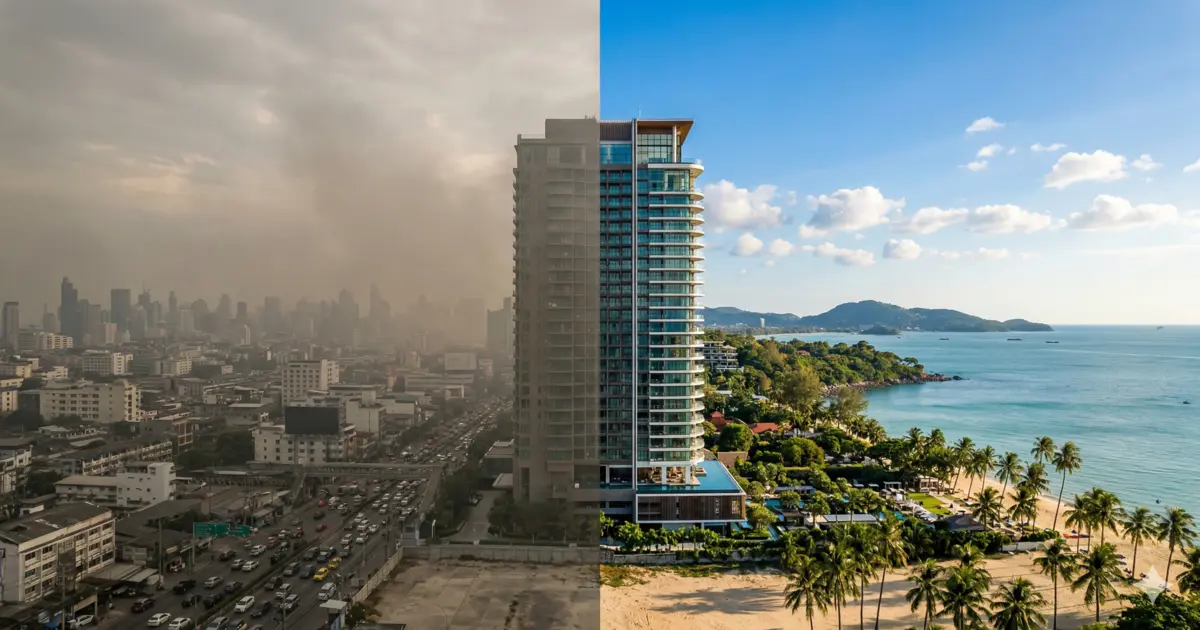
If you are considering buying property in Thailand in 2026, there is one factor that most real estate websites will not mention: the air you will breathe. Fine particulate matter (PM2.5) has become a defining variable in Thailand's property market, directly affecting where foreigners choose to live, how much their properties are worth, and even how long they can expect to stay healthy.
This is not a minor seasonal annoyance. Thailand ranked as the 48th most polluted country in the world in 2025, and 98 percent of its 69.5 million residents live in areas that routinely exceed national air quality standards. For property buyers, this means the traditional calculation of "location, location, location" now includes a critical fourth dimension: air quality.
This guide uses data from over 80 verified sources to give you the complete picture: which cities are safe, which months to avoid, how pollution affects property values, and what you can do to protect your investment and your health.
Thailand's PM2.5 Crisis: The Numbers That Matter
The World Health Organization (WHO) recommends an annual average PM2.5 concentration of no more than 5 micrograms per cubic meter (µg/m³). Thailand's national average in 2025 was 17.8 µg/m³, more than three times the WHO guideline. Thailand's own national safety threshold is set at a more lenient 15 µg/m³ annually, yet the vast majority of the population still lives above even that limit.
Critical Fact
During peak burning season in early 2026, satellite monitoring detected 4,750 active fire hotspots within Thailand on a single day, plus 5,505 in Myanmar and 2,704 in Laos. These transboundary fires send massive smoke plumes across borders, making northern Thailand's air quality among the worst in the world.
The primary driver is agricultural burning. Farmers clear land by burning crop residue from maize, sugarcane, and rice. This domestic burning is compounded by transboundary haze from Myanmar and Laos. Northern Thailand's deep mountain valleys trap this smoke under thermal inversions, creating hazardous conditions that last for weeks.
City-by-City Air Quality Comparison
Thailand's property market cannot be analyzed as a single entity. The air quality difference between Chiang Mai and Phuket is as dramatic as the price difference between a beachfront villa and a mountain condo.
| City | Peak Season AQI | Year-Round PM2.5 | Verdict |
|---|---|---|---|
| Chiang Mai | 200-254 (Severe) | Up to 14x safety limits (Feb-Apr) | Avoid Feb-Apr entirely |
| Bangkok | 51-100 (Moderate) | Peaks Dec-Feb, improving trend | Manageable with good filtration |
| Phuket | 20-35 µg/m³ (Good) | Rarely exceeds AQI 90-100 | Year-round safe haven |
| Koh Samui | ~18 µg/m³ (Good) | Consistently excellent | Best air quality in Thailand |
| Krabi | 40-70 (Good) | Rare spikes, generally clean | Emerging eco-friendly alternative |
| Hua Hin | ~94 AQI (Moderate) | Occasional agricultural smoke | Best mainland coastal option |
| Pattaya | ~84 AQI (Moderate) | Sea breezes help, but urban pollution | Acceptable but not pristine |
The pattern is clear: coastal and southern locations consistently outperform inland cities. Oceanic wind patterns and regular rainfall continuously disperse airborne particulates, creating natural safe zones. If year-round clean air is your priority, the islands and the Andaman coast are your best bet.
The Seasonal Calendar: When to Live Where
Many expatriates and digital nomads have adopted a seasonal migration strategy, moving between regions to avoid the worst air quality months. Understanding this calendar is essential for property buyers.
| Season | Months | Best Regions | Avoid |
|---|---|---|---|
| Cool / Early Dry | Nov - Jan | Chiang Mai, Phuket, Koh Samui, Krabi | Bangkok (early haze begins) |
| Peak Haze / Hot | Feb - Apr | Phuket, Koh Samui, Krabi, Hua Hin | Chiang Mai, Chiang Rai, Mae Hong Son |
| Rainy / Green | May - Oct | All regions (clean air nationwide) | Coastal monsoon rains (but air is clean) |
Property Buyer's Tip
If you plan to buy in Chiang Mai, consider it a 8-month property. Budget for renting elsewhere during the 3-month haze season (February through April), or ensure your building has medical-grade air filtration. Many experienced expats now own a condo in the north and rent short-term in the south during burning season.
How PM2.5 Affects Property Values and Rental Yields
Air quality is no longer just a health concern. It is now a monetized variable that directly affects how much your property is worth and how much rental income it generates.
The "Pollution Discount" on Property Values
Academic research using advanced spatial hedonic pricing models has quantified the financial impact of air pollution on Thai property values. The data reveals a reduction of approximately 39,838 THB (~$1,138 USD) per property for every marginal unit increase in pollution levels. The estimated welfare loss per household averages a staggering 568,078 THB (~$16,578 USD).
For foreign buyers with higher disposable income and a greater willingness to pay for clean air, this welfare loss translates directly into capital flight toward the coasts.
Chiang Mai: A Market in Structural Decline
The Chiang Mai condominium market tells a sobering story. In the first half of 2025, new project launches plummeted by 66.2 percent in volume and 74 percent in value. The market faces a massive inventory overhang with an absorption rate of just 1.6 percent per month, meaning it would take 57 months to clear existing stock.
Short-term rental data paints an equally volatile picture. Average annual Airbnb occupancy sits at a modest 42 percent. While December sees strong bookings, the March-April haze season causes occupancy to crash to 30-40 percent as tourists and expats flee south.
Phuket: The Clean-Air Premium
Compare this to Phuket, where hotel occupancy reached 79.5 percent in H1 2025 with a 7.8 percent increase in average daily rates. Rental yields in tourist-friendly coastal zones currently average an attractive 5 to 8 percent, driven by uninterrupted year-round demand. Clean air is not just good for your lungs; it is good for your portfolio.
| Metric | Chiang Mai | Phuket |
|---|---|---|
| New Project Launches (H1 2025) | -66.2% volume | Strong demand |
| Hotel Occupancy | 42% average, 30-40% in haze | 79.5% (H1 2025) |
| Rental Yields | Volatile, season-dependent | 5-8% year-round |
| Inventory Absorption | 57 months to clear | Healthy demand |
Health Impacts and Insurance Costs for Expats
The financial case against living in high-pollution zones goes beyond property values. Long-term PM2.5 exposure carries severe health consequences that directly affect your cost of living in Thailand.
The Health Toll
In 2024, approximately 12.3 million people in Thailand sought medical treatment for pollution-related illnesses, a 10.1 percent increase from the previous year. The most common conditions include chronic obstructive pulmonary disease (COPD), asthma, ischemic heart disease, and lung cancer.
Current pollution levels reduce the life expectancy of the average Thai resident by 1.8 years. In the severely affected northern provinces, this rises dramatically to 2.7 to 3.5 years of lost life expectancy.
Insurance Warning
If you develop respiratory issues during a stay in Chiang Mai, future COPD treatments may be permanently excluded from insurance coverage as a "pre-existing condition," or subject to 12-to-24-month waiting periods. Medical inflation in Asia-Pacific is projected at 14 percent in 2026, with Thai health insurance premiums rising nearly 10 percent.
What Expat Insurance Should Cover
For property buyers planning long-term residence in Thailand, comprehensive health insurance is not optional. Your policy should include:
- Unlimited emergency medical evacuation (air ambulance from Chiang Mai to Bangkok or Singapore can cost $30,000-$60,000)
- Respiratory and cardiovascular specialist coverage without annual visit caps
- No pre-existing condition exclusions for respiratory conditions
- Coverage in multiple provinces to support seasonal migration
Providers like AXA Thailand have launched specialized micro-insurance products targeting PM2.5-related acute respiratory infections. However, for high-value property owners, comprehensive international plans remain essential.
Government Action: Clean Air Act and Burning Penalties
The Thai government recognizes that PM2.5 threatens tourism revenue, public health, and foreign investment. Several significant legislative measures are now in progress.
The Draft Clean Air Act
The cornerstone legislation proposes a centralized Clean Air Policy Committee and a revolving Clean Air and Health Fund to finance community support and compensate pollution victims. While still in the legislative process, the Act represents Thailand's most serious commitment to systemic change.
Escalating Criminal Penalties
| Offense | Maximum Prison | Maximum Fine |
|---|---|---|
| Burning waste on private property | 3 months | 25,000 THB |
| Agricultural burning (fields) | 7 years | 140,000 THB |
| Forest burning (national parks) | 4-20 years | 400,000-2,000,000 THB |
The government has deployed satellite monitoring via GISTDA and NASA FIRMS to detect and prosecute illegal burning in real-time, with thousands of checkpoints across high-risk forest areas.
Protecting Your Investment: Green Buildings and Air Filtration
While government action operates on a long timeline, property buyers can take immediate steps to protect their homes and their health.
HEPA Filtration and Positive-Pressure Systems
Premium developments in Thailand now integrate HEPA filters that capture 99.6 percent of PM2.5 particles. Leading developers like Land and Houses have partnered with Delta Electronics to install positive-pressure fresh air systems that scrub incoming air and maintain slight internal pressure, physically preventing outdoor smog from seeping through window and door seams.
Green Building Certifications to Look For
| Certification | Focus | Notable Projects |
|---|---|---|
| TREES (Thai) | Energy efficiency, water, materials, indoor air | Central Westville, Central Nakhon Pathom |
| WELL Platinum | Occupant health, air filtration, water quality | One Bangkok, Dusit Central Park, CBRE HQ |
Tax Incentives for Clean-Air Upgrades
The Thai government offers attractive incentives for eco-retrofitting through Royal Decree No. 805 (2024-2028):
- Up to 200,000 THB personal income tax deduction for residential solar rooftop installation
- 150 percent business deduction for certified high-efficiency HVAC and energy machinery
Thailand vs. Vietnam, Indonesia, and the Philippines
Foreign real estate capital is mobile. When environmental risks escalate in one country, investors look at alternatives. Here is how Thailand compares with its regional competitors.
| Country | Global Pollution Rank | Avg PM2.5 | Foreign Ownership | Key Issue |
|---|---|---|---|---|
| Thailand | 48th | 17.8 µg/m³ | Condos (freehold), land (leasehold) | Northern haze severe, coasts clean |
| Vietnam | 23rd | 28.7 µg/m³ | 30% condo quota, no land | Hanoi severe (45.4), ownership restrictions |
| Indonesia | 15th | High (30-55 in Jakarta) | Leasehold only (mostly) | Jakarta severe; Bali clean (8-10% appreciation) |
| Philippines | 41st | 19 µg/m³ | Condos only, complex rules | Moderate, but fewer luxury health-optimized options |
Key Takeaway
Thailand's coastal regions offer cleaner air than most of Southeast Asia, combined with more favorable foreign ownership laws and a mature luxury property market with green building certifications. The challenge is specifically in the north, not across the entire country.
Future Outlook: Will Thailand's Air Get Better?
Expert consensus suggests Thailand's air quality will remain volatile in the near term but gradually improve over the coming decade, driven by two major forces:
Agricultural Reform: The 3R Model
The Ministry of Agriculture is implementing a three-pronged approach to eliminate agricultural burning:
- Re-Habit: Subsidizing non-burning land clearing and converting crop residue into biomass energy
- Replace with Perennial Crops: Transitioning highland farmers from maize (the main burning culprit) to coffee and avocado
- Replace with Alternate Crops: Diversifying crops in lowlands to break the monoculture burning cycle
Electric Vehicle Revolution
Thailand registered over 75,000 passenger EVs in 2023, with forecasts of 190,000 per year through 2024-2026. Bangkok is also electrifying its 89,000 motorcycle taxis, which currently produce 100,000 tonnes of CO2 annually. Officials estimate this will reduce fine dust emissions by 16 tonnes per year in the capital alone.
However, these structural changes require at least a decade to produce significant atmospheric improvement. In the meantime, property buyers should prioritize defensive real estate assets in naturally clean locations or buildings with advanced air filtration.
Property Buyer's Air Quality Checklist
Before signing any property contract in Thailand, verify these air quality factors:
- 1. Check historical AQI data for your specific location on aqi.in or aqicn.org. Look at February-April readings specifically.
- 2. Ask about HVAC systems. Does the building have HEPA filtration? Positive-pressure ventilation? Smart air quality monitoring?
- 3. Look for green certifications. TREES or WELL-certified buildings maintain higher resale values and healthier indoor environments.
- 4. Calculate the "full cost" of ownership. Include air purifiers (15,000-50,000 THB each), replacement filters, and potential seasonal relocation costs.
- 5. Secure comprehensive health insurance with medical evacuation coverage before signing. Do not wait until after you develop symptoms.
- 6. Consider rental yield seasonality. If investing for income, model your returns with a 30-40% occupancy drop during haze months in northern locations.
- 7. Verify coastal wind patterns. Properties on the western Andaman coast (Phuket, Krabi) benefit from consistent oceanic airflow that keeps PM2.5 low year-round.
Sources & References
- World Health Organization (WHO) — Global air quality database and PM2.5 guidelines
- Nation Thailand — Thailand ranked 48th worst in global air pollution (2025 data)
- Air Quality Life Index (AQLI), University of Chicago — Thailand PM2.5 impact on life expectancy
- AQI.in — Real-time Thailand PM2.5 data and city rankings
- ResearchGate — Air pollution and housing market valuation: spatial hedonic pricing approach
- Asia Property Awards — How air pollution is driving real estate transformation in Chiang Mai
- Cushman & Wakefield — Thailand real estate market outlook 2025-2026
- Savills — Thailand property market 2026: strategic outlook and emerging trends
- PMC/National Institutes of Health — Treatment costs for PM2.5-attributable respiratory diseases in Northern Thailand
- Hunton Andrews Kurth — Thailand's Draft Clean Air Act legal analysis
- Willis Towers Watson (WTW) — Asia Pacific medical inflation trends 2026
- Land and Houses PLC — AirPlus2 indoor air quality innovation for PM2.5 control
- Asian Development Bank (ADB) — Accelerating Thailand's E-Mobility Transition 2025-2035
- Enviliance Asia — Thailand fully revises national ambient air quality standards
- Mongabay — Civil-backed proposal to address root causes of Thailand's haze
This article was researched using Gemini Deep Research (84 verified sources across air quality databases, property market reports, medical journals, and government legislation) and written with AI assistance. Data reflects conditions as of April 2026. Air quality levels vary daily and seasonally. Always check real-time AQI data before making property decisions. Last updated: April 5, 2026.