Thailand Property Tax Guide for Foreign Owners: Every Tax, Fee & Strategy in 2026
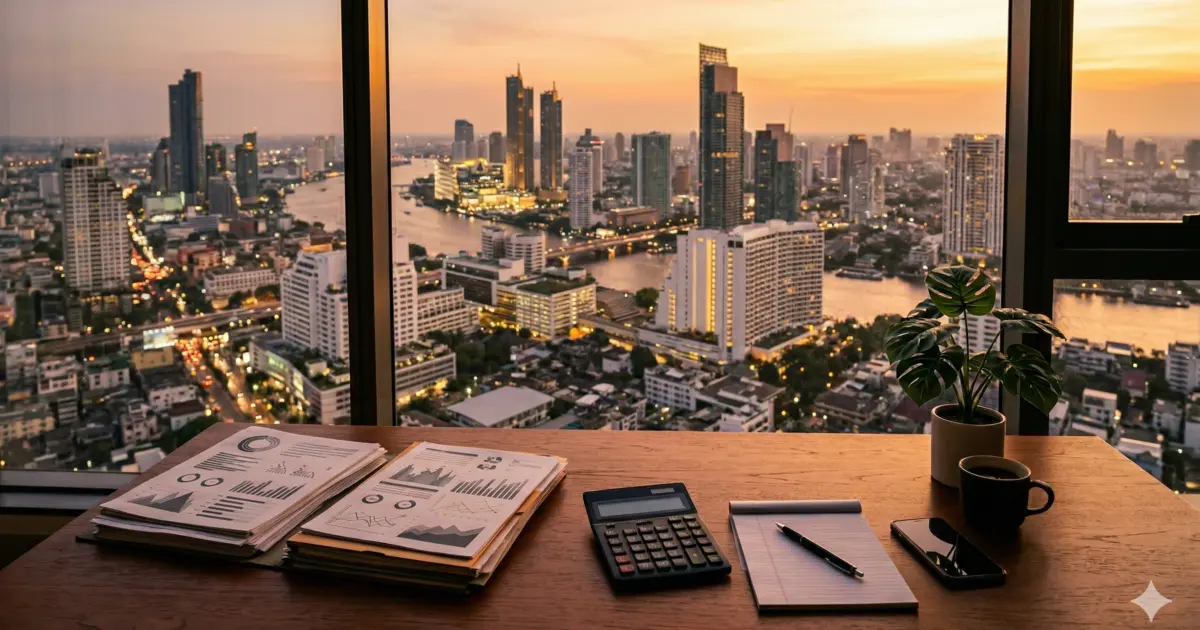
Thailand's property market attracts foreign investors with some of the lowest holding taxes in the world. A luxury condo appraised at 20 million THB costs roughly 4,000 THB per year in property tax — about $115 USD. But between withholding taxes, transfer fees, and recent anti-nominee crackdowns, the full tax picture is far more complex than that single number suggests.
This guide breaks down every tax, fee, and legal obligation you'll face as a foreign property owner in Thailand in 2026 — with exact rates, worked examples, and strategies to keep more of your money legally.
1. Annual Property Tax: What You Actually Pay
Thailand's Land and Building Tax Act B.E. 2562 replaced the old 12.5% assessed-rental-value system with a modern framework based on government-appraised capital value. The Treasury Department sets these cadastral values, which typically sit 30–50% below actual market prices.
Tax Rates by Property Type (2026)
| Property Type | Max Ceiling | 2026 Applied Rate |
|---|---|---|
| Agricultural | 0.15% | 0.01% – 0.10% |
| Primary Residence (Thai Tabien Baan) | 0.30% | 0.02% – 0.10% (above 50M THB only) |
| Foreign-Owned Residential | 0.30% | 0.02% – 0.30% (from first baht) |
| Commercial / Industrial | 1.20% | 0.30% – 0.70% |
| Vacant Land | 1.20% (up to 3%) | 0.30% (+0.30% every 3 years unused) |
Important: No 50M THB Exemption for Foreigners
Thai citizens with their name on a Tabien Baan (household registration) pay zero tax on the first 50 million THB of their primary residence. Foreign owners are classified as "Other Residential" — tax applies from the first baht. The COVID-era 90% discount has also expired.
Despite this, annual taxes remain extraordinarily low. Here's what foreign owners actually pay:
| Appraised Value | Annual Tax | Monthly Equivalent |
|---|---|---|
| 3M THB (studio condo) | 600 THB ($17) | 50 THB |
| 10M THB (1BR luxury) | 2,000 THB ($57) | 167 THB |
| 20M THB (2BR premium) | 4,000 THB ($115) | 333 THB |
| 50M THB (penthouse) | 15,000 THB ($430) | 1,250 THB |
2. Rental Income Tax & the 15% Withholding Trap
If you rent out your Thai property, you owe Thai income tax on that rental income — regardless of whether you live in Thailand or not. But Thailand's system is surprisingly generous for landlords, thanks to a 30% automatic expense deduction that requires zero receipts.
How Rental Income Tax Works
- Start with gross annual rent (e.g., 1,000,000 THB)
- Deduct 30% automatically — no receipts needed (= 700,000 THB)
- Deduct 60,000 THB personal allowance (= 640,000 THB taxable)
- Apply progressive rates (see table below)
| Taxable Income (THB) | Rate |
|---|---|
| 0 – 150,000 | 0% |
| 150,001 – 300,000 | 5% |
| 300,001 – 500,000 | 10% |
| 500,001 – 750,000 | 15% |
| 750,001 – 1,000,000 | 20% |
| 1,000,001 – 2,000,000 | 25% |
| 2,000,001 – 5,000,000 | 30% |
| Over 5,000,000 | 35% |
Worked Example: 1M THB Annual Rent
Gross rent: 1,000,000 THB → minus 30% deduction (300,000) → minus 60,000 allowance = 640,000 THB taxable. Tax: first 150K at 0% + next 150K at 5% (7,500) + next 200K at 10% (20,000) + final 140K at 15% (21,000) = 48,500 THB total tax. Effective rate: 4.85% on gross income.
The 15% Withholding Tax Trap
Warning: Don't Leave 101,500 THB on the Table
When a property management company pays rent to a non-resident foreigner, they withhold 15% at source. On 1M THB rent, that's 150,000 THB withheld. But your actual tax is only 48,500 THB — meaning 101,500 THB is yours to claim back. You must get a Thai Tax ID (TIN) and file form PND 90 between January and March. If you don't file, you forfeit the refund and pay an effective 15% instead of 4.85%.
3. Double Taxation Agreements: Don't Pay Twice
Thailand maintains over 60 Double Taxation Agreements (DTAs). Under Article 6 of these treaties, Thailand (as the country where the property sits) has the primary right to tax your rental income and capital gains. Your home country then provides relief so you don't pay double.
| Country | Relief Method | How It Works |
|---|---|---|
| United States | Foreign Tax Credit (FTC) | Dollar-for-dollar offset of Thai tax paid against US liability |
| United Kingdom | Tax Credit | Credit Thai tax against UK income tax |
| Australia | FITO | Foreign Income Tax Offset against ATO liability |
| Germany | Tax Credit | Credit method under bilateral treaty |
| Japan | FTC + Tax Sparing | Credit as if no Thai exemption was granted |
| South Korea | Foreign Tax Credit | Credit Thai tax against Korean liability |
| China | Credit Method | Credit Thai tax paid under Article 6 situs rule |
| Russia | Credit Method | Credit Thai tax paid upon repatriation |
The key takeaway: always declare your Thai rental income in your home country, but claim the credit for Thai tax already paid. With an effective Thai rate of ~5%, most investors in high-tax countries end up paying only the difference to their home government.
4. Taxes When Selling: Transfer Fees, SBT & Capital Gains
Thailand doesn't have a standalone capital gains tax. Instead, profit from selling property is taxed through a layered system at the Land Department during transfer. Two variables determine your total cost: how long you held and whether you're an individual or company.
The Four Transfer Levies
| Fee/Tax | Rate | When It Applies |
|---|---|---|
| Transfer Fee | 2% | Always. Based on appraised value. Usually split 50/50 buyer/seller |
| Specific Business Tax (SBT) | 3.3% | If held less than 5 years (3% + 0.3% municipal surcharge) |
| Stamp Duty | 0.5% | If held 5+ years (replaces SBT — never both) |
| Withholding Tax (WHT) | 1%–5% | Progressive for individuals; flat 1% for companies |
Withholding Tax Deductions by Holding Period
The longer you hold, the larger your tax deduction. This is the single most powerful tax optimization tool available:
| Years Held | Deduction | You're Taxed On |
|---|---|---|
| 1 | 92% | 8% |
| 2 | 84% | 16% |
| 3 | 77% | 23% |
| 4 | 71% | 29% |
| 5 | 65% | 35% (+ SBT eliminated) |
| 6 | 60% | 40% |
| 7 | 55% | 45% |
| 8+ | 50% | 50% |
Key Takeaway: The 5-Year Rule
Selling before 5 years costs you 3.3% SBT on the entire sale price. That's not 3.3% of profit — it's 3.3% of the gross value. On a 10M THB condo, that's 330,000 THB. After 5 years, this drops to just 50,000 THB (0.5% stamp duty). Patience saves you 280,000 THB.
Note for Foreign Buyers
The Thai government occasionally reduces the transfer fee to 0.01% for properties under 7M THB as a stimulus measure. However, foreign buyers are excluded from these reductions — always budget for the full 2%.
5. CAM Fees & Sinking Funds by City
Beyond taxes, your ongoing costs include Common Area Maintenance (CAM) fees and a one-time sinking fund. These are mandated by the Condominium Act B.E. 2522 and managed by the building's Condominium Juristic Person (CJP).
Sinking Fund (One-Time at Transfer)
A capital reserve for major repairs — elevator overhauls, facade repainting, roofing. Typically 500–800 THB per sqm. For a 45 sqm condo, expect 22,500–36,000 THB. Must be held in a separate bank account by law.
Monthly CAM Fees by City (2026)
| City | CAM Range (THB/sqm/mo) | 45 sqm Unit Monthly | Notes |
|---|---|---|---|
| Bangkok CBD | 60–100+ THB | 2,700–4,500 THB | High-rises with rooftop pools, co-working, automated parking |
| Chiang Mai | 40–45 THB | 1,800–2,025 THB | Low-rise developments, lowest in Thailand |
| Phuket | 40–80 THB | 1,800–3,600 THB | Varies hugely — basic condos vs. resort estates |
| Pattaya | 40–70 THB | 1,800–3,150 THB | Beachfront premium; older buildings cheaper |
CAM fees directly impact your net rental yield. A Chiang Mai condo with 40 THB/sqm CAM preserves far more of your rental income than a Bangkok luxury unit at 100 THB/sqm.
6. Major Tax & Legal Changes in 2025–2026
Three seismic shifts have reshaped the landscape for foreign property investors:
Anti-Nominee Crackdown (DSI + DBD + IBAS)
The Department of Special Investigation (DSI), working with the Department of Business Development (DBD), has deployed IBAS — an AI-powered screening tool that cross-references corporate registries, land transfers, and bank accounts. Results so far:
- 21,000+ companies under deep investigation
- CIB Nominee Sweep EP.3: 4 entities in Rayong/Chonburi dismantled — 72 rai, 2 billion THB luxury project
- 23 convicted in Phuket for facilitating nominee structures
- Mandatory in-person Thai shareholder appearances for new company formations
- Cross-referencing against 13.4 million State Welfare Card holders to catch proxy nominees
Warning: Nominee Companies Are Now High-Risk
The era of using Thai nominee companies to hold land is effectively over. AI-driven enforcement, inter-agency data sharing, and criminal prosecutions make this strategy legally and financially dangerous. Foreign investors must use legitimate structures: freehold condos, registered leaseholds, or BOI-promoted companies.
Foreign-Sourced Income: 2-Year Grace Period
Since January 2024, Thai tax residents (180+ days/year in Thailand) must pay tax on foreign income remitted to Thailand. But new 2026 legislation introduces a 2-year grace window: income remitted within 2 calendar years of being earned is exempt. Only income remitted after 24 months triggers progressive tax rates. This helps expats fund Thai property purchases from overseas savings without immediate tax exposure.
Crypto Capital Gains Exemption (2025–2029)
Under Ministerial Regulation No. 399, capital gains from selling cryptocurrency through SEC-licensed exchanges are 100% exempt from personal income tax through December 2029. This provides a tax-free pathway for crypto holders to liquidate and purchase Thai real estate. The exemption does not apply to staking income, mining rewards, or corporate entities.
7. Legal Tax Optimization Strategies
With nominee companies off the table, here are the strategies that remain fully legal and effective in 2026:
Strategy 1: Hold 5+ Years (Eliminate SBT)
The single most impactful optimization. Holding past the 5-year mark replaces the 3.3% Specific Business Tax with 0.5% stamp duty — saving you 2.8% of the entire property value on exit.
Strategy 2: File PND 90 for Rental WHT Refund
Get a Thai TIN and file annually. The difference between a passive 15% withholding and an optimized ~5% effective rate means recovering over 100,000 THB per million in annual rent.
Strategy 3: Invoke DTA Treaty Benefits
Claim Foreign Tax Credits in your home country. With Thailand's low effective rates, you'll typically owe only the difference between Thai and home-country rates — not the full domestic amount.
Strategy 4: BOI-Promoted Company (For Large Investors)
With 50M THB minimum capital, a BOI company can legally own freehold land (up to 5–20 rai depending on use), plus receive corporate income tax exemption for up to 13 years and 50% reduction for 5 more. This is the legitimate alternative to nominee structures for landed property.
Strategy 5: Registered 30-Year Leasehold
For villa buyers, a leasehold registered at the Land Department provides secure tenure without the legal risk of nominee companies. While the common "30+30+30" structure exists, note that renewals beyond the first 30 years are contractual promises, not statutory rights.
Strategy 6: Maximize Holding Period WHT Deductions
At 8+ years of ownership, 50% of the appraised value is deducted before calculating withholding tax. Combined with SBT elimination at year 5, long-term holders face effective exit taxes of just 1–3% of property value.
8. Thailand vs. Neighbors: Regional Tax Comparison
How does Thailand stack up against other Southeast Asian markets competing for foreign property investment?
| Tax Type | Thailand | Malaysia | Vietnam | Cambodia | Philippines |
|---|---|---|---|---|---|
| Acquisition Tax | 2% | 8% flat stamp | 2% | 4% | Varies |
| Annual Tax | 0.02–0.10% | State assessed | 0.03–0.15% | 0–0.1% | 1–2% |
| Rental Tax (Non-Res) | ~5% effective | 30% flat | Complex | 14% | 25% |
| Exit/CGT (<5 yrs) | WHT + 3.3% SBT | 30% RPGT | 2% | 20% | 6% gross |
| Exit/CGT (5+ yrs) | WHT + 0.5% stamp | 10% RPGT | 2% | 20% | 6% gross |
Bottom Line
Thailand offers the lowest combined tax burden for foreign property investors in Southeast Asia. Malaysia's 8% entry stamp duty alone exceeds Thailand's entire acquisition + annual tax for the first 10 years. The Philippines' 25% non-resident rental tax makes yield investing prohibitive. Only Vietnam's 2% flat exit tax is competitive, but tenure insecurity and ownership quotas offset that advantage.
9. Real-World Tax Scenarios
Scenario A: Chiang Mai Studio Condo (Buy & Rent)
| Item | Amount |
|---|---|
| Purchase price | 2,500,000 THB |
| Transfer fee (buyer's 1%) | 25,000 THB |
| Sinking fund (30 sqm × 600 THB) | 18,000 THB |
| Annual property tax | 500 THB/year |
| Monthly CAM (30 sqm × 42 THB) | 1,260 THB/month |
| Annual rent collected | 180,000 THB (15K/mo) |
| Income tax (after filing PND 90) | 0 THB (under 150K threshold after deductions) |
| Net yield | 5.7% gross / 5.1% net |
Scenario B: Bangkok Luxury 1BR (Buy, Rent 6 Years, Sell)
| Item | Amount |
|---|---|
| Purchase price | 7,000,000 THB |
| Sale price (6 yrs later, 15% appreciation) | 8,050,000 THB |
| Transfer fee (seller's 1%) | 70,000 THB |
| Stamp duty (0.5%, held 6 yrs — no SBT) | 40,250 THB |
| WHT (60% deduction at 6 yrs) | ~80,000 THB |
| Total exit cost | ~190,250 THB (2.4% of sale price) |
| 6 years rental income (net of tax) | ~1,800,000 THB |
| Total return | 2,659,750 THB (38% over 6 years) |
Sources & References
- Thai Revenue Department — Personal income tax rates, PND 90 filing, withholding tax regulations
- Department of Lands (DOL) — Transfer fees, cadastral valuations, title registration procedures
- Board of Investment (BOI) — Foreign land ownership privileges, CIT exemptions, promoted activity zones
- Office of the Council of State (Krisdika) — Land and Building Tax Act B.E. 2562, Condominium Act B.E. 2522
- CBRE Thailand — Market analysis, yield benchmarks, property investment trends
- Savills Thailand — Residential market reports, foreign investment analysis
- Knight Frank Thailand — Property market intelligence, luxury segment data
- Baker McKenzie Thailand — Transfer tax analysis, corporate structuring guidance
- Tilleke & Gibbins — Foreign ownership regulations, anti-nominee enforcement analysis
- DFDL Thailand — Land and Building Tax analysis, COVID discount expiry, legislative updates
- Siam Legal International — Property transfer procedures, leasehold vs. freehold analysis
- Global Property Guide — Thailand — Rental yields, tax comparison data, investment analysis
- HLB Thailand — Non-resident tax filing guidance, rental income optimization
- Department of Special Investigation (DSI) — Anti-nominee enforcement operations, IBAS deployment
- Department of Business Development (DBD) — Company registration requirements, nominee screening
- Securities and Exchange Commission (SEC Thailand) — Licensed digital asset exchanges, Ministerial Regulation No. 399
- ASEAN Briefing — Thailand's Land and Building Tax Act analysis for foreign investors
- Forvis Mazars Thailand — Tax rate tables, property classification guidance
This article was researched using Gemini Deep Research (40+ verified sources) and written with AI assistance. Tax rates and regulations are current as of March 2026. Consult a licensed Thai tax advisor before making investment decisions. Last updated: 23 March 2026.