Thailand Visa Options for Property Owners: Elite, LTR, DTV & Every Route in 2026
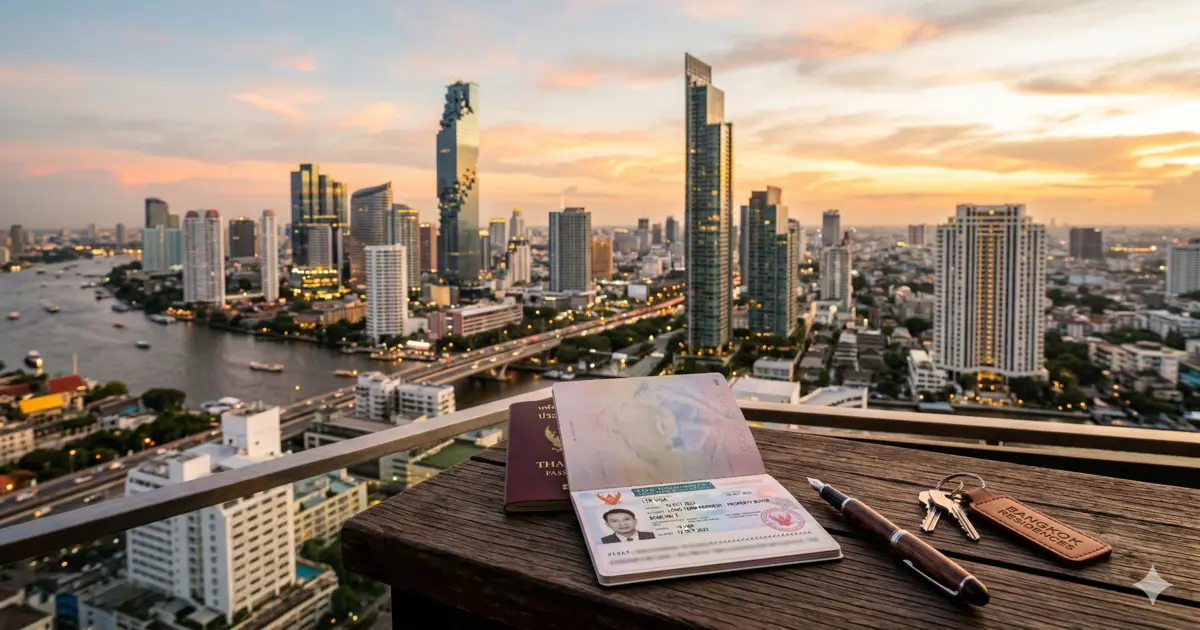
You've found your dream condo in Bangkok. The view is stunning, the price is right, and the agent tells you purchasing it will secure your right to live in Thailand. That agent is wrong.
Thailand is one of the most attractive real estate markets in Southeast Asia for foreign buyers — but it is also one of the most misunderstood when it comes to immigration. Unlike European Golden Visa programs where buying property grants automatic residency, Thailand strictly separates property ownership from visa rights. You can own a ฿50 million penthouse and still be deported if your tourist visa expires.
This guide breaks down every visa option available to foreign property buyers in 2026, including costs, duration, property rights, tax implications, and work permits — so you can make an informed decision before you sign anything.
The Myth: Buying Property Does NOT Give You a Visa
Critical Warning
Purchasing real estate in Thailand does not automatically grant residency, a visa, or any immigration rights. You must qualify for and obtain a visa through a separate application process.
This is the single most important fact for every foreign buyer to understand. Under Thai law, acquiring a condominium or villa gives you a property title — not a right to stay. Unless you explicitly qualify for one of the visa programs below, you remain subject to standard tourist visa limitations, which the government is tightening from 60 to 30 days visa-free in 2026.
Here's what foreigners can own:
- Condominium freehold — Full ownership in your name, registered with a Chanote (Nor Sor 4 Jor) title deed. Limited to 49% foreign quota per building. Funds must be wired from overseas with a Foreign Exchange Transaction (FET) form.
- Leasehold — Maximum 30-year lease on land, often with contractual renewal promises. The physical building can be owned separately via a Superficies right registered at the Land Department.
- No land ownership — Foreigners cannot own land in Thailand under the Land Code.
One more misconception: the yellow Tabien Baan (House Registration Book) issued to foreigners is not proof of ownership. It is merely an administrative certificate of residence for utilities and services.
Thailand Privilege Visa (Formerly Elite): The Premium Route
The Thailand Privilege Visa — rebranded from the famous "Elite Visa" — is the most popular long-stay option for affluent foreigners who want zero bureaucratic friction. No financial proof, no employment docs, no annual reporting. You pay a membership fee and receive a multiple-entry visa with airport fast-track, a personal liaison, and lifestyle perks through a points system.
| Tier | Duration | Cost | Family Add-on | Points/Year |
|---|---|---|---|---|
| Bronze | 5 years | ฿650,000 (~$18,000) | ฿650,000 | 0 |
| Gold | 5 years | ฿900,000 (~$24,800) | ฿900,000 | 20 |
| Platinum | 10 years | ฿1,500,000 (~$41,500) | ฿500,000* | 35 |
| Diamond | 15 years | ฿2,500,000 (~$69,000) | ฿500,000* | 55 |
| Reserve | 20 years | ฿5,000,000 (~$138,000) | ฿500,000* | 120 |
*Promotional family rate expires March 31, 2026. Bronze tier is also a time-limited promotional offer.
Important Limitations
The Privilege Visa does not include a work permit, does not grant special property rights beyond standard foreign ownership rules, and does not provide any tax benefits. The fee is a non-refundable sunk cost — unlike Malaysia's recoverable deposit model.
Best for: Affluent retirees who want hassle-free long-stay without annual renewals. Apply directly at thailandprivilege.co.th.
LTR Visa: The Best Deal for Serious Investors
The Long-Term Resident (LTR) Visa is the single most powerful visa for foreign property buyers. Administered by the Board of Investment (BOI), it offers 10-year residency, a digital work permit, and — most importantly — full tax exemption on foreign income for most categories.
At just ฿50,000 application fee, it costs a fraction of the Privilege Visa while delivering far more benefits.
The 4 LTR Categories
| Category | Key Requirements | Tax Benefit |
|---|---|---|
| Wealthy Global Citizen | $1M global assets + $500K invested in Thailand (property qualifies) | Exempt from foreign income tax |
| Wealthy Pensioner | Age 50+, $80K annual pension (or $40K + $250K in Thai property) | Exempt from foreign income tax |
| Work-From-Thailand | $80K income (or $40K + master's/patent), employer revenue $50M+ | Exempt from foreign income tax |
| Highly-Skilled Professional | $80K income (or $40K institutional), BOI targeted industries | Flat 17% income tax |
Why This Matters for Property Buyers
The LTR is the only visa that directly integrates property purchase into its qualification criteria. A $500K condo purchase can simultaneously satisfy the Wealthy Global Citizen investment requirement AND provide you with 10 years of tax-exempt residency. No other visa does this.
2026 Updates from Tilleke & Gibbins: the $80K income requirement was removed for Wealthy Global Citizens, the employer revenue threshold for remote workers dropped from $150M to $50M, the 5-year work experience mandate was abolished, and same-sex spouses are now fully recognized as dependents.
Apply at ltr.boi.go.th.
Direct Investment Visas: 3M and 10M THB Routes
The 3 Million THB Condo Visa
This is the "buy a condo, get a visa" scheme that developers love to promote. Purchase a new condominium worth at least ฿3 million (~$90,000) from a Thai developer, and you can apply for a one-year renewable long-stay visa.
But the restrictions are severe:
- Must be a newly built unit purchased directly from a developer — resales do not qualify
- The full ฿3M must be wired from overseas in foreign currency with an FET form
- Must be renewed annually with ongoing proof of ownership
- No work permit included
- Standard tax rules apply — no exemptions
This visa has faced strong opposition. The president of the Phuket Tourist Association argued that the ฿3M threshold is "dangerously low" and risks attracting non-quality visitors who exploit loopholes to conduct illicit businesses.
The 10 Million THB Investment Visa
A more flexible one-year renewable visa for high-net-worth buyers. Unlike the 3M condo visa, the ฿10 million (~$280,000) threshold can be met through a diversified portfolio:
- Newly built condominium purchase
- Registered long-term lease (minimum 3 years)
- Fixed deposit at a Thai commercial bank
- Thai government bonds or state enterprise bonds
According to Tilleke & Gibbins, applicants must hold a Non-Immigrant visa first, prove the ฿10M was remitted from abroad, and present the registered Chanote title deed. No work permit is included.
Destination Thailand Visa: The Digital Nomad Play
The DTV (Destination Thailand Visa) has become the dark horse of Thai immigration — offering almost identical geographic access to the Privilege Gold tier at a fraction of the cost.
| Feature | DTV | Privilege Gold |
|---|---|---|
| Cost | ฿10,000 (~$300) | ฿900,000 (~$24,800) |
| Duration | 5 years, multiple-entry | 5 years, multiple-entry |
| Stay per Entry | 180 days (extendable) | 1 year per entry |
| Work Permit | No (offshore only) | No |
| Tax Benefits | None | None |
Requirements: ฿500,000 bank balance, health insurance (฿40,000 inpatient / ฿10,000 outpatient), and proof of remote employment or enrollment in cultural programs (Muay Thai, culinary arts, etc.).
Tax Trap for Nomads
If you stay 180+ days in a calendar year, you become a Thai tax resident — your offshore salary becomes subject to progressive income tax (up to 35%) when remitted. Stay under 180 days or consider the LTR Work-From-Thailand category for tax exemption.
Apply at any Royal Thai Embassy.
Smart Visa: For Entrepreneurs and Tech Talent
The Smart Visa targets foreigners working in Thailand's "S-Curve" industries: next-gen automotive, smart electronics, medical tourism, robotics, aviation, digital business, and environmental management.
Key benefits: up to 4-year continuous stay, no work permit required (exempt), and no 4:1 Thai-to-foreigner employee ratio. The Startup (S) category requires a 25% share in a tech startup in a targeted industry plus a ฿600,000 deposit.
For property buyers who are also entrepreneurs, this visa provides operational legitimacy for running a Thai business — though standard property rules and tax obligations still apply.
Retirement Visa: The Classic Choice for Over-50s
The Non-Immigrant O-A (Retirement) Visa remains the most widely used long-stay visa for foreign retirees buying property in Thailand.
Requirements: Age 50+, plus either ฿800,000 maintained in a Thai bank account (2 months prior to application) or monthly income of ฿65,000 (~$1,850). The visa is valid for one year and renewable indefinitely from within Thailand.
Limitations: No work permit, mandatory 90-day immigration reporting, annual renewal with fresh financial proof, and no tax benefits. Many affluent retirees eventually upgrade to the Diamond Privilege tier (15 years, no reporting) or the LTR Wealthy Pensioner route (10 years, tax-exempt) to avoid annual bureaucracy.
Apply at any Thai embassy or extend from within Thailand at your local Immigration Bureau office.
Marriage Visa: Property Rights for Foreign Spouses
Foreign nationals married to Thai citizens can obtain a Non-Immigrant O (Marriage) Visa with lower financial requirements: ฿400,000 bank deposit or ฿40,000 monthly income. Uniquely, this visa allows you to apply for a work permit.
Property rights under a marriage visa are complex:
- Land must be registered solely in the Thai spouse's name. The foreign spouse must sign a declaration at the Land Department confirming all funds used are the Thai spouse's "separate property."
- The house built on the land can be registered as jointly owned marital property. Neither spouse can sell or mortgage it without the other's consent.
- Condominiums can be purchased by the foreign spouse in their own name under standard 49% quota rules.
According to Siam Legal, this joint management structure provides meaningful asset protection — but it requires careful legal structuring before purchase.
2026 Tax Rules Every Property Buyer Must Know
Thailand's tax landscape shifted dramatically in 2024 and continues evolving in 2026. If you plan to live in Thailand and buy property, you must understand these rules — they directly affect how you fund your purchase.
The 180-Day Rule
Any individual residing in Thailand for 180 days or more in a calendar year becomes a Thai tax resident, subject to progressive Personal Income Tax from 5% to 35%.
The 2024 Remittance Shock
Before 2024, foreign-sourced income was only taxed if remitted to Thailand in the same year it was earned. You could simply wait until January 1 to wire money tax-free. Revenue Department Orders 161/2566 and 162/2566 closed this loophole entirely — all foreign income earned from 2024 onward is taxable upon remittance, regardless of timing.
The 2026 Relief
Recognizing the chilling effect on property markets, the Revenue Department drafted a two-year grace period. Foreign income earned from 2024+ is exempt if remitted within the same year or the following year. For example, 2025 offshore income remitted in 2025 or 2026 to buy a condo = tax-free. But the same income remitted in 2027 = fully taxable.
LTR Holders Are Exempt
If you hold an LTR Visa (Wealthy Global Citizen, Wealthy Pensioner, or Work-From-Thailand), you are completely exempt from these remittance tax rules. This is arguably the LTR's most valuable feature — unlimited offshore capital can be remitted tax-free for property purchases or living expenses.
Sources: HLB Thailand, Nishimura & Asahi, Forvis Mazars.
Thailand vs. Malaysia vs. Philippines: Which Is Better?
Thailand is not the only game in Southeast Asia. Here's how it stacks up against the region's two main competitors for foreign property investors:
| Feature | Thailand (Privilege) | Malaysia (MM2H) | Philippines (SRRV) |
|---|---|---|---|
| Visa Duration | 5–20 years | 10–20 years | Indefinite |
| Capital Model | Non-refundable fee ($18K–$138K) | Recoverable deposit ($150K–$1M) | Recoverable deposit ($15K–$50K) |
| Land Ownership | No | Yes (freehold) | No (condo only) |
| Tax on Foreign Income | Progressive 5–35% | Territorial (exempt) | Pensions exempt |
| Path to Citizenship | None | None | Yes (10 years) |
| Deposit Convertible to Property | No (fee consumed) | 50% after 1 year | Yes (condo purchase) |
Bottom line: For pure capital efficiency and property rights, Malaysia's MM2H wins — your deposit earns interest and you can buy freehold land. The Philippines offers the cheapest entry and a citizenship path. But Thailand's LTR Visa bridges the gap with its unique combination of property-as-qualifying-investment plus complete foreign income tax exemption.
Which Visa Should YOU Get? A Persona Guide
| You Are... | Best Visa | Why |
|---|---|---|
| Ultra-HNW investor ($1M+ assets) | LTR — Wealthy Global Citizen | $500K condo = visa + 10yr stay + tax-exempt. Unbeatable ROI. |
| Digital nomad, buying a base | DTV | $300 for 5yr visa. Stay under 180 days to avoid tax. Search condos under ฿3M. |
| Early retiree (40–49) | Privilege Platinum/Diamond | Too young for retirement visa or LTR Pensioner. Costly but only option. Consider MM2H instead. |
| Retiree (50+, $80K+ pension) | LTR — Wealthy Pensioner | 10yr stay, no 90-day reporting, pension income tax-exempt. |
| Retiree (50+, modest pension) | Retirement Visa (Non-O-A) | ฿800K deposit in Thai bank. Annual renewal, but lowest barrier. See Chiang Mai properties. |
| Married to a Thai national | Marriage Visa (Non-O) | ฿400K deposit + can get work permit. House jointly owned, land in spouse's name. |
| Tech entrepreneur | Smart Visa (Startup) | 4yr visa, no work permit needed, no 4:1 ratio. Must be in S-curve industry. |
Not sure which area to buy in? Our AI-powered search can find properties matching your budget, visa strategy, and lifestyle preferences across Thailand's top areas for foreign buyers.
Sources & References
- Thailand Privilege Card (Official) — Official site for Privilege Visa tiers, pricing, and membership benefits
- BOI Long-Term Resident Visa Program — Official LTR application portal with 4-category requirements
- BOI LTR Visa Presentation (March 2026) — Latest BOI updates including 2026 regulatory easing
- Tilleke & Gibbins — Thailand Eases LTR Requirements — Legal analysis of 2026 LTR visa changes
- Tilleke & Gibbins — One-Year Visas for Condo Owners — Legal guide on 3M/10M THB investment visas
- Tilleke & Gibbins — BOI Land Ownership Regulations — 2026 e-Land system rules for corporate ownership
- DFDL — Building Ownership in Thailand — Superficies rights and house/land separation
- Siam Legal — LTR Visa Thailand 2026 — Comprehensive LTR requirements and tax benefits
- Siam Legal — Thailand Privilege Visa 2026 Guide — All tiers, pricing, and point system details
- Siam Legal — DTV Visa Thailand 2026 — Requirements, costs, and eligibility criteria
- Siam Legal — Property Ownership Through a Thai Spouse — Marriage visa property rights and legal structuring
- Savills — Foreign Buyer's Guide to Thai Property Law (2025) — FET forms, foreign quota, and ownership structures
- CBRE Thailand 2026 Outlook — Market analysis and developer pivot to luxury/foreign buyer segments
- Bangkok Post — Buy Property, Get Visa Controversy — Phuket opposition to 3M THB condo visa scheme
- Bangkok Post — MFA Proposes 30-Day Visa-Free — Thailand tightening tourist visa enforcement
- HLB Thailand — Foreign Income Remittance Tax Relief — 2026 two-year grace period for remittances
- Nishimura & Asahi — Tax Exemption for Foreign Income — Legal analysis of Revenue Department proposals
- BOI Smart Visa Program — Official Smart Visa application and eligibility
- Thai Immigration Bureau — Official immigration services and visa extensions
- Global Property Guide — Thailand Market Analysis 2026 — Property market data and yield analysis
- Global Residence Index — Malaysia MM2H Guide — MM2H tiers, deposit requirements, and property rules
- Philippine Retirement Authority — SRRV Program — Deposit requirements and condo conversion rules
- IMI Daily — Southeast Asian Investor Visas Compared (2026) — Regional residency-by-investment comparison
This article was researched using Gemini Deep Research (100+ verified sources) and written with AI assistance. It is intended as a general guide and does not constitute legal or immigration advice. Consult a qualified Thai immigration lawyer before making visa or property decisions. Last updated: March 25, 2026.