Hidden Costs of Buying Property in Thailand: Taxes, Fees & What Nobody Tells You
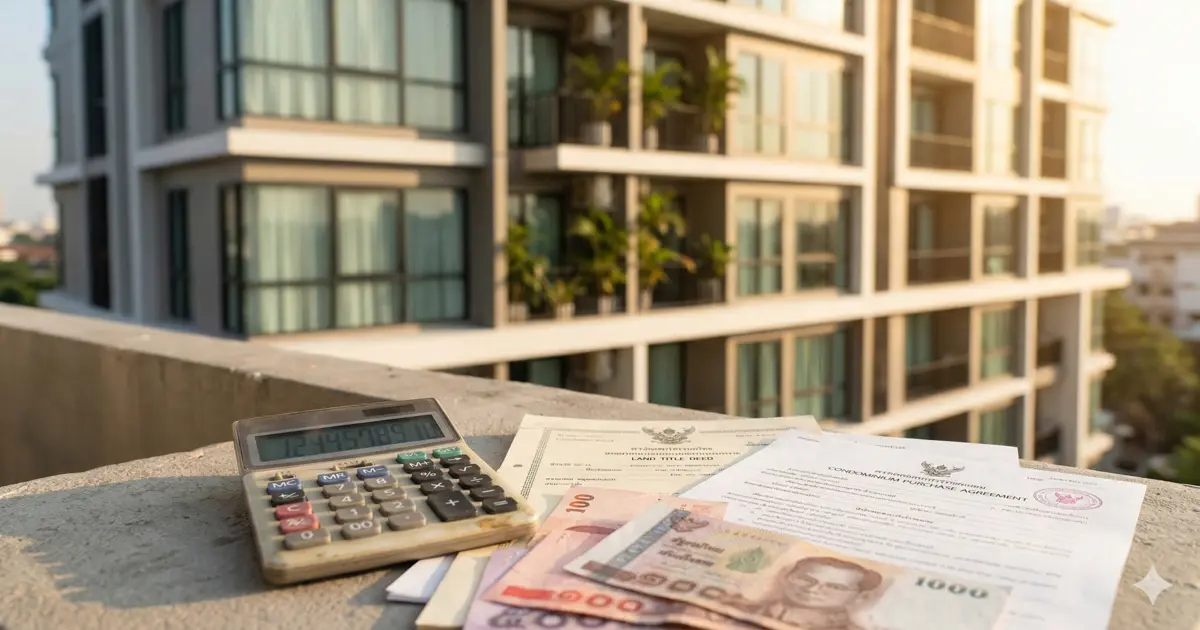
You found the perfect condo in Bangkok. The listing says 3 million baht. You budget 3 million baht. Then the bills start arriving — transfer fees, sinking funds, legal fees, furniture, utility deposits — and suddenly you're spending 15% to 20% more than you planned.
This is the reality for nearly every foreign buyer in Thailand. The base price is just the beginning. This guide breaks down every cost you'll encounter — from government taxes to the furniture package — so you can budget accurately and avoid the surprises that catch first-time buyers off guard.
Government Transfer Fees & Taxes
Every property transfer in Thailand triggers taxes calculated at the Land Office. The critical detail most buyers miss: all fees are based on either the registered sale price or the government's appraised value, whichever is higher.
| Tax / Fee | Rate | Who Pays | When It Applies |
|---|---|---|---|
| Transfer Fee | 2.0% | Split 50/50 or negotiated | Every transfer |
| Specific Business Tax (SBT) | 3.3% | Seller | If sold within 5 years |
| Stamp Duty | 0.5% | Seller | Only if SBT doesn't apply |
| Withholding Tax (Corporate) | 1.0% | Seller | Corporate seller only |
| Withholding Tax (Individual) | 1–3% | Seller | Progressive calculation |
Watch Out: The "50/50 Split" Myth
For new developments, consumer protection laws cap the buyer's share of the transfer fee at 1%. But in resale transactions, the split is entirely negotiable. In a seller's market, you may find yourself paying the full 2%. Always check your Sale and Purchase Agreement carefully.
SBT vs. Stamp Duty: These two are mutually exclusive. If the property was owned for less than 5 years, the seller pays 3.3% SBT. If owned for 5+ years, they pay 0.5% stamp duty instead. As a buyer, this matters because sellers facing SBT often try to pass costs through negotiation.
The Withholding Tax Trap
The withholding tax for individual sellers isn't a flat rate — it's a progressive calculation that catches many by surprise. The Land Office applies a standard deduction based on years of ownership:
| Years Owned | Deduction | Effective WHT |
|---|---|---|
| 1 year | 92% | ~1% |
| 3 years | 77% | ~1.5% |
| 5 years | 65% | ~2% |
| 8+ years | 50% | ~3% |
While this is technically the seller's cost, understanding it matters when you sell your property in the future. Plan your exit strategy around the 5-year mark to avoid the SBT and benefit from a higher deduction.
Legal Fees: What Good Lawyers Actually Cost
Skipping a lawyer to "save money" is the most expensive mistake foreign buyers make in Thailand. There's no centralized escrow system, no title insurance, and no consumer protection agency that will bail you out after a bad purchase.
| Service | Cost (THB) | What You Get |
|---|---|---|
| Title Search | 15,000–25,000 | Chanote verification, liens, encumbrances |
| Contract Review (SPA) | 15,000–30,000 | Amendment of developer's standard agreement |
| Transfer Representation | 10,000–20,000 | Physical presence at Land Office |
| Leasehold Structuring | 40,000–80,000 | 30-year lease + renewal + inheritance clauses |
What a Good Lawyer Should Check
Foreign quota verification (is the building under the 49% limit?), encumbrance search (mortgages, servitudes), litigation check (is the seller or developer in legal disputes?), and for off-plan: EIA approval and construction permits. Budget 30,000–70,000 THB total for a standard condo purchase.
Agent Commissions & the "Foreign Price"
Good news: in Thailand, the seller pays the agent's commission. Bad news: that doesn't mean you're not paying for it indirectly.
| Location | Commission | Negotiability |
|---|---|---|
| Bangkok CBD | 3% + 7% VAT | Low |
| Phuket / Samui | 5% | Moderate |
| Chiang Mai | 3% | High |
Warning: The "Foreign Price"
Some agents and developers inflate prices for international buyers to cover higher marketing costs or commissions. Always verify the price per square meter by checking local Thai-language listings, asking neighbors in the building, or browsing our search page for comparable properties.
Condominium: Sinking Fund & CAM Fees
Two costs that blindside first-time condo buyers: the sinking fund (one-time) and Common Area Maintenance (CAM) fees (monthly, but often paid 12 months in advance at transfer).
Sinking Fund
A one-time payment into a capital reserve for major repairs (elevator replacement, roof, structural work). Typically 300–800 THB per square meter. For a 50 sqm condo, expect 15,000–40,000 THB.
CAM Fees by Location
| Location | CAM (THB/sqm/mo) | 50 sqm Monthly | 12-Month Advance |
|---|---|---|---|
| Bangkok (Sukhumvit) | 50–90 | 2,500–4,500 | 30,000–54,000 |
| Phuket (Luxury) | 70–120 | 3,500–6,000 | 42,000–72,000 |
| Chiang Mai | 30–60 | 1,500–3,000 | 18,000–36,000 |
| Pattaya | 35–60 | 1,750–3,000 | 21,000–36,000 |
Leasehold: Registration & Renewal Costs
If you're buying a villa or house on leased land (the only option for foreigners wanting landed property), there are specific costs beyond the purchase price. For more on how this may change, see our guide to the proposed 99-year leasehold law.
- Lease Registration Fee: 1% of the total rent payable over the full 30-year term
- Stamp Duty on Lease: 0.1% of total lease value
- Renewal costs: Contractual only — the Land Office doesn't automatically honor "30+30+30" structures. Budget for legal fees and potential government fee increases at each renewal
The Renewal Cost Nobody Mentions
When your 30-year lease expires and you want to renew, you'll need to pay the registration fee again (1% of the new term's total rent), plus legal fees to draft a new lease, plus any increase in government fees. This future cost is almost never discussed at the point of sale.
The FET Form: Thailand's Money Trail Requirement
To legally own a condominium in your own name, you must provide the Land Office with a Foreign Exchange Transaction (FET) form — proof that your purchase funds came from outside Thailand and were converted to Thai Baht through a domestic bank.
Hidden FET Costs
- Exchange rate spread: Thai banks charge 0.5–2.0% on the mid-market rate — on a 5M THB transfer, that's 25,000–100,000 THB lost to conversion
- SWIFT/transfer fees: 500–1,500 THB per inward transfer
- Purpose correction fees: If your wire transfer doesn't state the exact purpose ("To purchase condominium unit X at [building]"), the bank charges to amend the FET record
Critical: Keep Your FET Form Forever
Losing your original FET form can make it impossible to repatriate funds when you sell the property. The FET is your proof that the money came in legally, and without it, the bank cannot send it back out. Store copies in multiple locations.
Mortgage & Financing Costs for Foreigners
Getting a mortgage as a foreigner in Thailand is possible but expensive. Only a few banks offer products, and the terms are significantly less favorable than domestic loans.
| Component | Terms for Foreigners |
|---|---|
| Loan-to-Value (LTV) | 50–60% (villas rarely financed) |
| Interest Rates | 5.0–8.0% variable (MRR-based) |
| Mortgage Registration | 1.0% of loan amount |
| Valuation Fee | 3,000–10,000 THB |
| Processing Fee | 1.0–1.25% of loan amount |
| Credit Life Insurance | Mandatory for most foreign loans |
| Available Banks | Bangkok Bank, UOB, ICBC |
Given these costs, many investors prefer developer installment plans — typically 0% interest during construction with 20–30% down payment spread over 12–24 months.
Annual Ownership Costs
Land & Building Tax
Thailand's property tax rates are refreshingly low compared to Western countries. For residential property (not your primary residence):
| Appraised Value | Tax Rate | Annual Tax on 5M THB |
|---|---|---|
| 0–10 million THB | 0.02% | 1,000 THB |
| 10–50 million THB | 0.03% | — |
| 50–100 million THB | 0.05% | — |
| Over 100 million THB | 0.10% | — |
That's right — a 5 million THB investment property costs just 1,000 THB per year in property tax. However, if left vacant, the rate increases by 0.3% every three years, up to a maximum of 3%.
Rental Income Tax
If you rent out your property, you owe Thai personal income tax on the rental income — regardless of your residency status. The good news: you get a standard 30% deduction for expenses before the progressive rates kick in (5% on 150K–300K THB, 10% on 300K–500K THB, etc.).
Warning: Non-Compliance Penalties
Failing to file rental income tax can result in a 200% penalty on the assessed amount plus a 1.5% monthly surcharge. The Revenue Department is actively cross-referencing Airbnb and booking platform data with property ownership records in 2026.
Renovation & Move-In Costs
| Cost Item | Range (THB) |
|---|---|
| Renovation (standard) | 6,000–15,000 per sqm |
| Renovation (luxury) | 50,000+ per sqm |
| Furniture package (1BR, 35–45 sqm) | 350,000–600,000 |
| Electricity meter deposit | 300–6,000 |
| Water meter deposit | 500–2,000 |
| Internet & cable setup | 1,000–3,000 |
For a fully furnished new-build condo, most of these costs don't apply. But for resale properties or bare-shell units, furniture alone can add 10–15% to your total spend.
All-In Cost: 3 Real Scenarios
Here's what you'll actually spend, from signing to moving in, for three common investment scenarios in 2026:
Scenario A: Entry-Level Condo in Bangkok (35 sqm)
| Cost Item | Amount (THB) |
|---|---|
| Purchase Price | 3,000,000 |
| Transfer Fee (buyer 1%) | 30,000 |
| Legal Fees | 35,000 |
| Sinking Fund (500/sqm) | 17,500 |
| CAM Fees (12 months advance) | 21,000 |
| Utility Deposits | 5,000 |
| Furniture Package | 350,000 |
| Total All-In | 3,458,500 (115.3%) |
Scenario B: Luxury Condo in Phuket (65 sqm)
| Cost Item | Amount (THB) |
|---|---|
| Purchase Price | 7,000,000 |
| Transfer Fee (buyer 1%) | 70,000 |
| Legal Fees | 55,000 |
| Sinking Fund (600/sqm) | 39,000 |
| CAM Fees (12 months) | 62,400 |
| Utility Deposits | 6,500 |
| Furniture & Decoration | 750,000 |
| Total All-In | 7,982,900 (114.0%) |
Scenario C: Villa on Leasehold in Koh Samui (150 sqm)
| Cost Item | Amount (THB) |
|---|---|
| Purchase Price | 15,000,000 |
| Lease Registration (1%) | 150,000 |
| Stamp Duty on Lease (0.1%) | 15,000 |
| Legal Fees (Lease Structuring) | 75,000 |
| Sinking Fund (800/sqm) | 120,000 |
| Maintenance (12 months) | 180,000 |
| Utility Installation (3-Phase) | 15,000 |
| Furniture & Landscaping | 2,500,000 |
| Total All-In | 18,055,000 (120.4%) |
The Rule of Thumb
Budget 15–20% above the listed price for your total all-in cost. Condos land around 114–115%, while villas with leasehold structuring and landscaping can reach 120%. The higher the price point, the more room for negotiation on fees — but also the more expensive the furniture.
Scams & Red Flags to Watch For
The Nominee Crackdown (2026)
Using a Thai "nominee" to hold land on your behalf has always been illegal. In 2026, enforcement has intensified: the Department of Business Development (DBD) and Land Department are actively cross-referencing company ownership data to identify proxy structures. Proposed amendments may allow asset forfeiture to the state without compensation.
Guaranteed Rental Returns (GRR)
Developers offering "8% guaranteed returns for 5 years" often inflate the property price by 15–20% to fund the guarantee. You're essentially paying yourself back. When the GRR period ends, hidden management fees appear and actual yields drop to 3–4%.
Transfer Fee Promises
Some developers promise to "pay all transfer fees" during the sales pitch. Check the SPA carefully — this promise sometimes applies only to the first transfer, or expires after a deadline. Get it in writing in the contract, not in a marketing brochure.
Tax Treaty Implications by Nationality
Starting in 2026, Thailand strictly enforces taxation on all foreign income remitted into the country by tax residents (180+ days). Your nationality determines your exposure:
| Nationality | Key Consideration |
|---|---|
| US Citizens | Must report global income to IRS. Thai-US DTA allows Foreign Tax Credits. Some pensions/Social Security exempt under treaty. |
| UK Nationals | SIPPs complex — Thailand may tax remitted pension income. ISAs NOT recognized as tax-exempt in Thailand. |
| Australians | Franking credits not recognized by Thai Revenue. Strategy: stage remittances across tax years to stay in lower brackets. |
| Chinese Buyers | Capital outflow restrictions are the main hurdle. Meticulous FET documentation essential. |
| Russian Buyers | Third-party banking hubs common. FET must clearly show the foreign purchaser's name. |
The LTR Visa Shield
Thailand's Long-Term Resident (LTR) Visa grants a full exemption on foreign-sourced income brought into the country. If you qualify (wealthy global citizen, pensioner, work-from-Thailand professional, or highly skilled professional), this visa can save you tens of thousands in annual taxes. It's the single most effective tax-planning tool available in 2026.
Ready to browse properties with a realistic budget? Start with our complete guide to foreign ownership to understand the legal framework first, then come back here to plan your actual spend.
Sources & References
- Thai Revenue Department — Personal Income Tax Rates & Withholding Tax Schedules
- Thai Land Department (DOL) — Transfer Fee Schedules & Registration Requirements
- Treasury Department — Government Appraised Value Cycles (2023–2026)
- Office of the Council of State (Krisdika) — Civil and Commercial Code, Sections 537–571
- Siam Legal — Property Purchase Fees & Legal Services for Foreigners
- Tilleke & Gibbins — Foreign Property Ownership Due Diligence Guide
- DFDL — Thailand Land & Building Tax Guide (2020 Reform)
- CBRE Thailand — Market Outlook & Transaction Cost Analysis
- Knight Frank Thailand — Residential Market Research
- Savills Thailand — Bangkok Condominium Market Report
- Board of Investment (BOI) — Long-Term Resident (LTR) Visa Program
- ExpatDen — Complete Guide to Buying Property in Thailand
- FazWaz — Property Buying Guide & Fee Calculator
- Global Property Guide — Thailand Transaction Costs & Rental Yields
- Bangkok Bank — Home Loan Products for Foreign Nationals
This article was researched using Gemini Deep Research (42 verified sources) and written with AI assistance. All tax rates and fee structures are for educational reference only — consult a qualified Thai tax advisor and property lawyer before making investment decisions. Last updated: March 19, 2026.