Thailand's 99-Year Leasehold: What It Means for Foreign Property Buyers in 2026
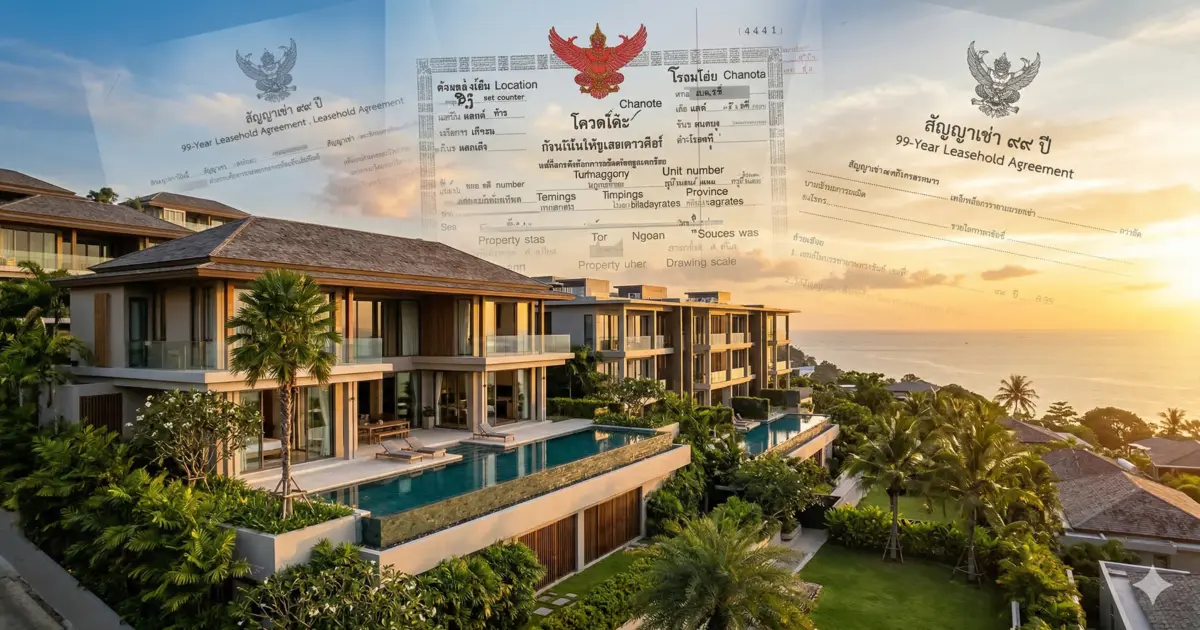
For decades, the dream of owning a beachfront villa in Phuket or a mountain retreat in Chiang Mai has come with a hard legal ceiling: 30 years. That's the maximum lease term Thailand allows foreigners to register on land they cannot own outright. But in 2026, a proposed amendment could rewrite the rules entirely — extending that limit to 99 years and fundamentally changing what it means for foreigners to invest in Thai property.
This isn't just a policy tweak. It's the most significant reform to Thailand's land tenure system since the Condominium Act of 1979, and it has the potential to unlock billions of baht in foreign investment while reshaping the competitive landscape of Southeast Asian real estate.
Here's everything you need to know — the law, the politics, the risks, and what you should be doing right now while the legislation works its way through parliament.
What Is the 99-Year Leasehold Proposal?
The proposed amendment to the Rights Over Leasehold Asset Act would extend the maximum registered leasehold term from 30 years to 99 years for non-agricultural land. This covers residential, commercial, and industrial plots — essentially every property type a foreign buyer would be interested in.
Championed by the Ministry of Interior and fast-tracked under Prime Minister Paetongtarn Shinawatra's administration, the reform is being positioned alongside another major proposal: raising the foreign condominium ownership quota from 49% to 75%.
Key Takeaway
The 99-year leasehold isn't just about longer leases. It's a shift from a "tenant" model to a "de-facto ownership" model — with rights to mortgage, transfer, and inherit the lease without requiring landlord consent for every transaction.
The reform also introduces a reversionary mechanism: land used for 99-year leases may be transferred to the Treasury Department, ensuring it reverts to state ownership at the end of the term. This clever structure allows the government to argue that Thai sovereignty over land is preserved — the state always gets it back — while giving foreign investors the multi-generational security they need.
Understanding the Current 30-Year Limit
Before we look forward, you need to understand what's been holding the market back. Thailand's current leasehold framework is governed by Sections 540 and 546 of the Civil and Commercial Code (CCC):
- Section 540: Any lease made for a period exceeding 30 years is automatically reduced to 30 years by operation of law.
- Section 546: Any pre-agreed renewal that, combined with the initial term, exceeds 30 years is rendered void.
The market's workaround? The infamous "30+30+30" structure, where developers promise two subsequent renewals to reach a total of 90 years. Sounds reassuring in a sales brochure. In practice, it's been a legal fiction — and one of the red flags foreign buyers should watch for.
Important Distinction
A registered lease is a property right (enforceable against anyone). A renewal promise is a personal contract (only binding between the original parties). If the landowner dies, sells the land, or simply refuses — your "90-year lease" could evaporate after year 30.
Supreme Court Rulings That Changed Everything
The final nail in the coffin for the "30+30+30" myth came from Thailand's highest court. These rulings are the reason the 99-year reform became politically necessary:
| Ruling | Principle | Impact |
|---|---|---|
| No. 4655/2566 (2025) | Prepaid 30+30+30 renewals are void as property rights | Killed the "90-year lease" myth entirely |
| No. 5277/2540 (1997) | Lessors may lawfully refuse renewal without damages | No legal recourse when landlord says no |
| No. 1213/2517 (1974) | Renewal clauses don't bind heirs or successors | Inheritance = renewal risk for lessees |
| Interior Ministry 2008 | Land Offices must reject auto-renewal leases | Administrative enforcement of 30-year cap |
The 2025 ruling was the catalyst. By closing the door on contractual workarounds, the Supreme Court essentially forced the government's hand: either create a proper legal framework for long-term foreign tenure, or watch investment flow to Phuket's competitors in the Philippines and Malaysia.
How the 99-Year Lease Would Work
The proposed framework introduces several radical departures from the existing system:
- Registered Property Right: The 99-year term would be a fully registered lease — not a contractual promise, but an enforceable property right recorded at the Land Office.
- Transfer & Mortgage Rights: Lessees could mortgage the lease, sell (assign) it to another buyer, or pass it to heirs — all without requiring the landlord's separate consent for each transaction.
- State Reversionary Model: Land may be transferred to the Treasury Department, making the state the ultimate "landlord." At year 99, land and improvements revert to the state as sovereign wealth.
- Non-Agricultural Only: The law would cover residential, commercial, and industrial land. Agricultural plots remain excluded.
Why This Matters
The "state reversionary" model is politically brilliant. It deflects the nationalist argument that Thailand is "selling land to foreigners" — because legally, the state always gets it back. Meanwhile, 99 years is long enough that it functions as de-facto ownership for any living buyer.
Thailand vs. ASEAN: Who Offers What?
Thailand's reform doesn't exist in a vacuum. It's a direct response to competitors who've been liberalizing their own property laws to attract foreign capital. The most significant catalyst was the Philippines' Republic Act 12252 (September 2025), which extended foreign lease terms from 50 to 99 years.
| Country | Land Ownership | Max Lease | Condo Quota |
|---|---|---|---|
| Thailand (Proposed) | Prohibited | 99 Years | 49% → 75% |
| Philippines | Prohibited | 99 Years (2025) | 40% |
| Singapore | Restricted (SLA) | 99 Years | 100% |
| Malaysia | Permitted (min price) | N/A (Freehold) | No cap |
| Vietnam | Prohibited (State) | 50 Years | 30% |
| Cambodia | Prohibited | 50 Years | Freehold (floors 2+) |
| Indonesia | Prohibited | 80 Years | Special zones |
With the Philippines now matching Singapore's 99-year standard, Thailand risks being left behind at 30 years — a position that's increasingly untenable for attracting serious institutional capital. The reform would put Thailand on equal footing with the region's leaders.
The Game Changer for Villas and Houses
This is where the 99-year lease becomes truly transformative. Under current law, foreigners cannot own land in Thailand. Period. If you want a villa in Phuket or a house in Chiang Mai, you can own the building (freehold) but only lease the land (30 years). This creates what the industry calls a "wasting asset" — as your lease shortens, your property's resale value drops because the next buyer inherits less time.
A 99-year lease dissolves this problem in three critical ways:
- Mortgageability: Banks are far more willing to finance a 99-year lease because the tenure exceeds typical 20–30 year loan terms. Currently, most Thai banks won't lend against a short-term leasehold.
- Inheritance: A 99-year right enables multi-generational transfer, mirroring the family legacy benefits of freehold. Your children — even grandchildren — can inherit meaningful tenure.
- Renovation Incentive: With near-lifetime security, owners invest more in upgrades — pools, solar panels, EV charging — rather than treating the property as a depreciating rental.
For developers, this opens an entirely new market segment: luxury branded residences (Ritz-Carlton, Banyan Tree, Aman) that currently struggle to sell leasehold villas to sophisticated buyers who understand the 30-year risk.
What This Means for Property Prices
Data from Singapore and Hong Kong — mature markets where 99-year leaseholds are standard — provides a useful framework for predicting price impact.
| Market Indicator | Data |
|---|---|
| Singapore: Value change per 1% lease change | ≈ 1.46% |
| UK: Discount for leases 60–79 years | 15–35% below extended value |
| Hong Kong: "Reneging risk" discount | 8–14% for unprotected leases |
| Projected Thai villa appreciation (30yr → 99yr) | 20–35% one-time increase |
The jump from 30 to 99 years represents a 230% increase in tenure. Adjusted for time-value and reduced depreciation risk, existing leasehold villas in prime locations could see a one-time capital appreciation of 20–35% once the law is enacted.
The 80-Year Threshold
UK and Singapore data shows that once a lease drops below 80 years, "marriage value" (the premium paid to extend) increases sharply, eroding property value. Starting at 99 years gives buyers a ~20-year buffer before this erosion begins.
CBRE Thailand forecasts that luxury and super-luxury segments in downtown Bangkok will see average asking prices increase by up to 15% year-over-year in 2026, driven partly by anticipation of the leasehold reform.
Foreign Buyer Statistics (2024–2026)
Despite the legal uncertainty, foreign buyers have been the primary stabilizer of Thailand's property market. While domestic transfers fell 9.1% in 2025, foreign ownership transfers actually increased:
| Metric | 2024 | 2025 | Change |
|---|---|---|---|
| Condo Transfers (Units) | 14,578 | 14,899 | +2.2% |
| Transfer Value (THB Billion) | 68.22 | 60.92 | −10.7% |
| Market Share (Units) | 13.4% | 14.7% | +1.3% |
| Market Share (Value) | 21.5% | 25.0% | +3.5% |
The decline in transfer value despite increased units suggests buyers are strategically spending less per unit — likely waiting for legal clarity on the 99-year reform before committing to higher-value purchases.
| Nationality | Share | Preferred Locations |
|---|---|---|
| Chinese | 33.2% | Bangkok, Chonburi, Chiang Mai |
| Myanmar | 11.4% | Bangkok (Sukhumvit), Samut Prakan |
| Russian | 9.2% | Phuket, Pattaya, Hua Hin |
| Taiwanese | 6.0% | Bangkok CBD, Chonburi |
| USA / Europe | 14.8% | Phuket, Samui, Bangkok |
Legal Risks and Political Wildcards
This wouldn't be a Thai property guide without the obligatory caveat about political uncertainty. And in 2026, that uncertainty is particularly acute.
Warning: Political Risk
PM Paetongtarn Shinawatra was removed by the Constitutional Court in late 2025. The current government operates under a 120-day confidence-and-supply arrangement. If the 99-year bill isn't passed before the next election cycle, it may be abandoned or heavily modified by a successor government.
Beyond politics, several enforcement questions remain unanswered:
- Treasury Department capacity: Can it realistically manage thousands of private residential plots under the state reversionary model?
- Tax structure: Current lease registration costs 1% of total rent (see our complete guide to property taxes in Thailand). For a 99-year term, would this be calculated upfront on the full term? That could be a massive lump sum.
- Land classification: The law excludes "agricultural" land, but defining urban vs. agricultural in fast-developing areas like Phuket or Samui is often subjective and vulnerable to local interpretation.
- Future government risk: Could a nationalist successor government revoke or modify 99-year rights? Hong Kong data shows an 8–14% "reneging risk" discount for properties with uncertain government backing.
What Foreign Buyers Should Do Now
Waiting passively carries its own risk — primarily the price spike that will follow official enactment. Here's a "compliance-first" strategy for the transition period (for a step-by-step walkthrough, see our buying timeline guide):
1. Use Existing Legal Mechanisms
- Superficies (Section 1410 CCC): Register a right of building ownership for 30 years or the owner's lifetime. This creates a separate title for the house that can be transferred independently and binds future landowners.
- Usufruct: Grants lifetime right to use and manage land — ideal for retirees who don't need resale flexibility (compare this with other options in our renting vs. buying analysis).
2. Add "Reform Clauses" to Contracts
Modern lease contracts should include a stipulation that if the statutory limit is extended to 99 years, the lessor is contractually obligated to re-register the lease for the new maximum term at the lessee's expense. This doesn't guarantee Land Office acceptance, but it provides legal basis to compel the landlord's cooperation.
3. Essential Due Diligence
- FET Form: Every foreign buyer must prove funds originated overseas in foreign currency. This Foreign Exchange Transaction form is mandatory for Land Office registration and eventual repatriation of sale proceeds — one of several hidden costs that catch foreign buyers off guard.
- Chanote Only: Only accept land with a Chanote (Nor Sor 4 Jor) title deed — the only GPS-surveyed, fully transferable title. Lower-grade titles may face boundary disputes that could invalidate a future 99-year registration.
- Verify Zoning: Confirm the land is classified as non-agricultural. If you're buying in a rapidly developing province, get written confirmation of land classification from the local Land Office.
Pro Tip
Hire a Thai property lawyer who specializes in foreign ownership — not a general practitioner. The intersection of Thai land law, foreign exchange regulations, and lease registration requirements is a highly specialized field. Budget 30,000–80,000 THB for legal review of a villa purchase. Also explore your visa options as a property owner early in the process.
When Will the Law Pass?
| Phase | Timeline | Status |
|---|---|---|
| Policy Revival | June 2024 | Complete |
| Public Consultation | Late 2024 – Early 2025 | Complete |
| Cabinet Approval | Late 2025 | Complete |
| House of Representatives | Late 2025 | First Reading Done |
| Committee Review | Early 2026 | In Progress (30–60 days) |
| Senate Consideration | 2026 | Scheduled (up to 60 days) |
| Royal Assent | Mid–Late 2026 | Pending |
The most realistic scenario: mid-to-late 2026, contingent on the current government maintaining enough political stability to shepherd the bill through the Senate. The wildcard remains whether early elections could disrupt the timeline.
Regardless of exact timing, the economic pressure is overwhelming. With household debt at 90.6% of GDP, mortgage rejection rates at 70%, and regional competitors offering 99-year terms, Thailand has limited options. As one industry executive put it: the government needs to "fuel the sector with foreign capital" to survive. The question isn't if the law will pass — it's when and in what form.
If you're considering property in Thailand, now is the time to start your research (including learning what happened to foreigners who bought 10 years ago), secure legal counsel, and browse available properties while prices still reflect the 30-year reality. The 99-year premium hasn't been priced in yet.
Sources & References
- Bangkok Post — "99-year leasehold bill clears first hurdle in parliament"
- CBRE Thailand — Thailand Real Estate Market Outlook 2026
- Real Estate Information Center (REIC) — Foreign Ownership Transfer Statistics 2024–2025
- Office of the Council of State (Krisdika) — Civil and Commercial Code, Sections 537–571 (Hire of Property)
- Savills Thailand — Bangkok Condominium Market Report
- JLL Thailand — Thailand Property Market Monitor
- Knight Frank Thailand — Research: Thai Residential Market
- Board of Investment (BOI) — Foreign Business Act & Investment Frameworks
- Thai Land Department (DOL) — Land Registration & Transfer Statistics
- Nikkei Asia — "Thailand's property slump deepens as household debt crushes demand"
- The Nation Thailand — "99-year leasehold to unlock foreign investment in Thai property"
- Global Property Guide — Thailand House Price History & Rental Yields
- Supreme Court of Thailand (Deka Database) — Rulings No. 4655/2566, 5277/2540, 1213/2517
- Republic Act No. 12252 (Philippines) — Investors Lease Act Amendment to 99 Years
- KKP Research — Housing Market Outlook: Mortgage Rejection Rates & Property Transfer Projections
This article was researched using Gemini Deep Research (48 verified sources) and written with AI assistance. All legal information is for educational purposes only — consult a qualified Thai property lawyer before making investment decisions. Last updated: March 19, 2026.