Thailand Property Scams: 10 Red Flags Every Foreign Buyer Must Know in 2026
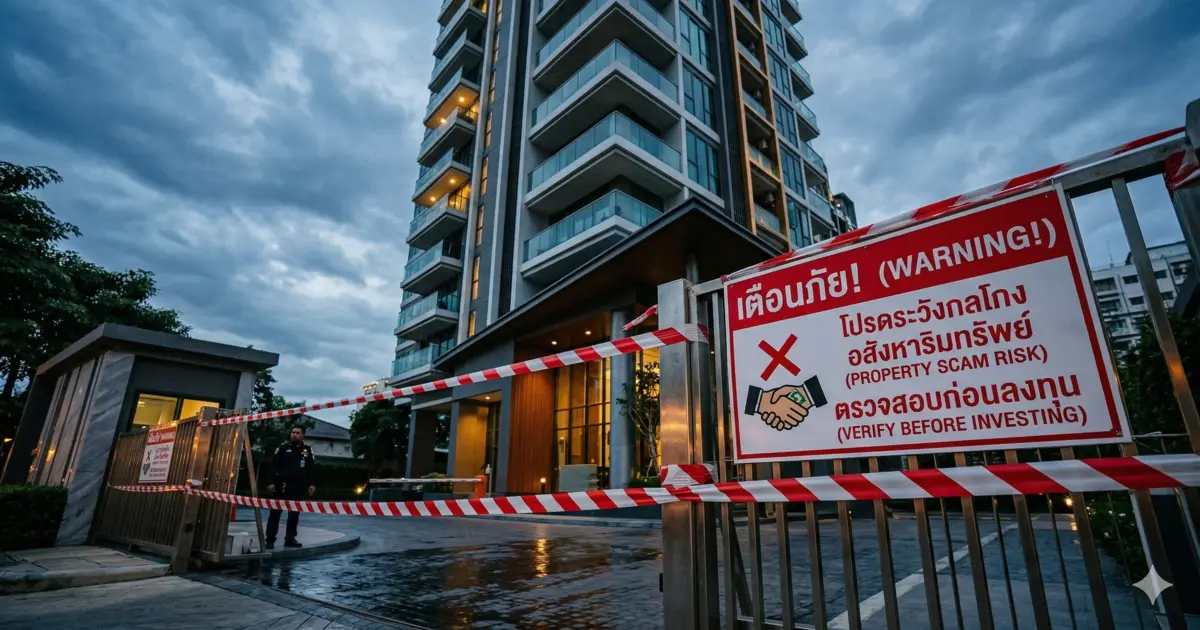
Thailand's property market is booming with foreign interest. Chinese investors poured 51 billion THB into Bangkok condos in just nine months. Western buyers are flocking to Chiang Mai, Phuket, and Koh Samui for retirement homes and investment properties. But behind the glossy brochures and sunset-drenched showrooms lies a market where over 60 billion THB was lost to fraud in 2024 alone.
This isn't a scare piece. Thailand offers genuinely excellent property at competitive prices. But the difference between a smart investment and a devastating loss often comes down to knowing what to watch for — and what to walk away from.
Why 2026 Is the Riskiest Year for Foreign Buyers
Three forces are colliding to create the perfect storm for property fraud:
| Force | What's Happening | Why It Matters |
|---|---|---|
| Domestic Collapse | Mortgage rejection rates hit 70%. Over 147B THB in unsold condo inventory. | Desperate developers cut corners and target cash-rich foreigners. |
| Developer Debt Crisis | 180B+ THB in corporate bonds maturing simultaneously. | Undercapitalized developers divert pre-sale deposits to service old debt. |
| Regulatory Crackdown | Government targeting 21,459 suspected nominee companies in 2026. | Previously "safe" ownership structures are now criminal offenses. |
The Royal Thai Police reported over 400,000 online fraud cases in Q1 2024 alone. Property scams are a significant and growing portion of that number — and foreigners are disproportionately targeted because they have capital but lack familiarity with Thai property law.
The 10 Most Common Property Scams in Thailand
1. Phantom Developers (The "Buy Now, Cry Later" Trap)
Sophisticated 3D renderings, Instagram-worthy showrooms, and aggressive Facebook ads sell off-plan condos that are never built. The developer collects deposits, diverts them to service existing debt, then either disappears or files for bankruptcy. Because Thailand does not require escrow accounts for property deposits, buyers are effectively unsecured creditors — last in line when the money runs out.
2. Guaranteed Rental Return (GRR) Fraud
Common in Phuket, Pattaya, and Koh Samui: developers promise 8–12% annual returns for 3–5 years. The math doesn't work — actual Thai hospitality yields average 6–9%. Here's the trick: the "guaranteed" returns are pre-calculated and baked into an artificially inflated purchase price. The developer pays you with your own money for the first year, you recruit friends, then the management company dissolves. You're left with an overpriced asset and zero recourse.
Red Flag
Any rental guarantee above 8% in Thailand is almost certainly unsustainable. If it sounds too good to be true, the returns are coming from your own inflated purchase price.
3. Fake Title Deeds & Double-Selling
Scammers forge or duplicate Chanote (Nor Sor 4 Jor) title deeds, selling land they don't own. In "double-selling" schemes, the same unregistered plot is sold to multiple foreigners simultaneously — exploiting the time gap between payment and Land Department registration while the seller juggles visa processing and international wire transfers.
4. Rental Deposit Scams
Fake listings on Facebook Marketplace and LINE groups use stolen photos from legitimate agencies. You're pressured to transfer a deposit via QR code to "secure" the property. Upon arrival, the unit is occupied, in foreclosure, or doesn't exist — and the "landlord" has blocked you.
5. Payment Interception (Business Email Compromise)
Hackers infiltrate unencrypted email threads between buyers, agents, and lawyers. At the critical moment of payment, they send spoofed emails with altered bank details. Your transfer lands in an untraceable offshore account. The FBI flags this as a multi-million dollar vector in cross-border real estate.
6. Illegal Nominee Structures
Agents market Thai Limited Companies as a "loophole" for foreign land ownership — 49% foreign shares with total voting control, 51% held by Thai "ghost shareholders." This is illegal and actively prosecuted (more on the crackdown below). Worse, the Thai nominees can realize their legal rights and extort you, sue for control, or sell the property out from under you.
7. Non-Refundable Deposit Traps
Under Thai Civil and Commercial Code Sections 672–673, deposits are non-refundable by default. Contracts may say "refundable upon negative due diligence" — but "negative" is kept deliberately subjective. When your lawyer finds problems, the seller disputes the severity, and litigating a $5,000–$10,000 deposit costs more than the deposit itself.
8. The "90-Year Lease" Myth
Developers sell villas with "90-year leases" structured as 30+30+30. In early 2025, the Thai Supreme Court (Judgment 4655/2566) ruled definitively: any lease beyond 30 years is void. Renewal clauses are personal promises between original signers — if the developer goes bankrupt, your remaining 60 years vanish. This ruling has triggered a liquidity crisis in the secondary villa market.
9. Off-Plan EIA Failures
Developers sell condos before securing Environmental Impact Assessment (EIA) approval — a strict legal prerequisite for construction. If the EIA is denied, construction halts, your deposit is absorbed into bankruptcy proceedings, and you have no secured claim to recover it.
10. Visa-Property Bundling Scams
Agents conflate property purchases with guaranteed long-term visas (Elite Visa, Retirement Visa) without explaining the separate financial requirements. Submitting false documents provided by these agents can lead to deportation and permanent blacklisting.
Real Cases: Billions Lost
These aren't hypothetical scenarios. They're documented cases from 2024–2026:
| Case | Location | Damages | What Went Wrong |
|---|---|---|---|
| New Nordic Development | Pattaya & Nationwide | 3.4 billion THB | DSI Special Case. Promised extraordinary returns violating legal interest rate caps. Ponzi-like structure. Thousands of victims. |
| Seabreeze Villas | Koh Samui | 160+ nominee companies | German developer used a law firm to create 160+ nominee companies. 16 individuals criminally charged. Provincial Police Region 8 raid. |
| Zog Villas | Koh Samui (Mae Nam) | 300M THB suspect funds | 93 violations across 24 locations. Built in protected "red zones" (slopes >50°). NACC + AMLO money laundering probe. |
| The Peaks Residences | Phuket (Kata Beach) | 5M+ THB per victim | Australian investors paid for luxury units never delivered. Developer's land overlapped a protected forest reserve. CIB investigation opened Sept 2024. |
Common Pattern
In every case above, the victims paid deposits before verifying land titles, EIA approvals, or developer solvency. Independent legal counsel would have uncovered these issues before a single baht was transferred.
Title Deed Red Flags: Chanote vs Nor Sor 3
Understanding Thailand's land title hierarchy is your first line of defense. Not all titles are equal — some give you full ownership rights, others give you nothing at all.
| Title Type | Thai Name | Survey | Investment Rating |
|---|---|---|---|
| Chanote | Nor Sor 4 Jor | GPS + satellite + physical markers | Excellent — Gold standard |
| Confirmed Possession | Nor Sor 3 Gor | Aerial survey (1:5000) | Good — Upgradeable to Chanote |
| Basic Possession | Nor Sor 3 | "Floating map" — relative boundaries | High Risk — Boundary disputes common |
| Temporary | Nor Sor 2 | Unsurveyed | Do Not Purchase |
| Possessory Right | Sor Kor 1 | Unsurveyed | Do Not Purchase — State owns the land |
How to Verify a Title Deed
A genuine Chanote has a red Garuda seal at the top. Hold it to light — you must see two watermarks: the Department of Lands insignia and the Ministry of Interior seal. The officer's signature must be in black ink intersected by a red stamp. Blue ink or missing stamp = severe red flag. Always demand an independent Title Search at the provincial Land Office.
The Nominee Company Crackdown (2024–2026)
This is the biggest legal shift in Thai property in decades. The government has moved from passive tolerance to active prosecution of nominee structures.
The Department of Business Development (DBD) formed a joint task force with the DSI, CIB, and Anti-Money Laundering Office (AMLO). The numbers are staggering:
- 46,918 high-risk entities investigated in 2025
- 21,459 suspected foreign-linked companies targeted in 2026
- 857 nominee companies identified, causing 15.28 billion THB in economic damage
- The Intelligence Business Analytics System (IBAS) went fully operational in late 2025, connecting DBD, Revenue Department, and AMLO data in real-time
How They're Catching Nominees
Two key enforcement tools:
DBD Order 2/2568 (effective January 2026): Thai shareholders must now submit bank statements proving they have the genuine financial capacity to capitalize their shares. This eliminates the use of low-income "ghost shareholders."
The "Rule of Five": Addresses hosting five or more registered companies are automatically flagged. Unannounced site visits follow, and Thai shareholders face rigorous interrogation about their knowledge of company operations.
Penalties
Under Foreign Business Act Sections 36–37: up to 3 years imprisonment and fines up to 1 million THB — for both the foreigner AND the Thai nominees. Proposed amendments would classify nominee violations as money laundering predicates, allowing AMLO to seize the property entirely without compensation.
Contract Traps That Cost Foreigners Millions
The Escrow Vacuum
Thailand's Business Escrow Act (2008) exists — but escrow is entirely voluntary. Almost no developer uses it. When you pay a deposit, your money goes directly into the developer's operational cash flow. If they go bankrupt, you're an unsecured creditor. Last in line. Near-total loss.
One-Sided Penalty Clauses
Standard developer contracts impose severe daily fines on buyers for late payments, while capping the developer's own liability for construction delays at negligible amounts. A project delivered 18 months late might cost the developer a few thousand baht — while missing your payment by a week could forfeit your entire deposit.
The Leasehold Collapse
The Thai Supreme Court's 2025 ruling (Judgment 4655/2566) didn't just limit leases to 30 years — it established that renewal clauses are personal promises, not property rights. If the original landlord sells, dies, or goes bankrupt, your renewal agreement dies with them. This affects every foreigner who bought a villa on a "90-year lease."
Your 10-Point Due Diligence Checklist
Synthesized from the protocols of Thailand's leading property law firms — Tilleke & Gibbins, DFDL, Siam Legal, and Silk Legal:
| # | Check | What You're Looking For |
|---|---|---|
| 1 | Title Deed Verification | Independent title search at the Land Office. Confirm Chanote (Nor Sor 4 Jor). Check the reverse for mortgages, liens, and encumbrances. |
| 2 | Foreign Quota Check | For condos: written confirmation from the juristic person that the 49% foreign freehold quota is not already full. |
| 3 | EIA Approval | For off-plan: verify the Environmental Impact Assessment has been approved. No EIA = no legal construction = your deposit is at risk. |
| 4 | Developer Solvency | Search Thai court databases for active lawsuits, bankruptcy filings, and consumer complaints against the developer. |
| 5 | Zoning & Land Use | Confirm the land isn't forest reserve, national park, or protected watershed. Check slope restrictions (>50° = illegal construction). |
| 6 | Boundary Survey | Hire an independent licensed surveyor to compare the Land Department's GPS coordinates with physical marker posts on the ground. |
| 7 | FET Documentation | Route all funds from overseas in foreign currency, converting to THB onshore. Obtain a Foreign Exchange Transaction (FET) form — mandatory for registration and fund repatriation. |
| 8 | Contract Review | Your lawyer (not the seller's) must review every clause. Look for: refund conditions, penalty symmetry, completion deadlines, escrow provisions. |
| 9 | Tax & Fee Calculation | Calculate all-in costs: Transfer Fee (2%), Specific Business Tax (3.3%), Withholding Tax, CAM fees. See our Hidden Costs guide. |
| 10 | Physical Inspection | Visit the property. Visit the Land Office in person. Talk to neighbors. Never buy sight-unseen from overseas based on a WhatsApp video. |
Warning Signs: Walk Away Immediately
If any of these happen during a property transaction, stop immediately and consult independent legal counsel:
Agent discourages independent lawyer
"It's standard, you don't need your own lawyer" = they're hiding something.
Deposit to personal account
Money should go to a verified corporate account, never a personal bank, offshore, or crypto wallet.
Nominee company pitched as "safe"
In 2026, this is criminal exposure: prison + asset seizure. Any agent suggesting this is negligent or complicit.
Rental returns above 8%
Thai hospitality averages 6–9%. Anything higher is likely pre-loaded into the sale price.
"Guaranteed" visa with purchase
Property ownership and visas have separate requirements. Conflating them is a scam indicator.
Urgency and pressure
"This unit won't last" or "price goes up Monday" — classic high-pressure sales to prevent due diligence.
The Safe Path: How to Buy Property in Thailand Correctly
Despite the risks, Thailand remains a fundamentally attractive market with high-quality assets, excellent infrastructure, and strong capital appreciation potential. The key is staying within the legally unassailable paths:
| Path | What You Get | Risk Level |
|---|---|---|
| Foreign Freehold Condo | Full ownership within 49% foreign quota. Inheritable. Mortgageable. | Low — if quota verified |
| 30-Year Registered Lease | Registered at Land Office. Protected against third-party claims. | Medium — finite term, no guaranteed renewal |
| BOI-Promoted Company | Board of Investment allows majority foreign ownership for qualifying businesses. | Low — if compliant |
Ready to explore properties safely? Browse verified listings on BaanRow — every property includes title type, foreign ownership eligibility, and transparent pricing. For more on the legal framework, read our complete guide: Can Foreigners Buy Property in Thailand?
Sources & References
- Bangkok Post — Property Section — Market data on domestic mortgage rejection rates, developer bond maturities, and foreign investment flows (2024–2026)
- Department of Special Investigation (DSI) — Special Case No. 56/2564: New Nordic Development fraud investigation, 3.4 billion THB damages
- Department of Business Development (DBD) — Nominee company investigations: 46,918 entities (2025), 21,459 targeted (2026), DBD Order 2/2568
- Tilleke & Gibbins — Legal Insights — EIA verification protocols, zoning due diligence, and corporate M&A approach to real estate acquisitions
- DFDL — Legal & Tax Updates — Foreign Exchange Transaction (FET) compliance, FBA amendments, and tax structuring for foreign buyers
- Siam Legal — Real Estate Practice — Title chain analysis, encumbrance searches, and foreign quota verification procedures
- Silk Legal — Developer solvency assessment and litigation history checks for property transactions
- Office of the Council of State (Krisdika) — Land Code Act of 1954, Foreign Business Act, Civil and Commercial Code Sections 540, 672–673
- Supreme Court of Thailand — Judgment Database — Judgment No. 4655/2566: 30-year lease cap ruling and renewal clause invalidation
- Office of the Consumer Protection Board (OCPB) — 2024 Notification classifying condo reservations as contract-controlled business, standardized refund clauses
- Anti-Money Laundering Office (AMLO) — Joint task force enforcement against nominee structures, IBAS integration, proposed FBA-money laundering predicate offenses
- The Nation Thailand — Property — Seabreeze Villas raid coverage, Zog Villas NACC investigation, nominee crackdown reporting
- The Phuket News — The Peaks Residences fraud case, CIB investigation, Australian investor complaints
- Savills Thailand — Market Insights — Condominium market analytics, foreign buyer statistics, and yield analysis
- CBRE Thailand — Research — Property market outlook, developer debt analysis, and luxury segment trends
- Board of Investment (BOI) — BOI promotion pathways for legitimate majority-foreign corporate property ownership
- Global Property Guide — Thailand — Rental yield benchmarks, gross yield comparisons by city, and foreign buyer trend data
- Prachatai — Investigative reporting on Royal Thai Police fraud statistics: 400,000+ cases Q1 2024, 60 billion THB losses
This article was researched using Gemini Deep Research (261 verified sources across Thai government databases, international law firms, and news organizations) and written with AI assistance. All statistics, case names, and legal references have been cross-referenced with official sources. Last updated: March 2026.