The Real Cost of Owning a Thailand Condo for 10 Years: What the Brochures Don't Show
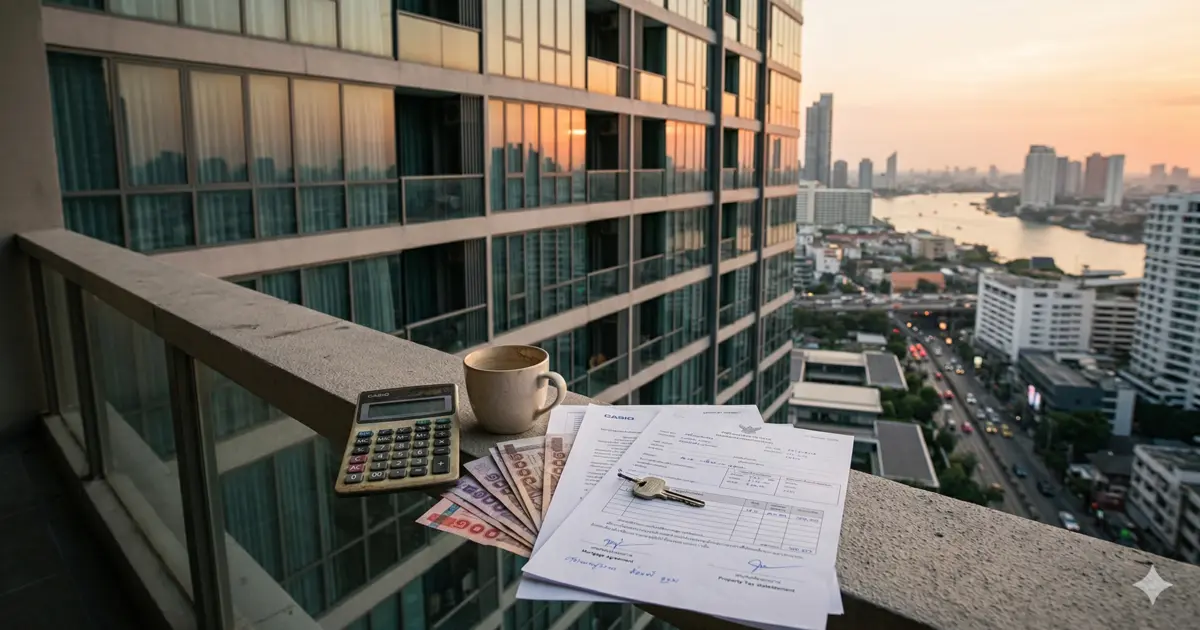
Every glossy condo brochure in Thailand tells the same story: buy a sun-drenched apartment, earn 7% rental yield, and watch your investment appreciate while you sip cocktails by the rooftop pool. After analyzing 151 sources of data spanning a decade of the Thai property market, we can now show you exactly what those brochures leave out.
The real cost of owning a Thailand condo for 10 years will consume 30% to 45% of your original purchase price in maintenance, taxes, renovations, and fees alone — before you even consider depreciation, currency risk, or the opportunity cost of locking your capital into concrete. This is the article that no developer wants you to read before signing that transfer contract.
The Brochure vs. Reality
If you've been researching whether foreigners can buy property in Thailand, you've likely encountered developer projections showing 5-7% annual rental yields, minimal ongoing costs, and steady appreciation. Here's what those projections systematically exclude:
| What the Brochure Says | What Actually Happens |
|---|---|
| "Low maintenance fees" | Developer subsidizes CAM for 1-3 years, then fees jump 30-50% |
| "Guaranteed 7-10% yield" | Programs collapse (New Nordic: 3.4B THB in damages) |
| "Minimal property taxes" | Short-term rental classification = 15x higher tax rate |
| "Strong appreciation potential" | 200,000+ unsold units in Bangkok; resales take 4+ years |
| "Move-in ready investment" | Year 5: cosmetic refresh needed. Year 10: full renovation mandatory |
Let's break down every real cost you'll face, backed by data from CBRE, Savills, Knight Frank, the Bank of Thailand, and the Thai Revenue Department.
CAM Fees: The Cost That Never Stops Rising
Common Area Maintenance (CAM) fees are the single largest recurring expense for any condo owner. They cover security, cleaning, pool maintenance, elevator servicing, and common area utilities. The problem? They escalate 3-5% annually — and developers deliberately suppress them during the first few years to make their yield projections look attractive.
| Location | Tier | CAM (THB/sqm/mo) | 60sqm Monthly | 35sqm Monthly |
|---|---|---|---|---|
| Bangkok Budget | Outskirts | 20–30 | 1,200–1,800 | 700–1,050 |
| Bangkok Mid-Range | On Nut, Bearing | 35–50 | 2,100–3,000 | 1,225–1,750 |
| Bangkok Luxury | Thonglor, Asoke | 60–90+ | 3,600–5,400+ | 2,100–3,150 |
| Phuket Standard | Phuket Town | 60–80 | 3,600–4,800 | 2,100–2,800 |
| Phuket Luxury | Bang Tao Branded | 120–150 | 7,200–9,000 | 4,200–5,250 |
| Chiang Mai / Pattaya | Standard–Mid | 30–60 | 1,800–3,600 | 1,050–2,100 |
| Koh Samui Premium | Beachfront | 100–120+ | 6,000–7,200+ | 3,500–4,200+ |
Warning: The Sinking Fund Trap
Your initial sinking fund contribution (300–800 THB/sqm) will almost certainly be depleted by year 10. When that happens, the juristic person levies a Special Assessment — often exceeding 800 THB/sqm — payable in a single quarter. If you don't pay, the building withholds your Debt Free Certificate, making your unit legally unsellable at the Land Office.
Property Taxes: The Foreign Owner Trap
Thailand's property taxes look deceptively low on paper. For a full breakdown, see our complete property tax guide. Here's the trap most foreigners walk into:
The primary residence exemption requires your name in the house registration book (Tabien Baan) as of January 1st. Foreign owners get a Yellow Tabien Baan, which some municipalities interpret differently. Most foreigners end up classified as "Other Residential" — paying 0.02% annually on appraised value.
But here's where it gets expensive: if you list your unit on Airbnb or booking platforms, aggressive municipalities can reclassify your property as commercial use, jumping your tax rate to 0.30% — a 15x increase. On a 10M THB condo, that's 30,000 THB annually instead of 2,000 THB.
Add rental income tax on top: non-residents pay a flat 15% withholding tax on gross rental income. On a 7M THB unit generating 350,000 THB/year in rent, you'll forfeit 52,500 THB annually — over half a million baht across a decade.
The Renovation Ticking Clock
Thailand's tropical climate — intense humidity, UV radiation, and heavy reliance on air conditioning — degrades buildings far faster than temperate climates. Our hidden costs guide covers purchase costs, but the real financial pain begins after you've owned the unit.
| Renovation Stage | Cost/sqm (THB) | 35sqm Unit | 60sqm Unit | What's Included |
|---|---|---|---|---|
| Year 5: Cosmetic Refresh | 3,000–6,500 | 105K–228K | 180K–390K | Repaint, fixture updates, grout repair |
| Year 10: Standard Reno | 12,000–18,000 | 420K–630K | 720K–1.08M | New floors, bathroom/kitchen overhaul, plumbing |
| Year 10: Premium | 18,000–25,000 | 630K–875K | 1.08M–1.5M | Custom built-ins, imported materials, smart upgrades |
Skip the Year 10 renovation and your unit will sit on the market for 4+ years at a 20-30% discount. The renovation isn't optional — it's the price of remaining competitive against developer-discounted new stock flooding the market.
Air conditioning alone costs 4,000-5,000 THB/year in servicing for a 60sqm unit, with full compressor replacement (45,000-60,000 THB) typically needed by year 7-8 due to coastal salt air or continuous Bangkok heat.
Utilities & Insurance: The Quiet Drain
These costs seem small individually but compound relentlessly over a decade:
| Expense | 35sqm/month | 60sqm/month | 10-Year Total (60sqm) |
|---|---|---|---|
| Electricity | 1,200–1,800 | 2,300–4,500 | 276K–540K |
| Water | 150–300 | 150–300 | 18K–36K |
| Internet | 600–1,200 | 600–1,200 | 72K–144K |
| Insurance (comprehensive) | 250–830/mo equiv. | 420–1,670/mo equiv. | 50K–200K |
Warning: Insurance Sub-Limits
Most Thai insurance policies cap all natural disaster coverage (flood, earthquake, storm) at just 20,000 THB per year in aggregate. A single plumbing failure or storm surge could cost you hundreds of thousands — completely out of pocket.
Three Case Studies: What 10 Years Actually Costs
We modeled three real-world scenarios using 2026 market data, 3% annual inflation, and standard maintenance schedules. These numbers include everything developers leave out of their brochures.
Case Study A: 3M THB Condo in Chiang Mai (35sqm)
| Cost Category | 10-Year Total (THB) |
|---|---|
| Sinking Fund (initial) | 14,000 |
| CAM Fees (3% escalation) | 216,000 |
| Property Taxes | 6,000 |
| Insurance | 30,000 |
| Utilities | 180,000 |
| AC maintenance + replacement | 45,000 |
| Year 5 cosmetic refresh | 122,500 |
| Year 10 standard renovation | 420,000 |
| Special assessments | 25,000 |
| TOTAL | 1,058,500 |
Key Insight
The 10-year carrying cost is 35.2% of the purchase price. Your 3M THB "investment" actually costs you 4.06M THB to hold for a decade — before accounting for depreciation or lost opportunity.
Case Study B: 7M THB Condo in Bangkok Sukhumvit (60sqm)
Total 10-Year Cost: 2,310,000 THB (33.0% of purchase price)
The mid-range Bangkok investment hits the hardest because it combines significant CAM fees (Sukhumvit buildings charge 60+ THB/sqm/mo), a mandatory Year 10 renovation costing 900,000 THB, and stiff competition from the 200,000+ unsold new units flooding the market. When you factor in the 5-10% secondary market discount needed to compete against developer-subsidized new stock, any theoretical capital gains are entirely consumed.
Case Study C: 15M THB Luxury Condo in Phuket (100sqm)
Total 10-Year Cost: 6,500,000 THB (43.3% of purchase price)
Luxury coastal properties are punishingly expensive to maintain. CAM fees alone (120 THB/sqm/mo, escalating 5% annually) accumulate to 1.8M THB over a decade. Add the Year 10 luxury renovation at 2.5M THB, commercial-rate property taxes at 450,000 THB, and comprehensive insurance — your 15M THB "dream investment" actually costs 21.5M THB over 10 years. This is a hospitality business, not a passive investment.
Depreciation: What Your Condo Is Actually Worth After 10 Years
Our analysis of what happened to foreigners who bought 10 years ago revealed the harsh reality of the secondary market:
- 200,000+ unsold units sitting in the Bangkok market alone, with 50% in the sub-3M THB segment
- Developers offering 5-10% cash discounts plus free transfer fees on new stock — making your resale unit look expensive by comparison
- Average time to sell a resale condo has stretched to over 4 years (was under 3)
- Unrenovated 10-year-old units require 20-30% price cuts to attract buyers
The math is brutal: if you bought at 7M THB, spent 2.3M THB on 10-year holding costs, and sell at a 15% discount (5.95M THB), your total loss is 3.35M THB — nearly half the original investment.
What Else Could You Have Done With That Money?
The most devastating comparison isn't between buying and renting in Thailand. It's between buying a physical condo and investing in liquid financial instruments:
| Investment (7M THB) | Annual Return | 10-Year Income | Liquidity |
|---|---|---|---|
| Thai REITs (avg 2025-26) | 8–9% dividend | 5.6M–6.3M | Sell same day |
| Industrial REITs (e.g., WHAIR) | 10.2% dividend | 7.14M | Sell same day |
| SET50 Dividends | 4.39% dividend | 3.07M | Sell same day |
| USD Fixed Deposits | 4.0%+ | 2.8M+ | Maturity (1-12mo) |
| Physical Condo (net) | <2.5% after all costs | 1.75M (minus 2.3M costs) | 4+ years to sell |
A diversified Thai REIT portfolio yielding 8% distributes 560,000 THB annually in pure, frictionless passive income. The same capital in a physical condo generates 350,000 THB gross rent — then loses 52,500 THB to withholding tax, 36,000 THB to CAM fees, one month's rent to agent commissions, plus maintenance and vacancy costs. The true net yield compresses to under 2.5%.
Currency Risk: The Hidden 14% Loss
When you buy a Thai condo with foreign currency, you're executing a massive, leveraged currency bet — often without realizing it.
Over the past decade, the Thai Baht has swung between 31 and 36 THB per USD. As of early 2026, it trades around 32.50-32.90. A buyer who purchased when the Baht was strong (30 THB/USD) and sells when it's weak (35 THB/USD) suffers an instant 14% loss on principal — wiping out years of accumulated rental income in a single currency swing.
For British buyers, the picture is even worse: the Pound's structural weakness post-Brexit permanently inflated the relative cost of Thai property, while European buyers face similar THB/EUR volatility. Unless you actively hedge with financial derivatives, FX variance can easily overshadow any capital appreciation.
The 2026 Developer Crisis
The current market environment adds a layer of risk that didn't exist five years ago. We've documented the red flags every buyer should watch for, but the systemic numbers are alarming:
- 147 billion THB in newly completed units scheduled for transfer in 2026
- 80 billion THB in developer bonds maturing the same year
- Over 50% of developers holding precarious BBB credit ratings
- The New Nordic collapse (3.4B THB in damages) as a warning of guaranteed yield failures
Warning: Off-Plan Risk
Buying off-plan in 2026 carries the highest developer insolvency risk in a decade. If a developer goes bankrupt before completion, you become an unsecured creditor in Thai bankruptcy court — often resulting in total capital loss. Always verify escrow protections before signing.
So What Should You Actually Do?
After reviewing all the data, here's our honest guidance:
Buy a Condo If...
You're buying for lifestyle, not returns. You plan to live in it, you understand the true 30-45% TCO, and you've accepted this is a consumption purchase — like buying a car — not a financial instrument. Check your visa options as a property owner to ensure you can actually stay.
Think Twice If...
You're treating it purely as an investment. Thai REITs deliver 3-4x the net yield with zero management headaches, instant liquidity, and no renovation bills. For capital preservation and income generation, the data overwhelmingly favors liquid financial instruments.
If you do decide to buy, follow the complete buying timeline and understand the leasehold vs freehold implications before committing. Buy secondary market at a distressed discount, verify the sinking fund balance, audit the juristic person's financials, and budget for the Year 5 and Year 10 renovation cycles from day one.
Ready to search properties with full transparency? BaanRow lists every hidden cost upfront — because informed buyers make better decisions.
Sources & References
- CBRE Thailand Research — Bangkok condominium market reports, secondary market analysis, oversupply data
- Savills Thailand Research — Property market outlook, pricing trends, investor sentiment surveys
- Knight Frank Thailand — Luxury condominium market data, CAM fee benchmarks across tiers
- REIC (Real Estate Information Center) — Official Thai government property market statistics and supply data
- Bank of Thailand — Real residential property price index, exchange rate data (THB/USD/EUR/GBP)
- Thai Revenue Department — Personal income tax rates, withholding tax regulations for non-residents
- Office of the Council of State (Krisdika) — Condominium Act B.E. 2522, Land and Building Tax Act B.E. 2562
- Global Property Guide — Thailand — Gross rental yields, transaction costs, landlord-tenant regulations
- Department of Special Investigation (DSI) — New Nordic Development investigation, guaranteed yield fraud cases
- Fiscal Policy Office — Property tax rate schedules, regulatory exemption frameworks
- TRIS Rating — Thai developer credit ratings, corporate bond maturity analysis
- Stock Exchange of Thailand (SET) — SET50 index performance, Thai REIT dividend yields and total returns
- Tilleke & Gibbins — Legal analysis of foreign property ownership structures and Tabien Baan regulations
- DFDL Legal — Cross-border tax planning for property investors in Thailand
- Bangkok Post — Property — Developer bond maturity crisis, 147B THB transfer pipeline reporting
- The Nation Thailand — Property — Secondary market liquidity data, days-on-market analysis
- Cushman & Wakefield Thailand — Commercial property classification standards, CAM benchmarking
- ASEAN Briefing — Property — Regional property tax comparisons, REIT yield analysis across Southeast Asia
This article was researched using Gemini Deep Research (151 verified sources) and written with AI assistance. All cost figures reflect 2026 market conditions. Last updated: April 2026.